Category: writing

Anything that doesn’t fit anywhere else goes here.

  • Your antagonist needs a Tuesday morning, not a backstory

    Your antagonist needs a Tuesday morning, not a backstory

    Your antagonist needs a Tuesday morning, not a backstory. Give them a breakfast, a small irritation, a person they call when they’re bored. That will do more work than three chapters of childhood trauma ever could.

    Most new writers reach for the origin story because it feels like the responsible thing to do. It isn’t. A well-built Tuesday morning tells the reader everything the backstory was trying to prove, and it does it without slowing the plot to a crawl.

    Why backstory rarely does the job you think it does

    Backstory is a writer’s tool, not a reader’s experience. When you write a villain’s traumatic past, you’re mostly reassuring yourself that they’re allowed to exist. The reader doesn’t need that reassurance. They need to believe the antagonist is a whole person who was already in motion before the story started.

    The problem is that backstory tends to explain rather than reveal. It tells us what happened. It doesn’t show us who the person became.

    And here’s the truth: readers tend to forget backstory/history. They remember behaviour. They remember the small, specific things a character does when no one important is watching.

    What a Tuesday morning actually shows

    A Tuesday morning is the antagonist’s ordinary life. Not the day they commit the crime, not the day they meet the protagonist, just a normal weekday when nothing much is happening.

    What do they eat? Do they eat? Do they cook, or do they stand at the counter picking at something? Who texts them, and do they reply? What’s the first thing that annoys them, and how do they handle that annoyance?

    These aren’t decorative details. They’re structural. A character who is patient with a slow barista and cruel to their assistant is telling you exactly who they are. A character who feeds a stray cat and then lies to their spouse about where they were is telling you even more.

    Backstory says they were hurt as a child. Tuesday morning says they still cannot bear the sound of a door closing too loudly. One is exposition. The other is character.

    The routine reveals the wound

    Here is the useful paradox: if you write a strong Tuesday morning, you often end up implying the backstory anyway. The reader fills it in themselves, and what they fill in is more powerful than anything you could have written directly.

    A man who eats the same breakfast every day at the same time in the same chair. A woman who checks the locks twice before bed and once again from the top of the stairs. A boss who cannot leave a meeting without having the last word, even when the last word is okay.

    We don’t need the flashback. We can feel the shape of the wound from the shape of the routine.

    How to write a Tuesday morning for your antagonist

    This is where the work gets practical. You don’t need to write the Tuesday morning scene into your book. You need to know it. It’s planning material, not necessarily page material.

    Here’s a short set of prompts that tend to break the character open:

    • What time do they wake up, and is it earlier or later than they’d like?
    • What’s the first lie they tell themselves before they leave the house?
    • Who has power over them in a small, daily way (a boss, a landlord, a mother-in-law)?
    • What do they do that they’d be embarrassed for the protagonist to see?
    • What comfort do they reach for when they’re stressed, and is it a person, a substance, or a ritual?

    Answer these five, and you’ll know more about your antagonist than most novels ever bother to establish. The answers will leak into their dialogue, their choices, their small cruelties, and their occasional kindnesses. That’s what makes a villain feel real.

    When the antagonist stops feeling like a villain

    There’s a moment in this process that usually catches new writers off guard. The antagonist stops feeling like a villain and starts feeling like a person you know. That’s uncomfortable. It’s also correct.

    A reader will only fear or grieve a person they believe exists. A cartoon villain is easy to defeat because the reader was never worried in the first place. The Tuesday morning fixes this by giving the antagonist weight.

    You can still let them do terrible things. In fact, the terrible things land harder now, because the reader watched them butter toast an hour earlier.

    Where this fits in your planning

    If you’re a planner, this work happens before drafting. If you’re a pantser, it can happen during the first read-through of your rough draft, when you realise your antagonist feels thin. Either way, it isn’t a bonus round. It’s core character work, and skipping it is why so many manuscripts stall in the middle.

    The protagonist gets a Tuesday morning almost by default, because we follow them everywhere. The antagonist gets one only if we deliberately build it. That asymmetry is where a lot of second-act problems actually begin.

    Spend an hour on your antagonist’s Tuesday. Not their tragedy, not their manifesto. Just the morning. Then go back to your draft and see what changes.

    Frequently asked questions

    Does this mean I should never write an antagonist backstory?

    Not at all. Write the backstory for yourself if it helps you understand the character. Just don’t confuse writing it with putting it on the page. Most of it belongs in your notes, not in the manuscript.

    What if my antagonist is a monster, a system, or a force rather than a person?

    Give it a Tuesday anyway. A corrupt institution has a break room. A haunted house has a weekday rhythm. Even an abstract force has small, specific behaviours that reveal its nature more than any grand statement of theme could.

    How much of the Tuesday morning should end up in the actual book?

    Often very little. A gesture, a habit, a line of dialogue, an object on a desk. The point of the exercise is to know the character so well that the small things you do choose to show carry real weight.

    Isn’t this just character development advice for any character?

    Yes, and that’s the point. We tend to do this work naturally for protagonists and forget it for antagonists. The Tuesday morning is a corrective for the specific place most writers cut corners.

    When in the writing process should I do this?

    As soon as the antagonist starts feeling flat, cartoonish, or too convenient for the plot. That might be during outlining, during drafting, or during your first revision pass. The signal is the flatness, not the stage.

  • How to make places in your novel feel believable

    How to make places in your novel feel believable

    Believable places in fiction are not built from long descriptions. They are built from small, specific details that a character notices, and from rules the writer refuses to break.

    If your settings feel like painted backdrops, the problem is almost never that you wrote too little. It’s that you wrote the wrong things, in the wrong voice, at the wrong moment.

    Let’s fix that.

    Why do fictional places feel flat in the first place?

    Most flat settings share the same root cause: the writer describes the place from the outside, like a camera panning across a room. The reader sees furniture, colours, maybe a window. Then the scene moves on and nothing sticks.

    A real place is not a list of objects. It’s a set of impressions filtered through whoever is standing in it. The kitchen your protagonist grew up in and the kitchen your antagonist is breaking into are the same kitchen, but they should read completely differently on the page.

    When we skip that filter, the setting becomes generic. And generic is the enemy of believable.

    What makes a place feel real to a reader?

    Three things, in this order: specificity, perception, and consistency.

    Specificity means one weird, exact detail beats ten vague ones. The corner of the skirting board where the cat had scratched a bald patch tells us more about a room than three paragraphs of general description. The reader’s brain fills in the rest, and because you gave them something specific, they trust you.

    Perception means the details are chosen by the character in the scene, not by the author hovering above it. A hungry character notices food smells. A frightened character notices exits. A grieving character notices things that don’t matter, because their mind is somewhere else.

    Consistency means the place behaves the same way every time we visit it. If the front door sticks in chapter two, it still sticks in chapter twelve unless someone fixed it (and if they did, that’s a scene).

    How much description is enough?

    Less than you think, placed more carefully than you’re currently placing it.

    My rough working principle: give the reader one strong sensory anchor when they arrive in a new place, one atmospheric shift as the scene develops, and one small detail that pays off later. That’s it. Three moments of setting work, spread across a scene, will do more than a paragraph of dense description up front.

    The temptation to front-load is huge, especially for pantsers who are figuring the place out as they write. Do it in the draft if you have to. Then cut it in revision and sprinkle what’s left across the scene.

    The senses beyond sight

    Most writers over-rely on what a place looks like. But smell, sound, temperature, and texture do more emotional work per word.

    The smell of damp brick after rain. The specific silence of a room where a clock has just stopped. The way a stone floor pulls heat out of your feet. These land harder than any visual because we rarely put them on the page, so the reader isn’t numb to them yet.

    How do you build a place the reader can navigate?

    Believable places have geography. The reader should always have a rough sense of where things are in relation to each other, even if you never draw them a map.

    A few practical moves:

    • Establish direction early. If a character walks east into the market, the market is east from now on.
    • Reuse landmarks. The same crooked church spire, the same wine stain on the tablecloth. Repetition builds solidity.
    • Let characters move through the space naturally. If they cross a room, tell us what they pass on the way.
    • Track the light. Time of day, season, weather. It anchors the reader in when as well as where.

    You don’t need to describe every corner. You need the corners you do describe to stay put.

    Why do invented worlds need stricter rules than real ones?

    Because the reader has no external reference. If you set a scene in Paris, the reader brings their own Paris to the page. If you set it in a city you invented, they only have what you give them, and any inconsistency is yours to own.

    This is where a lot of fantasy and science fiction settings collapse. The rules of the world (how magic works, how the technology behaves, how the politics function) get bent in chapter fifteen to solve a plot problem, and the whole place stops feeling real.

    Write the rules down somewhere. Not for the reader. For you. Then break them only when the breaking is the story.

    How do places reveal character?

    A place is a character test. What your character notices, what they ignore, what they touch, what they refuse to touch, all of it tells us who they are.

    Two characters walk into the same drawing room. One sees the good silver and starts calculating its worth. The other sees the smoke stain above the fireplace and thinks about their grandmother. Same room. Two completely different scenes.

    This is the trick that lifts settings from wallpaper to storytelling. The place isn’t just where the scene happens. It’s how you show us the person the scene is happening to.

    What about places that change over time?

    Settings should age with the story. If a village is under siege for six weeks, it doesn’t look the same in week six as it did in week one. Food runs out. People get thinner. The streets get quieter. Small details shift.

    The same principle applies to a single house across a novel. A room where something terrible happened is a different room afterwards, even if none of the furniture moved. Track that. Let the place carry the weight of what’s occurred in it.

    This is one of the hardest things to hold in your head across a long draft, which is exactly why a timeline that tracks setting shifts alongside character arcs is worth the effort.

    Frequently asked questions

    How much should I describe a place the first time a character enters it?

    One strong sensory anchor, filtered through the character’s current emotional state. If you find yourself writing more than three or four sentences of pure description before anything happens, you’re probably front-loading. Move most of it into the scene as the character interacts with the space.

    Do I need to draw a map for my novel?

    Only if you’ll actually use it. A rough sketch of the town, the house, or the region is useful for you as the writer, because it stops you contradicting yourself. Whether the reader ever sees a formal map is a separate question, and mostly a genre convention.

    How do I make a real-world location feel fresh?

    Write the version of it your specific character would see. The Paris of a homesick tourist is a different city from the Paris of a pickpocket. Avoid postcard details. Reach for the small, weird, specific things that only someone standing in that place would notice.

    What’s the biggest mistake writers make with settings?

    Treating description as separate from character and plot. If your setting paragraphs could be lifted out without changing the scene, they’re doing decorative work, not story work. Every detail should be pulling double duty: showing us the place and showing us the person in it.

    How do I keep settings consistent across a long novel?

    Keep a running document of the places you’ve established, the details you’ve committed to, and the rules of any invented world. Update it as you write. It’s much easier to check a reference than to remember whether the bakery was on the left or the right of the square in chapter three.

  • The self-deception scene that turns your readers into fans

    The self-deception scene that turns your readers into fans

    Every novel has one scene it’s actually about. It’s the scene where your character stops lying to themselves. Get that scene right and the reader believes everything else. Get it wrong, or skip it, and the ending never quite lands, no matter how clean your plot is.

    This is the moment your protagonist admits the thing they’ve been dodging for the entire book. Not to another character. To themselves. And it’s the scene where your reader finally trusts the story you’ve been telling them.

    Why self-deception is the real engine of a novel

    Most writers think the engine of a novel is the plot. It isn’t. The plot is the track. The engine is the lie your character believes about themselves at the start of the book.

    They think they’re the responsible one. They think they don’t need anyone. They think they’re doing it for their family. Whatever the lie is, the whole story is a machine designed to make that lie impossible to keep believing.

    Every scene either reinforces the lie or chips at it. And the reader, whether they can name it or not, is watching that lie the whole time. They’re waiting for the crack.

    What does the moment of admission actually look like?

    It’s usually quieter than writers expect. New writers tend to write this scene loud. Shouting matches. Big declarations. A confession in the rain.

    That’s rarely what does the work. The scene where your character stops lying to themselves is often small. A pause. A sentence they say out loud and then hear back. A moment alone in a car, or a kitchen, or a hotel room, where the excuse finally sounds thin even to them.

    The reason it’s quiet is that self-deception cracks in private. Other people can push on the lie, but they can’t break it. Only the character can do that, and they can only do it when there’s no one left to perform for.

    The three things this scene needs to do

    • Name the lie plainly, in the character’s own internal voice, without dressing it up
    • Show the cost of having believed it (what it broke, who it hurt, what it stopped them doing)
    • Change what the character wants for the rest of the book, even by a small degree

    If your scene does those three things, it will land. If it’s missing one, it won’t, and you probably already sense which one.

    Why readers can feel this scene coming

    Readers are smarter than we give them credit for. From the first few chapters, they’ve clocked the gap between what your character says and what your character does. That gap is the lie.

    Every time the character rationalises, every time they blame someone else for something clearly their own doing, every time they refuse an offer of help they obviously need, the reader files it away. They’re not annoyed by it. They’re waiting.

    When the admission scene arrives, the reader isn’t surprised. They’re relieved. That relief is what people mean when they say a book felt earned.

    How do you write it without making it feel like a therapy session?

    The trap here is on-the-nose dialogue. A character who suddenly explains their own psychology in a neat paragraph reads like a writer, not a person.

    Real admission is halting. It circles the thing before it lands on it. The character says three wrong versions before they say the true one, and often they don’t even realise the true one is true until a beat after they’ve said it.

    A useful move: let the character try to keep the lie going in the same scene. Have them reach for the old excuse one more time and find it doesn’t fit anymore. That failure to keep lying is more powerful than any speech about growth.

    A short checklist before you write the scene

    • What exact sentence is the character finally admitting? Write it as one line, in their voice.
    • Who is with them, if anyone? (Often the answer is no one, or one person who barely speaks.)
    • What have they lost or nearly lost that made this admission possible?
    • What is the very next thing they do differently? Not think. Do.

    If you can answer those four, the scene will write itself in a session.

    Where this scene sits in the structure

    It’s almost never the climax. That’s the mistake most writers make. They save the admission for the final confrontation and then wonder why the ending feels rushed.

    The admission scene usually sits before the climax. It’s the thing that makes the climax possible. The character couldn’t have done what they do in the final act if they were still lying to themselves at the start of it.

    Think of it as the pivot. Everything before it is the character running from the truth. Everything after it is the character acting on the truth, even clumsily, even badly, but honestly.

    What if my character doesn’t have a lie?

    They do. You might not have found it yet.

    Sometimes the lie isn’t in the first draft. It shows up in the second, when you can see the whole shape of the book and notice what your character keeps flinching away from. That flinch is the lie.

    If you genuinely can’t find one, ask a simpler question: what does this character believe about themselves at the start of the book that isn’t quite true? Even a small version of that question will give you the seed. The rest of the story is the seed growing until it can’t be ignored.

    Frequently asked questions

    Does every novel need this scene?

    Every character-driven novel does. Plot-driven genre work can sometimes get away with a lighter version, but even thrillers and mysteries feel deeper when the protagonist has to admit something to themselves along the way. Readers respond to it whether or not they can name why.

    Can the lie be something small?

    Yes, and often the small ones work best. I'm fine on my own or I don't care what they think are more believable and more resonant than grand moral lies. The size of the lie matters less than how honestly the character has been protecting it.

    What if the admission happens gradually across several scenes?

    That’s fine, and often more realistic, but there still needs to be one scene where the reader sees it land. You can build to it across chapters, but pick the moment where the character says or thinks the true thing plainly, and let that scene carry the weight.

    How do I know if I’ve written it well?

    Read the scene out loud. If it sounds like a character speaking, keep it. If it sounds like you explaining your character, cut it and try again with less. The best version of this scene almost always has fewer words than your first draft.

    Should the other characters notice the shift?

    Usually not right away, and that’s part of what makes it powerful. The reader knows. The character knows. Everyone else in the story finds out through actions in the scenes that follow. That gap between internal change and external recognition is where a lot of the best writing happens.

  • The lie your character tells themselves

    The lie your character tells themselves

    Quote of the Week

    “Every man has three characters: that which he shows, that which he has, and that which he thinks he has.” Alphonse Karr

    There’s something in that third character that keeps pulling me back. The one he thinks he has. That’s the lie, isn’t it? Not the deliberate deception, but the version of themselves your character honestly believes is real.

    And I’ve come to think that lie matters more than whatever painful truth sits behind it. The truth is what happened. The lie is what your character is doing about it right now, on the page, in every scene. It’s the mask that shapes their voice, their choices, the way they walk into a room.

    Readers don’t fall in love with a character’s backstory. They fall in love with the gap between who a character claims to be and who they actually are.

    Craft Deep Dive

    Most writing advice tells you to find your character’s wound. Find the thing that broke them. Find the truth they’re running from. That’s fine, but it’s also the least interesting part of the equation.

    The wound is static. It already happened. It sits in the past like a photograph.

    The lie is active. The lie is the story your character tells themselves so they don’t have to feel the wound. “I don’t need anyone.” “I’m the reasonable one.” “I’ve moved on.” “I’m just protecting my family.” These are the sentences your character would defend to the death, and they’re almost always false in some crucial way.

    Here’s why the lie is the more powerful writing tool: the lie generates behaviour. It creates the specific, weird, contradictory choices that make a character feel like a person instead of a plot device. Someone who believes “I don’t need anyone” will sabotage the moment a real connection appears. Someone who believes “I’m the reasonable one” will explode in an unreasonable way at exactly the wrong moment.

    A useful test: if you removed your character’s backstory entirely, could a reader still identify their lie from their behaviour on the page? If yes, you’ve done the work. If no, the lie is still living in your notes, not in the story.

    And here’s the payoff. The plot is the pressure that cracks the lie. Every scene either reinforces the lie (the character doubles down) or threatens it (the character resists, deflects, panics). The moment the lie finally breaks is your climax, whether the story is a thriller, a romance, or a quiet literary novel.

    Story Breakdown (In Action)

    Imagine a detective who tells herself, and everyone around her, that she’s better off working alone. Her partner died three years ago and she believes she caused it. That’s the truth she’s running from.

    But the lie is what we actually watch on the page. She turns down help. She takes on cases that are too big for one person. She snaps at a young officer trying to shadow her. She goes home to a flat with no photos on the walls and tells herself she prefers the quiet.

    Every one of those beats comes from the lie, not the wound. A reader doesn’t need to know about her dead partner in chapter one. They need to feel the shape of her isolation, and start to suspect it’s a shape she’s built on purpose.

    When the truth finally lands, it lands hard, because we’ve been reading the lie for two hundred pages without knowing it.

    Common Beginner Mistake

    The most common mistake is telling the reader the truth too early and forgetting to write the lie at all.

    A new writer will front-load the backstory. Chapter one: here is the wound, here is what happened, here is why the character is the way they are. And then the rest of the book has nowhere to go, because the tension has already been resolved for the reader before the story begins.

    The lie is what keeps the reader leaning forward. Trust it. Let your character behave in ways that don’t quite add up, and let the reader do the beautiful work of noticing.

    Practical Writing Exercise

    Pick a character you’re currently writing and answer these three questions in one sitting:

    1. What sentence would this character say about themselves that they fully believe is true?
    2. In what specific way is that sentence false?
    3. Write one short scene, no more than 400 words, in which the character behaves in a way that a careful reader could tell is shaped by the lie, without the character ever naming it.

    The goal isn’t to explain the lie. The goal is to perform it on the page.

    Apply This in Clear ARC

    Inside Clear ARC, the character profiles are the natural home for this work. Add each major character’s description the truth of their backstory, and the lie they tell themselves about it.

    Then, as you plan each scene, you can check your character against that lie. Is this scene reinforcing it, threatening it, or breaking it? If a scene does none of those three things, it’s probably not pulling its weight.

    Clear ARC’s scene planning lets you build your outline with that pressure in mind, so by the time you’re drafting, every scene has a job to do against the lie.

    Clear ARC Feature Spotlight

    The character development tools inside Clear ARC are built for exactly this kind of layered work. You can track internal beliefs alongside external events, so your character’s inner story stays visible while you plot the outer one in the timeline. And because everything cross-links, you can see at a glance which scenes are testing which beliefs, and where the arc has gone quiet.

    If you’ve been meaning to sit down and properly map a character’s lie against their arc, this is the week. First month is free, cancel any time.

    This Week’s Writing Challenge

    Take your protagonist and write down, in one sentence, the lie they tell themselves. Then read the last three scenes you wrote and ask:

    • Does the lie show up in their behaviour?
    • Is anything on the page pressing against it?
    • If a reader had only these three scenes, would they sense the shape of what this character is avoiding?

    If the answer to any of those is no, you’ve found your next revision.

  • How to write a scene that makes readers cry

    How to write a scene that makes readers cry

    Quote of the Week

    “The good writer, the great writer, has what I have come to think of as the three S’s: the power to see, to sense, and to say.” , Brenda Ueland

    Sad scenes fail when we skip straight to say. We tell the reader the character is devastated, and we expect them to feel it with us.

    But tears don’t come from the saying. They come from the seeing and the sensing first. The small details we noticed. The weight in the room before anyone spoke. The thing the character couldn’t bring themselves to look at.

    If you want the reader to cry, you have to let them feel it the same way grief reveals itself in real life: slowly, and through specifics.

    Deep Dive

    Here’s the truth most writing advice dances around: readers don’t cry because a sad thing happened. They cry because they recognised something.

    A character can lose everything on page one and the reader will feel nothing, because nothing has been built yet. The same loss on page two hundred can wreck them. What changed isn’t the event. It’s the accumulation.

    So before the sad passage itself, ask yourself what the reader has been allowed to love. You cannot break a heart that hasn’t been opened. If your character loses a sister, the reader needs to have spent real time with that sister. Not a flashback montage. Actual presence on the page. A habit. A way of laughing. An argument that never got finished.

    Then, when you write the passage itself, resist the urge to describe the emotion. Describe what the emotion is doing to the body, the room, the small tasks. A character who has just received terrible news doesn’t sob and collapse. They notice the dishwasher is still running. They put the kettle on because that’s what you do. They can’t remember if they’ve already put the kettle on.

    Specificity is the whole game. Generic grief feels like a stock photo. The specific detail (the unopened birthday card, the voicemail they never deleted, the way the dog keeps waiting by the door) is what makes a reader stop reading and stare at the wall for a minute.

    And finally: trust silence. The most devastating passages often have the fewest words. White space on the page gives the reader room to bring their own grief to yours. That’s where the tears actually come from. Not your words, theirs.

    Story Breakdown (In Action)

    Imagine a scene where a father is clearing out his adult daughter’s childhood bedroom after her funeral. You could write three pages of him weeping. The reader will feel sympathy, but they won’t cry.

    Now imagine this instead: he finds a shoebox under the bed. Inside, a stack of letters she wrote to him as a child but never gave him. He sits on the edge of the bed. He doesn’t open them. He just holds the box. Outside, a car alarm goes off and stops. He still doesn’t open them.

    The reader will cry at the second version because they’re doing the imagining. They’re the ones picturing what those letters might say. You gave them the shoebox. They brought the rest.

    Common Beginner Mistake

    The most common mistake is naming the feeling instead of building it. Sentences like “she felt a wave of overwhelming sadness wash over her” or “his heart was breaking into a thousand pieces” do the opposite of what you want. They tell the reader what to feel, which means the reader doesn’t have to feel anything themselves.

    The reader’s tears are a gift they give your book. You can’t demand them. You can only create the conditions.

    Practical Writing Exercise

    Take a sad scene you’ve already written, or write a new one this week, and try this:

    1. Cut every sentence that names an emotion directly (sad, heartbroken, devastated, grief, sorrow).
    2. Replace each one with a physical detail, a small action, or an observation the character makes about their surroundings.
    3. Find the moment of highest emotion and cut it in half. Then cut it in half again. Leave space.
    4. Read it aloud. If you feel something in your chest when you read it, the reader will too.

    Apply This in Clear ARC

    The reason emotional payoffs land or don’t usually traces back to structure, not prose. Clear ARC lets you map your character’s relationships and emotional beats across the whole novel, so you can see exactly how much page time the reader has spent with a character before you ask them to grieve that character.

    If the answer is “not much,” you know what to fix before you ever rewrite the sad scene itself. The scene isn’t broken. The setup is.

    Clear ARC Feature Spotlight

    Clear ARC’s timeline lets you trace a single character’s presence through your entire manuscript at a glance. You can see where they appear, where they’re absent, and where the emotional weight is being built or skipped. For writing scenes that need to land hard, this is where the work actually gets done.

    Start your first month free.

    This Week’s Writing Challenge

    Write a 300-word passage in which something deeply sad happens, without ever naming an emotion. No “sad,” no “grief,” no “heartbroken.” Only what the character sees, does, and notices. Read it back the next day and see if it still moves you.

  • The tiny final action that makes your novel memorable

    The tiny final action that makes your novel memorable

    The ending most readers carry with them is not the explosion. It is a character making coffee for someone they used to hate. The small ending that readers talk about is almost never the climax. It is a tiny, ordinary action in the last few pages that the chapter-one version of this character would never have done.

    That one beat is the proof they changed. Everything before it is the setup for that proof.

    Why grand finale gestures feel hollow

    Big endings often feel hollow because they are about plot, not character. The villain falls. The kingdom is saved. The speech is delivered. None of that tells the reader who the protagonist became, only what they did.

    Readers feel the change when they see it expressed in something small. A character who flinched at touch in chapter one now puts a hand on a friend’s shoulder without thinking. A character who never apologised says sorry, plainly, without making it about themselves. The action is quiet. The meaning is enormous.

    The grand gesture impresses. The small contradictory action hits home.

    The principle of the small contradictory action

    Here is the principle, stripped down. At the end of your book, your character does one specific thing they would never have dreamed of doing at the start of the book (i.e. the chapter-one version of them could not, or would not, have done). It is not announced. It is not explained. It just happens, and the reader feels it.

    The action has to be small enough to feel real and specific enough to be impossible to fake. Generic kindness does not work. A vague sense of growth does not work. The reader needs to recognise the exact gesture as the opposite of who this person used to be.

    This is why it is called contradictory. It contradicts the version of the character we met on page one. That contradiction is the entire emotional payoff.

    A few qualities the action tends to share:

    • It is physical or behavioural, not a thought or a feeling.
    • It is directed at a specific person, often the person they were furthest from at the start.
    • It costs them something the old version would never have paid.
    • It happens once, briefly, and the story moves on.

    Notice what is not on that list. No speech. No internal monologue explaining what it means. The reader does the work, which is why they remember it.

    How to write a chapter-one moment you can mirror at the end

    You cannot write the small ending until you have planted the small beginning. The contradictory action only works if the reader has a clear, specific memory of the opposite behaviour from early in the book.

    In chapter one, give your character a small, ordinary moment that reveals exactly who they are. Not a dramatic incident. A throwaway. They walk past someone who needs help. They refuse a cup of tea. They lie about something tiny. They sit in the car for an extra minute before going inside.

    The moment should be:

    • Brief, two or three sentences at most.
    • Physical and observable.
    • Easy for the reader to forget on a conscious level but easy to recognise when echoed.

    Then, at the end, mirror it. Same setting if possible. Same kind of moment. Different response. The reader will feel the echo before they consciously remember the original beat, and that is what makes it land.

    This mirroring is not subtle on the page. It is subtle in the writer’s intention. The scene reads naturally. The structure is doing the work underneath.

    Three quiet endings that work because of one gesture

    Think about the endings of books that genuinely stayed with you. The ones you remember years later. Almost none of them are remembered for the climax. They are remembered for one specific small thing near the end.

    A character who has spent the whole book unable to be touched, allowing a hand on their arm. A character who has lied for hundreds of pages, telling one plain truth and not waiting to see the reaction. A character who has refused to ask for help, sitting down at a table and accepting a meal someone else cooked.

    None of those are speeches. None of them are battles. They are gestures. And they work because the writer earned them across every chapter that came before.

    The pattern is the same in every case. Set up a specific behaviour early. Reinforce it lightly through the middle. Contradict it in one small, undeniable beat at the end.

    A checklist: would the chapter-one version of your character do this?

    When you are drafting your ending, run the final small action through these questions.

    • Would the chapter-one version of this character do this exact thing? If yes, the action is not contradictory enough.
    • Is the action physical and observable, not internal? If no, rewrite it as something the reader can see.
    • Does it cost the character something the old version would not have paid? If no, raise the cost.
    • Is there a specific earlier scene this beat is mirroring or contradicting? If no, plant one in chapter one or two.
    • Are you explaining what it means on the page? If yes, cut the explanation. Trust the reader.
    • Could a different character in your book do this action and have it mean the same thing? If yes, it is too generic. Make it specific to this person’s history.

    If the action passes all six, you have the beat your book has been building toward, whether you knew it or not.

    Planting the contrast early without forcing it

    The hardest part is planting the contrast in chapter one without making it feel like a setup. The reader should not see the seed. They should only feel it sprout at the end.

    This is where scene notes and event notes earn their keep. When you know the small final action you are aiming for, you can go back to your early scenes and find the natural place to plant its opposite. A line of dialogue. A refused gesture. A single sentence of behaviour that fits the scene anyway.

    You are not adding a flag for the reader. You are adding a memory the reader will not realise they are holding until the end calls it back.

    Frequently asked questions

    What if my book genuinely needs a big climactic ending?

    It probably does. The small contradictory action does not replace the climax. It comes after it, in the quiet pages where the dust is settling. The climax resolves the plot. The small gesture resolves the character.

    How small is too small?

    If the reader could miss it entirely, it is too small. If it needs a paragraph of explanation to land, it is too big. The right size is one specific physical action a reader can picture clearly and feel the weight of without being told what to feel.

    Can the small action be a line of dialogue?

    Yes, if the dialogue is something the old version of the character would not have said. One sentence works better than a paragraph. The shorter and plainer it is, the more it tends to land.

    Do I have to know the ending before I write chapter one?

    No. Many writers discover the final small action in a late draft, then go back and plant the contrasting moment in the opening. That is normal. The mirror can be added in revision.

    What if I am a pantser and I do not plan endings at all?

    Then write the draft, find the small ending, and revise the opening to match it. The principle still works. You are just doing the planting backwards.

  • Why your major characters need strong beliefs

    Why your major characters need strong beliefs

    Your major characters believe something on page one. By the last page, those beliefs should be unrecognisable, or proven right at terrible cost. Everything between those two points is the story testing the belief, and a working belief is the single thing that turns events into an arc.

    Without one, scenes happen near your characters instead of to them. The plot moves, the characters react, and the reader feels nothing in particular. With known and recognisable beliefs, every scene has a target, because every scene is either pressing on the belief or asking the characters to defend it.

    A backstory is not a working belief

    Backstory is what happened. A working belief is what your characters conclude from it. Those are not the same thing, and confusing them is the reason a lot of arcs feel flat even when the past is rich and well-imagined.

    A character whose mother left when they were six has a backstory. A character who believes people I love will always leave first, so I leave first has a working belief. The first is information. The second is a pressure point your story can squeeze.

    The test is simple. Can the belief be challenged by a scene? If yes, it is a working belief. If it just sits there as fact, it is backstory, and you still have a step to do.

    How do you phrase a belief in one sentence?

    Force yourself to write it as a single line your character would never actually say out loud. The unsaid part is what makes it powerful. If they could say it cleanly, they would have already examined it, and a belief that has been examined is no longer driving them (an examined and understood belief is no longer a belief because it has turned into truth or fact).

    A few shapes that tend to work:

    • I am only safe when I am in control.
    • People always leave, so I never ask them to stay.
    • If I am useful, I am allowed to exist.
    • Love is something you earn by being good enough.
    • The world rewards the people who refuse to need anyone.

    Notice the structure. Each one has a condition and a consequence. That is what makes it testable. Two examples:

    a) I am only safe when X invites the story to remove X and see what happens.

    b) People always Y invites the story to introduce one person who does not Y.

    If your one-sentence belief does not have a condition or a consequence, it is probably a value, not a belief. Values are stable. Beliefs are pressure points. You want the pressure point.

    Why the belief has to be wrong

    A belief that is fully true cannot drive an arc, because there is nothing to learn and nothing to lose. The belief has to be wrong, or wrong enough in the world of your story that holding onto it costs the character something they cannot afford.

    Wrong does not always mean factually false. Sometimes the belief was true once and is no longer. Sometimes it is partly true but applied to the wrong situations. Sometimes it is true and the cost of it being true is what breaks them.

    The character who believes I am only safe when I am in control is not wrong that control feels safe. They are wrong that safety is worth what they pay for it. Your story does not have to prove the belief false. It has to prove the price.

    This is where a lot of first drafts go soft. The writer is sympathetic to the character, so the belief never quite gets tested, and the ending arrives without anyone having to pay for anything. The reader closes the book and forgets it the next morning.

    Designing scenes that test the belief from different angles

    One scene cannot break a belief. Beliefs are load-bearing. They have been holding the character upright for years, sometimes decades. Your story has to poke them from several angles before they give.

    When you plan scenes, ask which angle each one is coming from. You are looking for variety, not repetition.

    • A scene where the belief works and protects them, so the reader sees why they hold it.
    • A scene where the belief costs them something small they barely notice.
    • A scene where someone they trust contradicts the belief directly, and they reject the contradiction.
    • A scene where the belief fails in a way they cannot rationalise.
    • A scene where they act on the belief and harm someone they love.

    That is five different pressures, not five repeats of the same pressure. If three of your scenes are doing the same job, cut two of them and find new angles. The belief should be tested from above, below, and sideways before it breaks.

    When does the belief actually crack?

    The crack tends to sit later than new writers expect. Most working drafts crack the belief around the midpoint, because the midpoint feels like the natural turning place, and then spend the second half on plot rather than aftermath.

    Move it later. The belief usually wants to crack somewhere in the final quarter, often at the moment of the worst external pressure, because that is when the character has the least energy left to defend it. Before that crack, the character can still hold the line. After it, they cannot.

    The crack scene itself is rarely loud. It is often quiet, almost private, a moment where the character realises they cannot keep believing what they believed and still live with what they have done or seen. The fireworks are external. The crack is internal.

    What comes after the crack matters as much as the crack itself. The character has to act differently, and the reader has to see them do it. A belief that breaks off-page and is only reported in dialogue afterwards is not an arc. It is a summary.

    Tracking the belief across the book

    The reason this is hard to feel in a draft is that the belief shifts in tiny increments across many scenes, and you cannot hold all of them in your head at once. You can hold one scene. You cannot hold forty.

    This is where a timeline helps more than a character sheet. A character sheet tells you what the belief is. A timeline shows you where it is being tested, where it bends, and whether the pressure is actually building or just repeating. If you can see the whole shape laid out, you can see the arc instead of guessing at it.

    Write the belief at the top. Then mark every scene that touches it, and note what that scene does to it: holds, presses, bends, defends, breaks. When you look at the marks together, you will see the gaps. Long stretches with no marks mean the belief has gone quiet, and the character is drifting. Clusters of the same mark mean you are repeating yourself.

    Frequently asked questions

    What if my character has more than one belief?

    Most characters do, but only one needs to be load-bearing for the story you are telling. Find the one your plot is actually testing and treat that as the arc-driver. The others can shift in the background, but they should not compete for the spotlight, or the ending will feel diffuse.

    Can the belief be proven right instead of broken?

    Yes, and some of the most painful endings work this way. The belief is confirmed, but the cost of being right is something the character cannot bear. The arc is still an arc, because the character ends the book unable to hold the belief the same way they held it on page one.

    What if I do not know my character’s belief yet?

    Write the first act anyway, then read it back and ask what your character is acting as if they believe. Their behaviour will tell you. Beliefs are usually visible in what a character avoids, defends, or refuses to consider, long before they can be named.

    How is this different from a character flaw?

    A flaw is a trait. A belief is a sentence the character is living by. Flaws describe; beliefs drive. You can have a stubborn character with no arc, but a character who believes asking for help proves I am weak has somewhere to go.

    Does this work for non-fiction or memoir?

    Yes, and arguably more directly. In memoir, the belief is one you actually held, and the book is the record of what tested it. The same shape applies: name the belief, show it working, show it failing, show what replaced it.

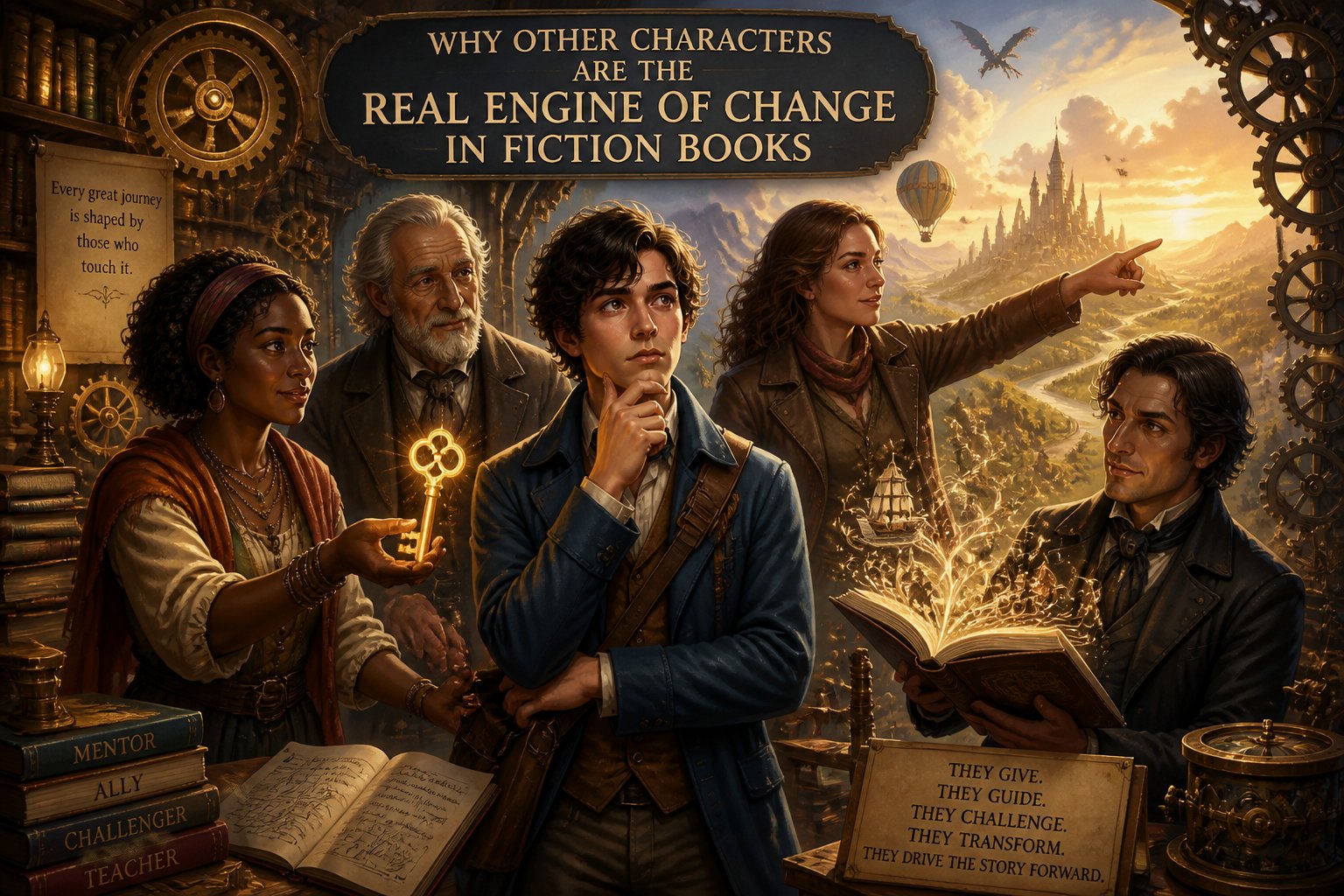
  • Why other characters are the real engine of change

    Why other characters are the real engine of change

    A character alone in a room cannot grow. They can only think. Growth needs someone else in the doorway with an opinion.

    If your protagonist feels flat, the problem is almost never the protagonist. It’s that nobody around them is pushing hard enough. Other characters are the real engine of change in fiction, and a first draft with a lonely lead is a first draft with no pressure system.

    The lonely protagonist problem in first drafts

    First drafts love a lonely hero. The writer is alone at the keyboard, deep in the protagonist’s head, and the page starts to mirror that. The protagonist thinks. The protagonist remembers. The protagonist walks somewhere and thinks some more.

    Nothing changes, because nothing is pressing on them. Internal monologue is not pressure. A character can stew for fifty pages and end the chapter exactly where they started, because they were the only voice in the room.

    Real change happens when someone else walks in with an agenda the protagonist cannot ignore. That is the moment the scene starts working. Not when the protagonist decides to feel differently, but when somebody forces the question.

    The three pressure roles: the one who agrees, the one who opposes, the one who loves

    Most cast problems come down to a missing pressure role. Strong protagonists tend to be surrounded by at least three kinds of people, and each one pushes in a different direction.

    The one who agrees is the ally. They share the goal, but they are not a yes-person. They want the protagonist to win and they have opinions about how. When the protagonist hesitates, the ally is the one saying we have to move, and the agreement itself becomes pressure.

    The one who opposes is the rival or antagonist. They want a different outcome, and they are willing to spend effort getting it. Their pressure is the easiest to write because it looks like conflict on the page, but it is often the least interesting if it stands alone.

    The one who loves is the most uncomfortable role. They don’t care about the goal. They care about the protagonist as a person, and they want them safe, or happy, or home. Their pressure cuts sideways through the plot, and that is exactly what makes it powerful.

    When all three are present, the protagonist cannot drift. Every choice costs them something with somebody.

    How conflicting pressures create the moment of choice

    A moment of real character change is almost always a moment of impossible choice. Not impossible in the cosmic sense, just impossible to make without losing something.

    If the ally, the rival, and the loved one all want the same thing, there is no choice to make. The protagonist follows the consensus and the scene goes flat. If only one of them is in the room, the protagonist can postpone the decision, because there’s no opposing force to make them commit.

    The interesting moments happen when at least two of the three are pulling in different directions inside the same scene. The ally wants the mission completed. The loved one wants the protagonist to come home alive. The protagonist now has to pick, and whichever way they pick, they reveal who they actually are.

    That is character change. A visible choice between two people they cannot fully satisfy.

    Designing a side character whose pressure is uncomfortable rather than convenient

    Most side characters in weak drafts are convenient. They show up to deliver information, agree with the protagonist, or get in the way for a chapter and then leave. Their pressure is mild because their wants are mild.

    A good side character wants something specific from the protagonist, and that something is at least a little uncomfortable to give. Maybe they want loyalty the protagonist can’t quite promise. Maybe they want honesty the protagonist has been avoiding. Maybe they want time the protagonist doesn’t have.

    The test is simple. If your protagonist could give this character what they want without changing anything about themselves, the character isn’t applying pressure. They are just decoration.

    Uncomfortable pressure doesn’t mean dramatic pressure. A mother who quietly wants her son to call more often is applying real pressure, because giving in costs the son time he was using elsewhere. The discomfort is the point. Comfort produces nothing.

    Scene-level test: who in this room is pushing the protagonist toward change?

    This is the question I’d run on every scene in a draft that feels limp.

    Who is in this room with the protagonist, and what does each of them want from the protagonist right now? Not in general. In this scene.

    If the answer is nobody, the scene is probably a thinking scene, and thinking scenes need to be rare. If the answer is one person who wants something easy to give, the scene will read as filler. If the answer is two or more people who want different things from the protagonist, the scene has a chance of producing change.

    Run this check chapter by chapter. You’ll find that the scenes you already love are the ones where two or three people are pressing on the protagonist from different directions. The scenes you keep meaning to fix are usually the ones where the protagonist is essentially alone.

    Linking characters to scenes so you can see who is pushing, chapter by chapter

    The reason this is hard to track in your head is that it lives across two layers of your book. The cast lives on one mental shelf, the scenes live on another, and the pressure each character is applying lives in the gap between them.

    What helps is treating side characters as scene-level participants, not just cast-list entries. For every scene, name who is present and what they want from the protagonist in that specific moment. When you can see that laid out chapter by chapter, the empty stretches become obvious. So do the stretches where the same one person is doing all the pushing.

    The protagonist’s arc isn’t a line you draw through their head. It’s a sequence of moments where other people stood close enough to force a choice. If you can see those moments mapped against your chapters, you can see your arc.

    Frequently asked questions

    Can a protagonist change without other characters present?

    Rarely, and usually not convincingly. A protagonist alone can realise something, but realisation is not change. Change shows up in a choice, and choices need stakes, which usually means someone else is in the room or waiting for an answer.

    How many side characters does a protagonist need to create real pressure?

    At minimum, you want the three pressure roles represented somewhere in the cast: someone who agrees, someone who opposes, someone who loves. They don’t all need to be in every scene, but they should all exist in the book and apply pressure across it.

    What if my antagonist is the only source of pressure?

    Then your protagonist’s arc will feel narrow. Pressure from a single direction is easy to resist or easy to surrender to. It’s the cross-pressure from allies and loved ones that forces the harder, more revealing choices.

    How do I know if a side character is too convenient?

    Ask whether the protagonist could give them what they want without changing. If yes, the character is decoration. A useful side character wants something the protagonist would have to stretch, sacrifice, or risk to provide.

    Does this apply to non-fiction or memoir?

    Yes. In memoir especially, the people around you in a given chapter are the ones who made you choose. The same scene-level question works: who was in the room, and what did they want from you?

  • How to Create Unforgettable Characters Readers Can’t Stop Thinking About

    How to Create Unforgettable Characters Readers Can’t Stop Thinking About

    Building Emotional Depth That Resonates

    Characters stick with readers when they feel emotionally real, not perfect. Writers need to dig into vulnerability, inner conflict, and authentic flaws to create people who live beyond the page.

    Moving Beyond Likeability

    Readers don’t need characters to be nice or agreeable. They need characters who feel true to life, which means embracing contradictions and messy emotions. A character who’s always pleasant becomes forgettable, whilst one who struggles with jealousy, selfishness, or fear feels human.

    The mistake many writers make is confusing likeability with relatability. A character can be difficult, harsh, or deeply flawed and still captivate readers. What matters is giving them emotional truth—reasons behind their behaviour that readers can understand, even if they don’t approve.

    Think about characters who frustrate others but can’t help themselves. Someone who pushes loved ones away because they’re terrified of abandonment. A person who lies to protect themselves from past trauma. These traits create depth because they reveal authentic human struggles, not sanitised versions of them.

    Crafting Authentic Vulnerability

    Vulnerability means letting characters be emotionally exposed in ways that hurt. It’s not about crying scenes or breakdown moments. It’s about showing what characters desperately want to hide—their shame, their fears, their secret inadequacies.

    Real vulnerability happens in small moments. A character’s hand trembling when they reach for a door handle. The way someone’s voice goes quiet when a painful topic surfaces. These details matter more than dramatic confessions because they reveal what characters try to conceal.

    Writers must be willing to make characters uncomfortable. Let them face their worst fears. Force them to confront the parts of themselves they’ve been avoiding. This discomfort creates the emotional stakes that make readers invest in the character’s journey.

    Showing Inner Conflict in Action

    Inner conflict drives emotional depth better than any external obstacle. It’s the gap between what a character wants and what they fear, between who they are and who they wish to be. This internal struggle must play out through choices and behaviour, not just thoughts.

    A character torn between ambition and loyalty shouldn’t just think about the dilemma. They should make small choices that reveal the conflict—hesitating before betraying a confidence, or volunteering for a project that pulls them away from family.

    Key ways to show inner conflict:

    • Characters contradict themselves in dialogue
    • They hesitate or second-guess decisions
    • Their actions don’t match their stated values
    • They react disproportionately to minor triggers

    The strongest writing advice about inner conflict emphasises making it visible through action. Readers should see the character wrestling with themselves, not just hear about it. This creates unforgettable characters because readers recognise the same battles they face in their own lives.

    Mastering Character Development

    Character development works when characters want something specific and when losing that thing would break them in a way that matters. These two elements create the foundation for characters who stay with readers long after the story ends.

    Establishing Specific Goals and Motivations

    A character who wants “to be happy” gives readers nothing to hold onto. A character who wants to win back custody of her daughter by proving she’s been sober for six months creates immediate tension and direction.

    The goal needs to be concrete enough that readers can track progress. Abstract wants like “finding peace” or “becoming a better person” don’t create scenes. They create vague character moments that drift past without impact.

    Strong motivations answer why the character can’t walk away. A detective who investigates a murder because it’s his job is forgettable. A detective who investigates because the victim was his daughter’s best friend and he promised to keep her safe has skin in the game. The why matters more than the what.

    Characters also need goals that conflict with each other. A mother who wants to protect her son whilst also wanting him to become independent creates internal tension that plays out in every decision she makes. These competing drives generate character arcs that feel earned rather than imposed by plot requirements.

    Personal Stakes and What Drives Attachment

    Readers attach to characters who have something real to lose. The stakes can’t be theoretical or distant. They need to threaten what the character values most, whether that’s a relationship, an identity, or a belief about themselves they’ve built their entire life around.

    A character fighting to save the world feels less immediate than a character fighting to save their younger brother. Scaling down the stakes often increases emotional investment because readers can imagine the specific loss rather than processing an abstract catastrophe.

    The attachment also needs vulnerability. Characters who maintain perfect control never let readers in. A character who’s terrified of failing, who makes mistakes because fear overrides good judgement, creates openings for readers to connect with the struggle rather than just admiring the competence.

    Physical stakes work, but psychological stakes cut deeper. Losing a job matters. Losing the identity built around that job, the sense of purpose it provided, and the belief that hard work guarantees security creates the kind of character development that transforms someone by the final page.

    Designing Morally Complex Characters

    Characters who exist in the moral grey zone stick with readers long after they finish the book. These are the people readers argue about, defend, and can’t quite shake from their minds.

    Understanding Morally Grey Characters

    A morally grey character doesn’t fit neatly into the “good” or “bad” box. They make choices that come from their own internal logic, even when readers don’t agree with those choices.

    These characters believe they’re doing what’s necessary. Maybe they’ll lie and manipulate to protect their family. Maybe they’ll hurt others to achieve what they see as a greater good. The key is that their worldview makes sense to them, even if it’s flawed.

    Readers connect with these characters because they reflect real human complexity. Most people aren’t purely good or evil. They’re messy. They make mistakes. They do the wrong thing for the right reasons, or vice versa.

    The strongest morally grey characters have a code they follow. They might cross terrible lines, but there are certain things they won’t do. This internal boundary reveals what they truly value beneath all the grey.

    Exploring the Allure of the Antihero

    An antihero lacks the traditional qualities of a hero. They might be selfish, rude, or violent. Yet readers find themselves rooting for them anyway.

    What separates an antihero from a villain is connection. Writers give readers something to hold onto—vulnerability, humour, or a goal worth supporting. The character might be cruel to enemies but gentle with children. They might push people away whilst desperately wanting to be loved.

    The best antiheroes struggle with their choices. They feel the weight of what they do, even if they do it anyway. This internal conflict keeps them human rather than monstrous.

    Antiheroes work because they ask uncomfortable questions. Would the reader betray someone to save many? Would they become what they hate to protect what matters? These questions make antiheroes impossible to dismiss.

    Revealing Flaws, Wounds, and Growth

    Characters stick with readers when they feel broken in ways that matter. Writers create this connection by showing flaws that drive the story forward and wounds that shape how characters see their world.

    Utilising Flaws for Connection

    Flaws make characters feel like real people instead of cardboard cutouts. A character who’s too trusting might keep getting betrayed. Someone with a quick temper could push away the people they care about most.

    The best flaws create problems that can’t be solved with a simple conversation. They run deep and affect how the character makes decisions throughout the story. A flaw works well when it directly conflicts with what the character wants to achieve.

    Effective flaws often include:

    • Pride that prevents asking for help
    • Fear of abandonment leading to pushing others away
    • Perfectionism that creates paralysis
    • Mistrust stemming from past betrayal

    Readers connect with flawed characters because they recognise similar struggles in themselves. The character who can’t admit when they’re wrong feels familiar. The person who sabotages their own happiness hits close to home.

    These imperfections shouldn’t just sit there as interesting details. They need to create inner conflict and drive the character’s choices in ways that move the plot forward.

    Mapping the Character Arc Through Transformation

    A character arc shows how someone changes from beginning to end. The character starts with certain beliefs shaped by their wounds and flaws. Events in the story challenge these beliefs until the character must choose between old patterns and new growth.

    The transformation doesn’t need to be massive. Small shifts in perspective can feel just as powerful as complete personality overhauls. What matters is that the change feels earned through the events of the story.

    Strong character arcs typically follow this pattern:

    1. Character holds limiting belief
    2. Story events challenge that belief
    3. Character resists change initially
    4. A crucial moment forces a decision
    5. Character transforms (or refuses to change)

    Not every character needs to improve. Some compelling arcs show characters getting worse as their flaws consume them. Others feature characters who stay true to their core beliefs whilst the world around them changes.

    The key is making readers understand why the character changes or doesn’t change based on everything they’ve experienced.

    Crafting Distinct Voices and Unique Qualities

    Every character needs to sound different and feel special. When readers can tell who’s speaking without a dialogue tag, and when characters stick in their minds long after the story ends, that’s when character development truly succeeds.

    Developing a Memorable Character Voice

    A character’s voice comes from their background and personality. A teenager from London won’t talk like a retired farmer from Cornwall. Age, education, and life experience all shape how someone speaks.

    Word choice matters loads. Some characters use big words whilst others keep it simple. A university professor might say “magnificent,” but a mechanic might just say “brilliant” or “proper good.” Writers should think about sentence length too. Does the character ramble on, or do they speak in short, punchy sentences?

    Speech patterns make characters recognisable. Maybe one character always asks questions. Another might use the same phrases over and over. These small habits create a voice that readers remember.

    Reading dialogue aloud helps test if it sounds natural. If a character’s words feel stiff or weird when spoken, they need a rewrite. Real people pause, interrupt, and trail off mid-thought. Unforgettable characters do the same.

    Infusing Special or Standout Traits

    Characters need something that makes them different from everyone else. This could be a physical feature, a strange habit, or an unusual skill. The key is making these traits feel real, not random.

    The best traits connect to the character’s story. A character who bites their nails might be anxious about something specific. Someone who collects vintage maps might have a reason rooted in their past. These details shouldn’t just sit there looking pretty. They should reveal something deeper about who the character is.

    Writers should avoid going overboard. Three or four standout qualities work better than ten. Too many quirks make a character feel fake, like they’re trying too hard. The goal is creating someone who feels like a real person, just more interesting than most.

    Integrating Conflict and Tension

    Conflict reveals who characters truly are under pressure, and tension keeps readers emotionally invested in what happens next. Both internal struggles and external relationships create the friction that makes characters feel alive and memorable.

    Internal Versus External Struggles

    Inner conflict drives character development by showing the gap between who a character is and who they want to become. A character might crave connection whilst sabotaging every relationship. They might project confidence whilst privately falling apart.

    External struggles—fights, obstacles, dangerous situations—only become meaningful when they expose something internal. A physical battle matters more when it forces a character to confront their deepest fear. A deadline creates real tension when it threatens something the character desperately needs to protect.

    The strongest stories layer both together. A character faces an external threat whilst wrestling with self-doubt. They chase a goal whilst battling shame. This combination creates unforgettable characters because readers see both the action and the emotional truth underneath it.

    Common internal conflicts include:

    • Fear versus desire
    • Independence versus loneliness
    • Control versus vulnerability
    • Loyalty versus self-preservation

    Leveraging Relationships and Contrasts

    Relationships magnify tension by forcing characters to navigate competing needs and vulnerabilities. A character who avoids intimacy becomes more interesting when paired with someone who demands emotional honesty. Someone who masks pain with humour reveals themselves differently around people who see through the deflection.

    Contrasts between characters create natural friction. Pair someone controlled with someone impulsive. Place someone desperate for approval alongside someone who refuses to perform. These dynamics force characters to react, adapt, and reveal aspects of themselves they might otherwise hide.

    The tension doesn’t need to be hostile. Two characters who care about each other but want incompatible things create compelling conflict. A mentor who must let go. A friend who can’t save someone they love. These relationships expose emotional wounds whilst driving the story forwards.

    Practical Writing Advice for Lifelong Impact

    Characters stick with readers when writers strike the right balance between familiar humanity and extraordinary depth, then layer in specific details that make those characters impossible to forget.

    Balancing Relatability and Aspiration

    Writers often struggle between making characters feel accessible and making them interesting enough to follow. The solution isn’t choosing one over the other.

    Readers need to recognise something human in a character. That might be insecurity about belonging, fear of failure, or the desire to protect someone they love. These universal feelings create the bridge between reader and character.

    But readers also want characters who do things they can’t or won’t do themselves. A character might speak truths no one else will say. They might take risks the reader fears. They might pursue dreams the reader abandoned.

    The sweet spot comes when a character feels both recognisable and aspirational. A shy character who forces herself to speak up at a crucial moment. An angry character who learns to channel rage into purpose. A lonely character who risks connection despite past hurt.

    Key elements to balance:

    • Root extraordinary actions in relatable emotions
    • Let aspirational traits come with realistic costs
    • Show characters struggling with the same choice readers face
    • Make confident behaviour stem from deep insecurity or pain

    Tips to Ensure Readers Remember Your Characters

    Specific details create lasting impressions. Generic traits fade immediately.

    Instead of “she was kind,” show her stopping to help even when she’s running late. Instead of “he was angry,” show him gripping his coffee cup until his knuckles go white. Physical habits, speech patterns, and repeated behaviours make characters stick.

    Give each character a contradiction that feels true. The surgeon with steady hands who can’t make a personal decision. The comedian who uses humour to avoid every serious conversation. The confident leader who panics when alone.

    Memory anchors that work:

    • A specific phrase the character repeats under stress
    • An unusual reaction to a common situation
    • A secret the character keeps from everyone (including themselves)
    • A wound that shapes multiple decisions throughout the story

  • How to Open a Book With a Character Worth Following

    How to Open a Book With a Character Worth Following

    Quote of the Week

    “Every character should want something, even if it is only a glass of water.”

    Kurt Vonnegut

    Vonnegut is pointing at something that trips up almost every opening chapter I read. Wanting is not the same as needing. A character who wants a glass of water is already alive on the page, because wanting reveals something about them, even if it is small.

    And here is the part that gets uncomfortable. A character who only wants good things, sensible things, admirable things, is a character we cannot follow for very long. Because a person with no flaw has nowhere to go.

    That is why the opening of a book is really the opening of a wound. You are not introducing a hero. You are introducing a problem shaped like a person.

    Craft Deep Dive

    The first chapter has one job most writers get wrong: it has to make the reader trust that this character is worth 300 pages of their attention. Not likeable. Worth following. Those are very different things.

    Likeable characters are safe. Worth-following characters have a fault line.

    When I read openings that fall flat, it is almost always the same issue. The writer has introduced a competent, kind, reasonable person doing competent, kind, reasonable things. And there is nowhere for the story to push against. No pressure point. No fracture the plot can widen.

    A starting flaw is not a personality quirk. It is not a bad habit tacked on for texture. It is the specific way this character sees the world wrong at the beginning. It is the belief they hold, often without knowing they hold it, that the story is going to break open.

    The flaw has to be visible in behaviour, not stated in narration.

    A character who thinks they are unlovable does not tell us so. They flinch when someone gets close. They pick fights before they can be left. They over-explain themselves in a room full of people who already like them. The reader sees the shape of the wound long before they hear the word for it.

    The flaw has to cost them something on page one.

    This is the part I want to press on. If your opening chapter shows the flaw but the flaw has no consequence yet, the reader has no reason to lean in. The flaw needs to already be making their life smaller, quieter, lonelier, more brittle. Something the reader can feel the character losing, even if the character does not see it yet.

    Story Breakdown (In Action)

    Imagine a novel that opens with a woman arriving late to her sister’s engagement party. She has a gift, a good one, thoughtfully chosen. She is warm, funny, apologises for the traffic. Everyone is pleased to see her.

    And then, in the space of two pages, we see her deflect three questions about her own life. She turns every conversation back to the other person. She laughs a little too quickly. When her sister asks if she is seeing anyone, she says “you know me” and changes the subject.

    We have not been told anything. But we know. This is a woman who has decided her own story is not worth taking up space with. That is the flaw. And the moment the plot puts her in a situation where she has to speak for herself or lose something she loves, the whole book is going to turn on it.

    Nothing dramatic happened in that opening. But the fracture is visible.

    Common Beginner Mistake

    The most common mistake I see is writers introducing the flaw as backstory instead of behaviour. A paragraph explaining that the character was hurt in the past, or grew up with a difficult parent, or lost someone important, and that this is why they are the way they are.

    The reader does not need the explanation on page one. They need the evidence. Backstory delivered too early feels like a character sheet read aloud. Behaviour that hints at the same wound feels like meeting a real person.

    Trust the reader to notice. They will.

    Practical Writing Exercise

    Take the opening scene of your current project, or a new one, and try this:

    1. Write down, on a separate page, the one belief your protagonist holds about themselves at the start of the book that is going to be wrong by the end.
    2. Now look at your opening scene. Find three moments where that belief shapes what they do, say, or avoid. Not what they think. What they do.
    3. If you cannot find three, rewrite the scene until you can.
    4. Cut any line where the character, or the narrator, names the flaw directly. Let behaviour carry it.

    You are not making the character more flawed. You are making the flaw legible.

    Apply This in Clear ARC

    Inside Clear ARC, the character planning view is where this work lives. When you set up a protagonist, there is a space to define the internal starting position separately from the external goal. That separation matters. The external goal is what they are chasing. The internal starting position is what is quietly stopping them from getting it.

    Once that is in place, every scene you plan can be checked against it. Does this scene show the flaw pressing on their life? Does it widen the fracture, or does it let them off the hook? Planning the arc this way means the flaw is not something you remember to include, it is something the structure of the book keeps returning to.

    Clear ARC Feature Spotlight

    The character arc tracker in Clear ARC lets you plot the internal shift alongside the external plot points, so you can see at a glance whether the two are moving together. Most sagging middles are not plot problems, they are arc problems: the external story is progressing but the character’s inner position has not shifted in fifty pages. Seeing them side by side stops that happening.

    Start your arc here:

    This Week’s Writing Challenge

    Write the first 500 words of a story where the protagonist’s flaw is visible in every single paragraph, but never named.

    • No backstory.
    • No internal monologue explaining who they are.
    • Just behaviour, dialogue, and the small choices they make.

    When you finish, hand it to someone who has not read anything else of yours and ask them to describe the character in one sentence. If they name the flaw without you pointing to it, you have done the work.