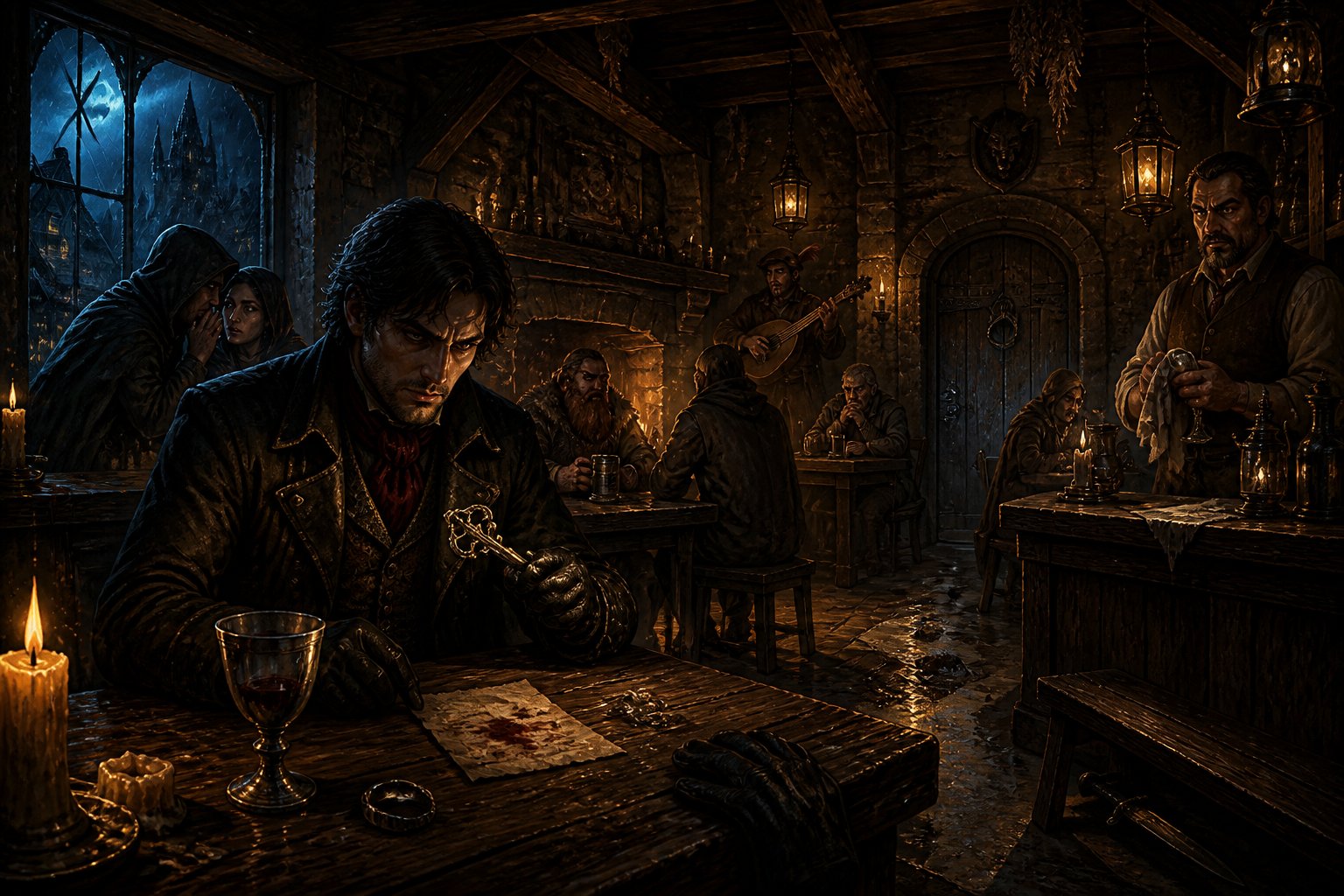
If your fantasy tavern feels generic, it’s almost never the tavern’s fault. It’s that nobody in it wants anything from it.
The fire crackles. The ale is warm. There’s a bard in the corner playing something wistful. And yet the scene sits flat on the page, because a setting without desire is just furniture.
This is the thing new fantasy writers miss when they build a location. A tavern is not a place. A tavern is a room full of wants, and every one of those wants points somewhere else.
Why does the generic fantasy tavern happen in the first place?
We copy the shape without copying the engine. We’ve all read the scene: hooded stranger in the corner, gruff barkeeper polishing a mug, drunk at the bar muttering about the old king. It reads like fantasy, so we write it like fantasy.
But those scenes worked in the books we’re remembering because the characters in them wanted things. The hooded stranger was watching for someone. The barkeeper was hiding a debt. The drunk was trying to be overheard.
Remove the wants and you’re left with costume. A generic tavern is a scene where every character is waiting for the protagonist to arrive so the plot can happen. That’s why it feels dead. Nothing was happening before the door opened.
What does a tavern with no desire actually look like?
It looks like a description paragraph followed by a conversation. The description tells us the tavern is smoky and loud. The conversation is between our protagonist and one plot-relevant NPC. Everyone else is scenery.
Here’s the test. Pick any character in your tavern scene who isn’t the protagonist. Ask what they want, right now, in this room, tonight. If your answer is “nothing” or “they’re just there,” the scene is generic.
Generic doesn’t mean badly written. It means the room contains no gravity. Nobody is pulling on anything. The protagonist walks through it like a museum, and the reader follows, politely bored.
Why does desire fix the tavern problem?
Because desire creates behaviour, and behaviour creates texture. The moment a character wants something from the tavern, they start doing things a generic patron wouldn’t do.
The merchant who wants information leans in when new arrivals speak. The girl who wants to leave home keeps glancing at the door every time it opens. The old soldier who wants to be left alone shifts his chair so his back is to the room. None of these people need names or arcs. They need one want each.
And here’s the useful part. The reader doesn’t need to know what any of these people want. They only need to see the behaviour. The tavern goes from a set to a system, and the protagonist is now moving through a place where other lives are already in motion.
How do you give a tavern desire without adding ten characters?
You don’t need ten characters. You need three or four background wants and one foreground want.
Here’s the shape that works:
- One character who wants something from the protagonist (the plot-relevant NPC)
- One character who wants something from another character in the room (not the protagonist)
- One character who wants to avoid something or someone in the room
- One character who wants something from the tavern itself (a job, a bed, a drink they can’t afford)
That’s four wants. Four small engines running in the background. The protagonist walks in and the room already has weather. Now every glance, every silence, every overheard word means something, because it’s connected to a want the reader can feel even if they can’t name it.
What does the barkeeper want?
This one deserves its own section, because the barkeeper is the character most often written as furniture. They pour drinks. They wipe mugs. They nod at the protagonist and deliver a line of exposition.
Give the barkeeper a want and the whole scene lifts. Maybe they want the protagonist to leave quickly because trouble is coming. Maybe they want to overhear the conversation at table three. Maybe they want to sell the upstairs room to someone with coin because their daughter is sick.
You don’t have to explain any of this. You just have to know it, and let it shape how they pour the drink, how long they hold eye contact, what they don’t say. A barkeeper with a want is a person. A barkeeper without one is a prop.
Why does the tavern itself need a want too?
This is the move most writers skip. The tavern as an institution wants something. It wants to survive the winter. It wants to keep the guard captain drinking there. It wants to shake off the reputation it picked up last summer.
When the location has a want, the location behaves. The prices are set a certain way. Certain patrons are welcome and certain ones aren’t. The fire is banked low or roaring depending on whether the owner wants people to stay or leave.
This is worldbuilding through character, applied to a building. The tavern isn’t a backdrop. It’s a slow-moving character with its own agenda, and every choice about décor, menu, staff, and layout is that agenda made visible.
How do you track all these wants without losing them?
This is where a lot of pantsers hit a wall. You seed four background wants into chapter three and by chapter eleven you’ve forgotten two of them. The barmaid who was saving to leave town has quietly evaporated. The merchant with the debt is now just “a merchant.”
The fix is boring and it works. Keep a running list of every character’s want, updated when it changes or resolves. Even the ones who appear once. Especially the ones who appear once, because those are the ones you’ll want to bring back in chapter twenty when you realise you need someone who already knows the protagonist.
Characters disappear when we stop tracking them. So do their wants. And when the wants disappear, the tavern goes back to being generic.
Frequently asked questions
How many characters should a tavern scene have?
As few as you can get away with while still having weather in the room. Four or five is usually enough. What matters is that each one wants something, not that the tavern is crowded.
Do the background characters need names?
No. “The merchant,” “the barmaid,” “the man with the scar” all work. Names cost the reader memory. Only spend that cost on characters who will come back.
What if my tavern scene is only there for exposition?
Then the exposition will feel generic too, because it’s being delivered in a dead room. Give the room wants first, then deliver the exposition. The information lands harder when it’s competing with other things happening.
Can this same principle work for other locations?
Yes. Markets, throne rooms, temples, ships, war camps, any location that feels flat is usually a location where nobody wants anything specific. Desire is what turns a setting into a scene.
How do I know if a background want is working?
If you can delete the character and the scene loses nothing, the want wasn’t working. If deleting them changes the temperature of the room even slightly, the want was doing its job.
Where to go from here
The generic tavern is a symptom, not a disease. The disease is treating setting as decoration instead of as a collection of wants. Fix that and the tavern fixes itself, and so does the market, the temple, the throne room, and every other room your protagonist walks into.