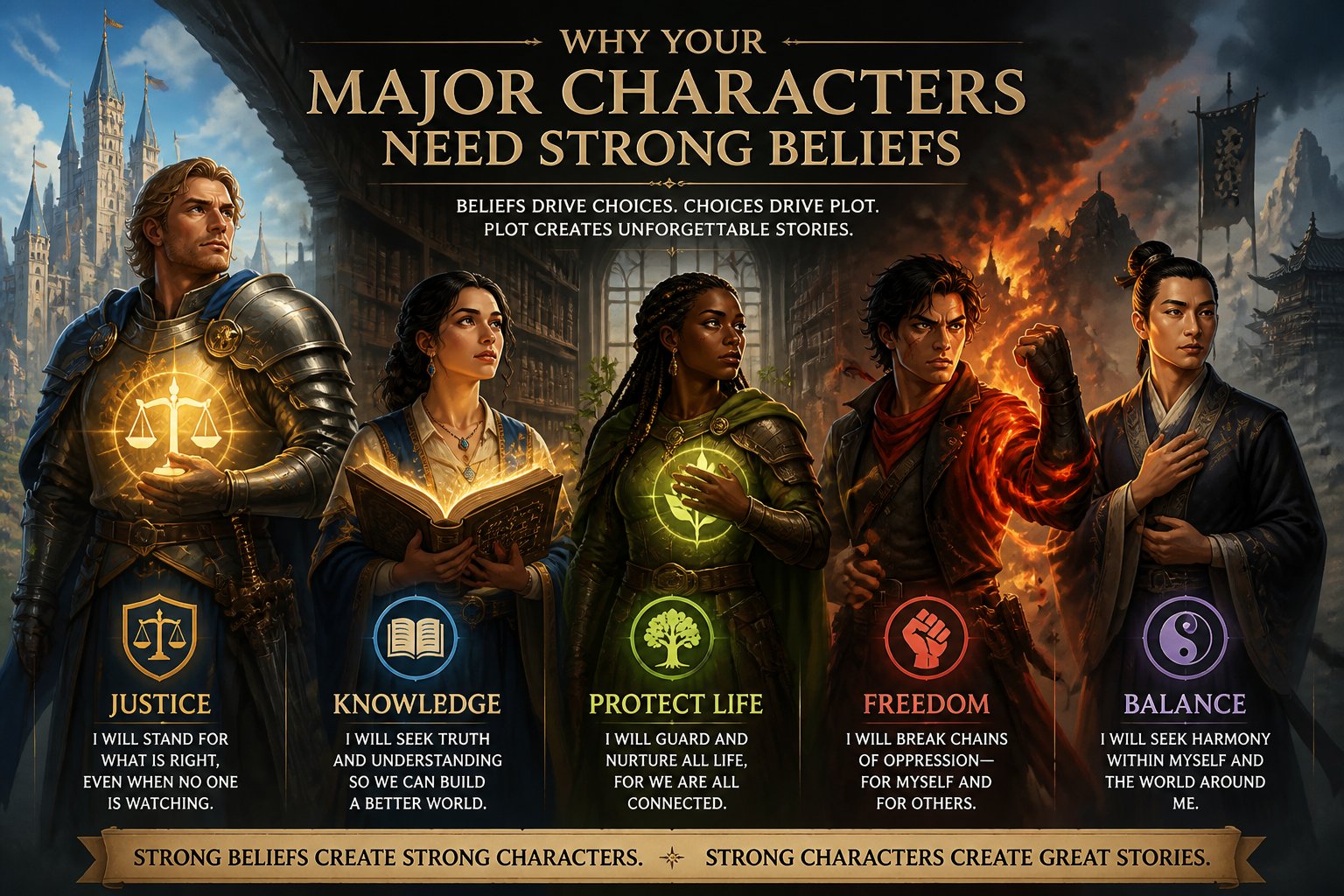
Your major characters believe something on page one. By the last page, those beliefs should be unrecognisable, or proven right at terrible cost. Everything between those two points is the story testing the belief, and a working belief is the single thing that turns events into an arc.
Without one, scenes happen near your characters instead of to them. The plot moves, the characters react, and the reader feels nothing in particular. With known and recognisable beliefs, every scene has a target, because every scene is either pressing on the belief or asking the characters to defend it.
A backstory is not a working belief
Backstory is what happened. A working belief is what your characters conclude from it. Those are not the same thing, and confusing them is the reason a lot of arcs feel flat even when the past is rich and well-imagined.
A character whose mother left when they were six has a backstory. A character who believes people I love will always leave first, so I leave first has a working belief. The first is information. The second is a pressure point your story can squeeze.
The test is simple. Can the belief be challenged by a scene? If yes, it is a working belief. If it just sits there as fact, it is backstory, and you still have a step to do.
How do you phrase a belief in one sentence?
Force yourself to write it as a single line your character would never actually say out loud. The unsaid part is what makes it powerful. If they could say it cleanly, they would have already examined it, and a belief that has been examined is no longer driving them (an examined and understood belief is no longer a belief because it has turned into truth or fact).
A few shapes that tend to work:
I am only safe when I am in control.People always leave, so I never ask them to stay.If I am useful, I am allowed to exist.Love is something you earn by being good enough.The world rewards the people who refuse to need anyone.
Notice the structure. Each one has a condition and a consequence. That is what makes it testable. Two examples:
a) I am only safe when X invites the story to remove X and see what happens.
b) People always Y invites the story to introduce one person who does not Y.
If your one-sentence belief does not have a condition or a consequence, it is probably a value, not a belief. Values are stable. Beliefs are pressure points. You want the pressure point.
Why the belief has to be wrong
A belief that is fully true cannot drive an arc, because there is nothing to learn and nothing to lose. The belief has to be wrong, or wrong enough in the world of your story that holding onto it costs the character something they cannot afford.
Wrong does not always mean factually false. Sometimes the belief was true once and is no longer. Sometimes it is partly true but applied to the wrong situations. Sometimes it is true and the cost of it being true is what breaks them.
The character who believes I am only safe when I am in control is not wrong that control feels safe. They are wrong that safety is worth what they pay for it. Your story does not have to prove the belief false. It has to prove the price.
This is where a lot of first drafts go soft. The writer is sympathetic to the character, so the belief never quite gets tested, and the ending arrives without anyone having to pay for anything. The reader closes the book and forgets it the next morning.
Designing scenes that test the belief from different angles
One scene cannot break a belief. Beliefs are load-bearing. They have been holding the character upright for years, sometimes decades. Your story has to poke them from several angles before they give.
When you plan scenes, ask which angle each one is coming from. You are looking for variety, not repetition.
- A scene where the belief works and protects them, so the reader sees why they hold it.
- A scene where the belief costs them something small they barely notice.
- A scene where someone they trust contradicts the belief directly, and they reject the contradiction.
- A scene where the belief fails in a way they cannot rationalise.
- A scene where they act on the belief and harm someone they love.
That is five different pressures, not five repeats of the same pressure. If three of your scenes are doing the same job, cut two of them and find new angles. The belief should be tested from above, below, and sideways before it breaks.
When does the belief actually crack?
The crack tends to sit later than new writers expect. Most working drafts crack the belief around the midpoint, because the midpoint feels like the natural turning place, and then spend the second half on plot rather than aftermath.
Move it later. The belief usually wants to crack somewhere in the final quarter, often at the moment of the worst external pressure, because that is when the character has the least energy left to defend it. Before that crack, the character can still hold the line. After it, they cannot.
The crack scene itself is rarely loud. It is often quiet, almost private, a moment where the character realises they cannot keep believing what they believed and still live with what they have done or seen. The fireworks are external. The crack is internal.
What comes after the crack matters as much as the crack itself. The character has to act differently, and the reader has to see them do it. A belief that breaks off-page and is only reported in dialogue afterwards is not an arc. It is a summary.
Tracking the belief across the book
The reason this is hard to feel in a draft is that the belief shifts in tiny increments across many scenes, and you cannot hold all of them in your head at once. You can hold one scene. You cannot hold forty.
This is where a timeline helps more than a character sheet. A character sheet tells you what the belief is. A timeline shows you where it is being tested, where it bends, and whether the pressure is actually building or just repeating. If you can see the whole shape laid out, you can see the arc instead of guessing at it.
Write the belief at the top. Then mark every scene that touches it, and note what that scene does to it: holds, presses, bends, defends, breaks. When you look at the marks together, you will see the gaps. Long stretches with no marks mean the belief has gone quiet, and the character is drifting. Clusters of the same mark mean you are repeating yourself.
Frequently asked questions
What if my character has more than one belief?
Most characters do, but only one needs to be load-bearing for the story you are telling. Find the one your plot is actually testing and treat that as the arc-driver. The others can shift in the background, but they should not compete for the spotlight, or the ending will feel diffuse.
Can the belief be proven right instead of broken?
Yes, and some of the most painful endings work this way. The belief is confirmed, but the cost of being right is something the character cannot bear. The arc is still an arc, because the character ends the book unable to hold the belief the same way they held it on page one.
What if I do not know my character’s belief yet?
Write the first act anyway, then read it back and ask what your character is acting as if they believe. Their behaviour will tell you. Beliefs are usually visible in what a character avoids, defends, or refuses to consider, long before they can be named.
How is this different from a character flaw?
A flaw is a trait. A belief is a sentence the character is living by. Flaws describe; beliefs drive. You can have a stubborn character with no arc, but a character who believes asking for help proves I am weak has somewhere to go.
Does this work for non-fiction or memoir?
Yes, and arguably more directly. In memoir, the belief is one you actually held, and the book is the record of what tested it. The same shape applies: name the belief, show it working, show it failing, show what replaced it.
If you found this useful, I send a regular newsletter on character work, plot structure, and the craft problems that trip up new authors. Each one is short, practical, and built around the kind of question that stalls a draft. Subscribe to my newsletter if you want the next one in your inbox.