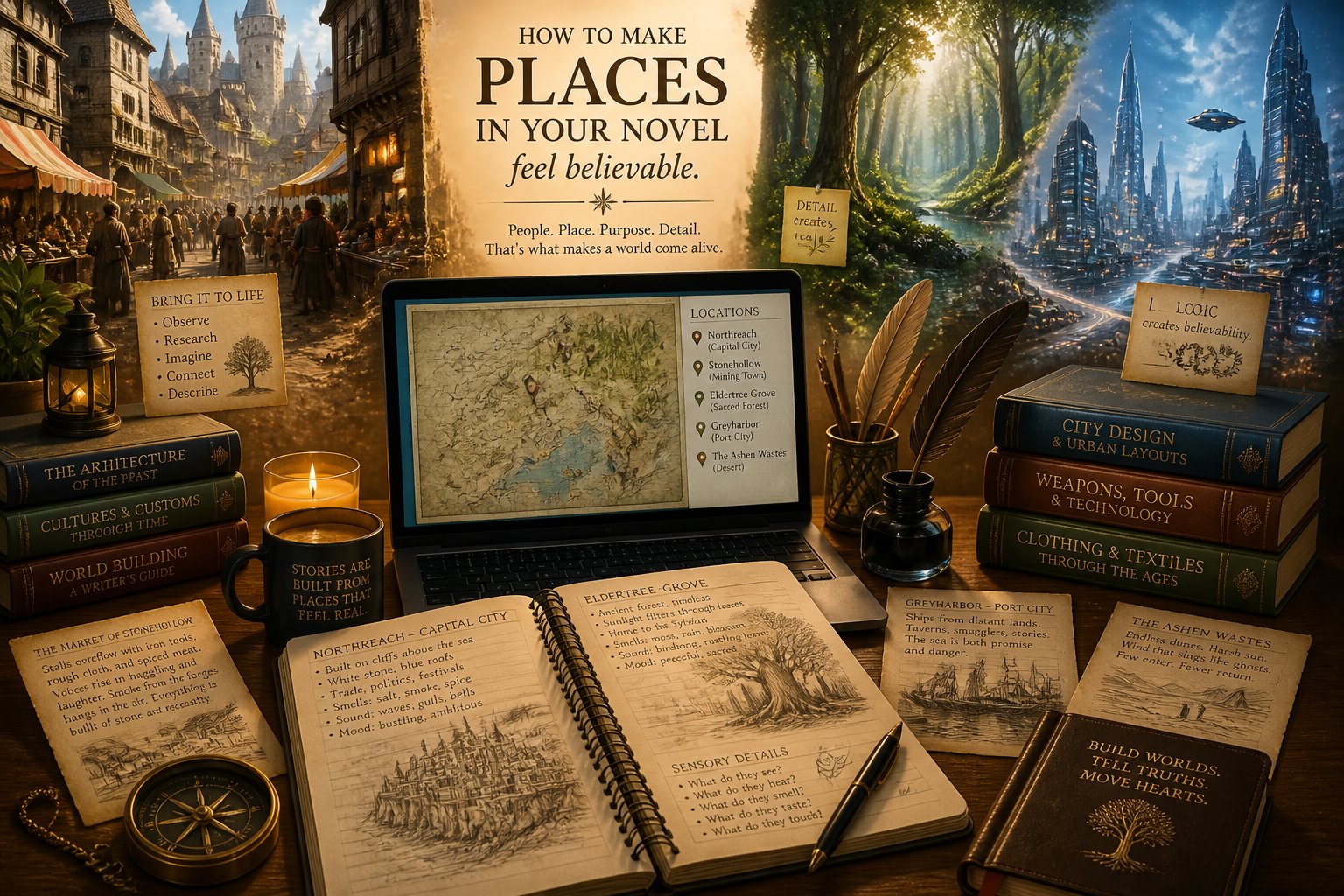
Believable places in fiction are not built from long descriptions. They are built from small, specific details that a character notices, and from rules the writer refuses to break.
If your settings feel like painted backdrops, the problem is almost never that you wrote too little. It’s that you wrote the wrong things, in the wrong voice, at the wrong moment.
Let’s fix that.
Why do fictional places feel flat in the first place?
Most flat settings share the same root cause: the writer describes the place from the outside, like a camera panning across a room. The reader sees furniture, colours, maybe a window. Then the scene moves on and nothing sticks.
A real place is not a list of objects. It’s a set of impressions filtered through whoever is standing in it. The kitchen your protagonist grew up in and the kitchen your antagonist is breaking into are the same kitchen, but they should read completely differently on the page.
When we skip that filter, the setting becomes generic. And generic is the enemy of believable.
What makes a place feel real to a reader?
Three things, in this order: specificity, perception, and consistency.
Specificity means one weird, exact detail beats ten vague ones. The corner of the skirting board where the cat had scratched a bald patch tells us more about a room than three paragraphs of general description. The reader’s brain fills in the rest, and because you gave them something specific, they trust you.
Perception means the details are chosen by the character in the scene, not by the author hovering above it. A hungry character notices food smells. A frightened character notices exits. A grieving character notices things that don’t matter, because their mind is somewhere else.
Consistency means the place behaves the same way every time we visit it. If the front door sticks in chapter two, it still sticks in chapter twelve unless someone fixed it (and if they did, that’s a scene).
How much description is enough?
Less than you think, placed more carefully than you’re currently placing it.
My rough working principle: give the reader one strong sensory anchor when they arrive in a new place, one atmospheric shift as the scene develops, and one small detail that pays off later. That’s it. Three moments of setting work, spread across a scene, will do more than a paragraph of dense description up front.
The temptation to front-load is huge, especially for pantsers who are figuring the place out as they write. Do it in the draft if you have to. Then cut it in revision and sprinkle what’s left across the scene.
The senses beyond sight
Most writers over-rely on what a place looks like. But smell, sound, temperature, and texture do more emotional work per word.
The smell of damp brick after rain. The specific silence of a room where a clock has just stopped. The way a stone floor pulls heat out of your feet. These land harder than any visual because we rarely put them on the page, so the reader isn’t numb to them yet.
How do you build a place the reader can navigate?
Believable places have geography. The reader should always have a rough sense of where things are in relation to each other, even if you never draw them a map.
A few practical moves:
- Establish direction early. If a character walks
east into the market, the market is east from now on. - Reuse landmarks. The same crooked church spire, the same wine stain on the tablecloth. Repetition builds solidity.
- Let characters move through the space naturally. If they cross a room, tell us what they pass on the way.
- Track the light. Time of day, season, weather. It anchors the reader in when as well as where.
You don’t need to describe every corner. You need the corners you do describe to stay put.
Why do invented worlds need stricter rules than real ones?
Because the reader has no external reference. If you set a scene in Paris, the reader brings their own Paris to the page. If you set it in a city you invented, they only have what you give them, and any inconsistency is yours to own.
This is where a lot of fantasy and science fiction settings collapse. The rules of the world (how magic works, how the technology behaves, how the politics function) get bent in chapter fifteen to solve a plot problem, and the whole place stops feeling real.
Write the rules down somewhere. Not for the reader. For you. Then break them only when the breaking is the story.
How do places reveal character?
A place is a character test. What your character notices, what they ignore, what they touch, what they refuse to touch, all of it tells us who they are.
Two characters walk into the same drawing room. One sees the good silver and starts calculating its worth. The other sees the smoke stain above the fireplace and thinks about their grandmother. Same room. Two completely different scenes.
This is the trick that lifts settings from wallpaper to storytelling. The place isn’t just where the scene happens. It’s how you show us the person the scene is happening to.
What about places that change over time?
Settings should age with the story. If a village is under siege for six weeks, it doesn’t look the same in week six as it did in week one. Food runs out. People get thinner. The streets get quieter. Small details shift.
The same principle applies to a single house across a novel. A room where something terrible happened is a different room afterwards, even if none of the furniture moved. Track that. Let the place carry the weight of what’s occurred in it.
This is one of the hardest things to hold in your head across a long draft, which is exactly why a timeline that tracks setting shifts alongside character arcs is worth the effort.
Frequently asked questions
How much should I describe a place the first time a character enters it?
One strong sensory anchor, filtered through the character’s current emotional state. If you find yourself writing more than three or four sentences of pure description before anything happens, you’re probably front-loading. Move most of it into the scene as the character interacts with the space.
Do I need to draw a map for my novel?
Only if you’ll actually use it. A rough sketch of the town, the house, or the region is useful for you as the writer, because it stops you contradicting yourself. Whether the reader ever sees a formal map is a separate question, and mostly a genre convention.
How do I make a real-world location feel fresh?
Write the version of it your specific character would see. The Paris of a homesick tourist is a different city from the Paris of a pickpocket. Avoid postcard details. Reach for the small, weird, specific things that only someone standing in that place would notice.
What’s the biggest mistake writers make with settings?
Treating description as separate from character and plot. If your setting paragraphs could be lifted out without changing the scene, they’re doing decorative work, not story work. Every detail should be pulling double duty: showing us the place and showing us the person in it.
How do I keep settings consistent across a long novel?
Keep a running document of the places you’ve established, the details you’ve committed to, and the rules of any invented world. Update it as you write. It’s much easier to check a reference than to remember whether the bakery was on the left or the right of the square in chapter three.
If you found this useful, I write regular newsletters on craft problems like this one, covering setting, character, plotting, and the specific traps that catch new authors mid-draft. Subscribe to my newsletter and I’ll send the next one straight to your inbox.