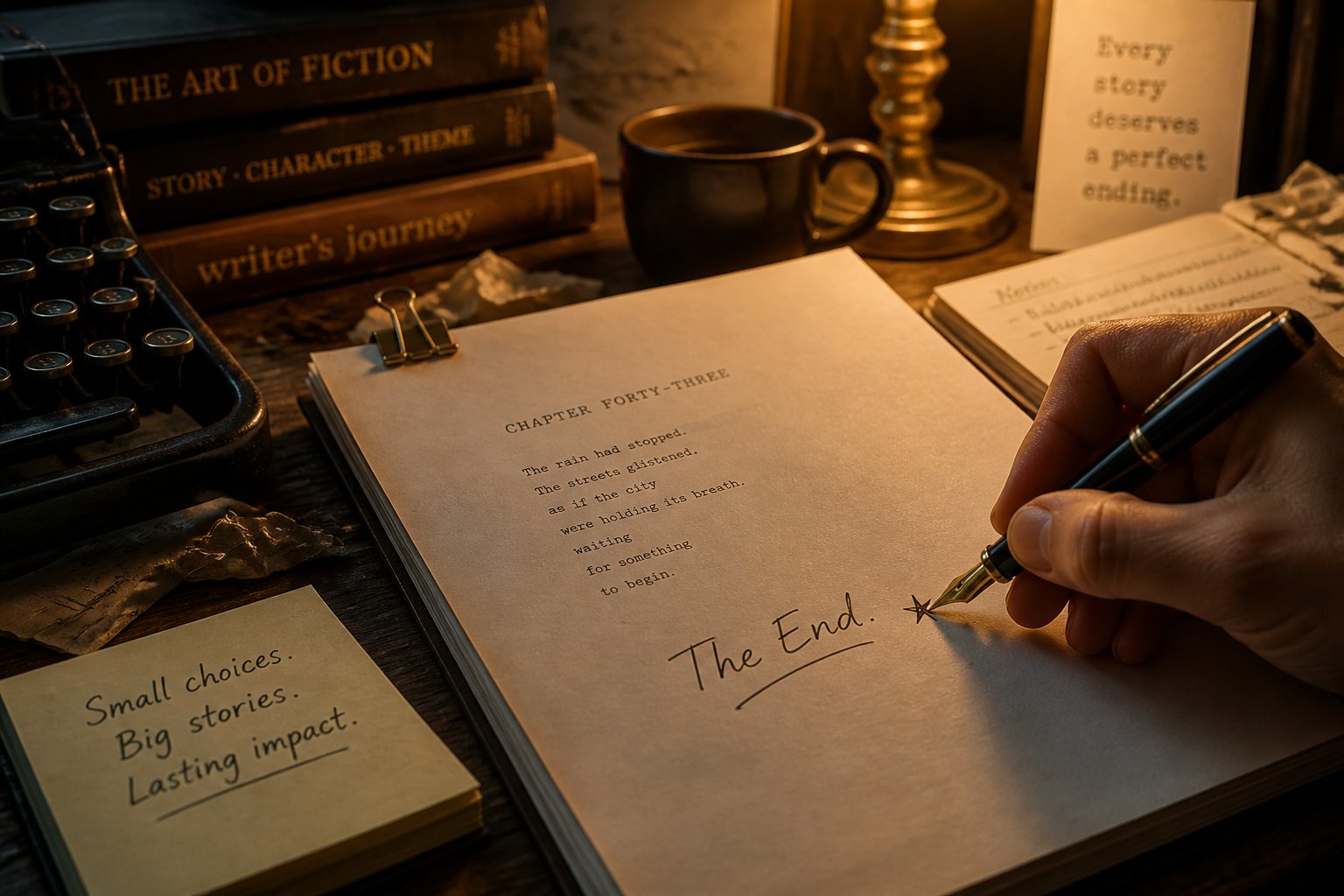
The ending most readers carry with them is not the explosion. It is a character making coffee for someone they used to hate. The small ending that readers talk about is almost never the climax. It is a tiny, ordinary action in the last few pages that the chapter-one version of this character would never have done.
That one beat is the proof they changed. Everything before it is the setup for that proof.
Why grand finale gestures feel hollow
Big endings often feel hollow because they are about plot, not character. The villain falls. The kingdom is saved. The speech is delivered. None of that tells the reader who the protagonist became, only what they did.
Readers feel the change when they see it expressed in something small. A character who flinched at touch in chapter one now puts a hand on a friend’s shoulder without thinking. A character who never apologised says sorry, plainly, without making it about themselves. The action is quiet. The meaning is enormous.
The grand gesture impresses. The small contradictory action hits home.
The principle of the small contradictory action
Here is the principle, stripped down. At the end of your book, your character does one specific thing they would never have dreamed of doing at the start of the book (i.e. the chapter-one version of them could not, or would not, have done). It is not announced. It is not explained. It just happens, and the reader feels it.
The action has to be small enough to feel real and specific enough to be impossible to fake. Generic kindness does not work. A vague sense of growth does not work. The reader needs to recognise the exact gesture as the opposite of who this person used to be.
This is why it is called contradictory. It contradicts the version of the character we met on page one. That contradiction is the entire emotional payoff.
A few qualities the action tends to share:
- It is physical or behavioural, not a thought or a feeling.
- It is directed at a specific person, often the person they were furthest from at the start.
- It costs them something the old version would never have paid.
- It happens once, briefly, and the story moves on.
Notice what is not on that list. No speech. No internal monologue explaining what it means. The reader does the work, which is why they remember it.
How to write a chapter-one moment you can mirror at the end
You cannot write the small ending until you have planted the small beginning. The contradictory action only works if the reader has a clear, specific memory of the opposite behaviour from early in the book.
In chapter one, give your character a small, ordinary moment that reveals exactly who they are. Not a dramatic incident. A throwaway. They walk past someone who needs help. They refuse a cup of tea. They lie about something tiny. They sit in the car for an extra minute before going inside.
The moment should be:
- Brief, two or three sentences at most.
- Physical and observable.
- Easy for the reader to forget on a conscious level but easy to recognise when echoed.
Then, at the end, mirror it. Same setting if possible. Same kind of moment. Different response. The reader will feel the echo before they consciously remember the original beat, and that is what makes it land.
This mirroring is not subtle on the page. It is subtle in the writer’s intention. The scene reads naturally. The structure is doing the work underneath.
Three quiet endings that work because of one gesture
Think about the endings of books that genuinely stayed with you. The ones you remember years later. Almost none of them are remembered for the climax. They are remembered for one specific small thing near the end.
A character who has spent the whole book unable to be touched, allowing a hand on their arm. A character who has lied for hundreds of pages, telling one plain truth and not waiting to see the reaction. A character who has refused to ask for help, sitting down at a table and accepting a meal someone else cooked.
None of those are speeches. None of them are battles. They are gestures. And they work because the writer earned them across every chapter that came before.
The pattern is the same in every case. Set up a specific behaviour early. Reinforce it lightly through the middle. Contradict it in one small, undeniable beat at the end.
A checklist: would the chapter-one version of your character do this?
When you are drafting your ending, run the final small action through these questions.
- Would the chapter-one version of this character do this exact thing? If yes, the action is not contradictory enough.
- Is the action physical and observable, not internal? If no, rewrite it as something the reader can see.
- Does it cost the character something the old version would not have paid? If no, raise the cost.
- Is there a specific earlier scene this beat is mirroring or contradicting? If no, plant one in chapter one or two.
- Are you explaining what it means on the page? If yes, cut the explanation. Trust the reader.
- Could a different character in your book do this action and have it mean the same thing? If yes, it is too generic. Make it specific to this person’s history.
If the action passes all six, you have the beat your book has been building toward, whether you knew it or not.
Planting the contrast early without forcing it
The hardest part is planting the contrast in chapter one without making it feel like a setup. The reader should not see the seed. They should only feel it sprout at the end.
This is where scene notes and event notes earn their keep. When you know the small final action you are aiming for, you can go back to your early scenes and find the natural place to plant its opposite. A line of dialogue. A refused gesture. A single sentence of behaviour that fits the scene anyway.
You are not adding a flag for the reader. You are adding a memory the reader will not realise they are holding until the end calls it back.
Frequently asked questions
What if my book genuinely needs a big climactic ending?
It probably does. The small contradictory action does not replace the climax. It comes after it, in the quiet pages where the dust is settling. The climax resolves the plot. The small gesture resolves the character.
How small is too small?
If the reader could miss it entirely, it is too small. If it needs a paragraph of explanation to land, it is too big. The right size is one specific physical action a reader can picture clearly and feel the weight of without being told what to feel.
Can the small action be a line of dialogue?
Yes, if the dialogue is something the old version of the character would not have said. One sentence works better than a paragraph. The shorter and plainer it is, the more it tends to land.
Do I have to know the ending before I write chapter one?
No. Many writers discover the final small action in a late draft, then go back and plant the contrasting moment in the opening. That is normal. The mirror can be added in revision.
What if I am a pantser and I do not plan endings at all?
Then write the draft, find the small ending, and revise the opening to match it. The principle still works. You are just doing the planting backwards.
If you found this useful, I send a regular newsletter on character work, plot structure, and the craft problems that trip up new authors.