
Building a chapter planning template is one of the most practical things a first-time novelist can do before writing a single scene. A solid template keeps your story on track, surfaces structural problems early, and gives you a clear milestone to aim for each time you sit down with your pen. ClearARC was built for writers who want that kind of focused structure.
This guide walks through the whole build: gathering your inputs, choosing a format, laying down the fields, testing on early chapters, and fixing the problems that always show up around the midpoint. Total time is roughly two to three focused sittings. Skill level: beginner-friendly, though experienced novelists will recognise the moves.
What You Will Need Before You Start
 Before you touch a spreadsheet or open a fresh notebook, gather the raw material. A chapter template is a container; you still need something to pour into it.
Story materials to gather
- A working premise, written in one or two sentences.
- A rough protagonist arc: who they are on page one, who they are on the last page.
- At least a loose sense of the ending, even if it is only an image or a line of dialogue.
- A genre and a target word count so you can estimate chapter count.
- Any character notes, world notes, or scene fragments already on paper.
If your protagonist still feels vague, spend an afternoon on character arc basics before you start slotting them into chapter rows. A template will not fix an undercooked lead; it will only expose the gaps faster.
Choosing your format: paper vs. digital
Paper notebooks and index cards suit visual thinkers who want to spread the whole story across a table and move scenes around by hand. A dedicated writing app keeps everything searchable, portable, and safe from coffee. Neither is morally superior. Pick the one you will actually open tomorrow morning.
Knowing your target chapter length shapes how many rows the template needs. Literary fiction tends to run 2,000 to 5,000 words per chapter; thrillers punch shorter; epic fantasy stretches longer. Match the genre before you decide on a count, and take a look at how to deep plan your novel if you want a longer view of the whole planning arc.
Takeaway: you need a premise, an arc, an ending sketch, a genre-appropriate chapter length, and a format you will stick with. That is the whole shopping list.
Before You Start: What to Back Up and What Can Break
 A chapter template is powerful precisely because it commits you to structural decisions early. That same power is what breaks first-time projects when it is used carelessly.
Outlines built in isolation from your character notes are the most common failure mode. A chapter can look immaculate on paper and still contradict the protagonist’s established voice or motivation once you draft it. Keep the character document open beside the template, and if you have not yet nailed down what your lead actually wants, why your protagonist feels boring is worth an hour before you go further.
The second risk is over-prescribing. If every beat in every chapter is nailed down before drafting begins, the writing itself starts to feel like form-filling. Leave room for discovery; the best scenes usually arrive sideways. Writers who lean fully improvisational should read the pantser’s ferocious obstacle to see where the middle ground sits.
Third: backup. If your outline lives in only one place, a lost file or a spilled coffee can erase weeks of planning. Export a copy to a second location weekly. A photograph of an index card wall counts. The ClearARC user manual has notes on export routines worth borrowing whatever tool you use.
Takeaway: keep character and outline in the same eyeline, resist total prescription, and back the thing up.
Step-by-Step: Building Your Chapter Planning Template
 Here is the build, five steps, in order. Do them in one sitting if you can.
Step 1: Define the core fields every chapter entry needs
Open your chosen format. Create one entry per chapter with these fields: chapter number, working title, POV character, location, time stamp in story, one-sentence purpose, and open questions to resolve. That last field is the sleeper. It is where you record what you have not yet solved, and it is what you scan when you get stuck. If subplots are already tangling, one field that holds your plot together shows how a single purpose line can save a chapter.
Step 2: Add a scene-level layer inside each chapter
Beneath each chapter entry, list the individual scenes: their goal, their conflict, and their outcome. This is the difference between a chapter plan (a summary) and a chapter outline (a plan you can actually draft from). Three to five scenes per chapter is typical. Scenes that end exactly where they started are usually the ones cut in revision, so mark them now. The piece on looping to make readers want to read on is useful here.
Step 3: Build in structural signposts
Mark the fixed rows: end of Act One, midpoint, Act Two break, climax. These are the poles the whole tent hangs on. When you scroll through the template, you should always see how close you are to the next major turn. First-time novelists who want a refresher can lean on how to use a three-act structure template to place these rows accurately.
Step 4: Include a word count and status tracker
Add two columns: target word count, and status (Not started / In progress / Drafted / Revised). This turns the template into a live progress tracker. You will find yourself opening it just to move one entry from “In progress” to “Drafted,” which is a small dopamine hit worth engineering. For writers testing different arcs, how to use a story structure template shows how status columns interact with structural planning.
Step 5: Test the template on your first three chapters
Fill in chapters one, two, and three completely. Not thirty. Three. You will discover which fields are essential and which are noise. Redundant fields go. Missing fields get added. Only then do you populate the rest. The seven-point story structure is a handy sanity check on whether those first three chapters are pulling their weight.
Takeaway: core fields, scene layer, signposts, tracker, then test on three. Adjust before scaling.
What a Finished Chapter Template Actually Looks Like
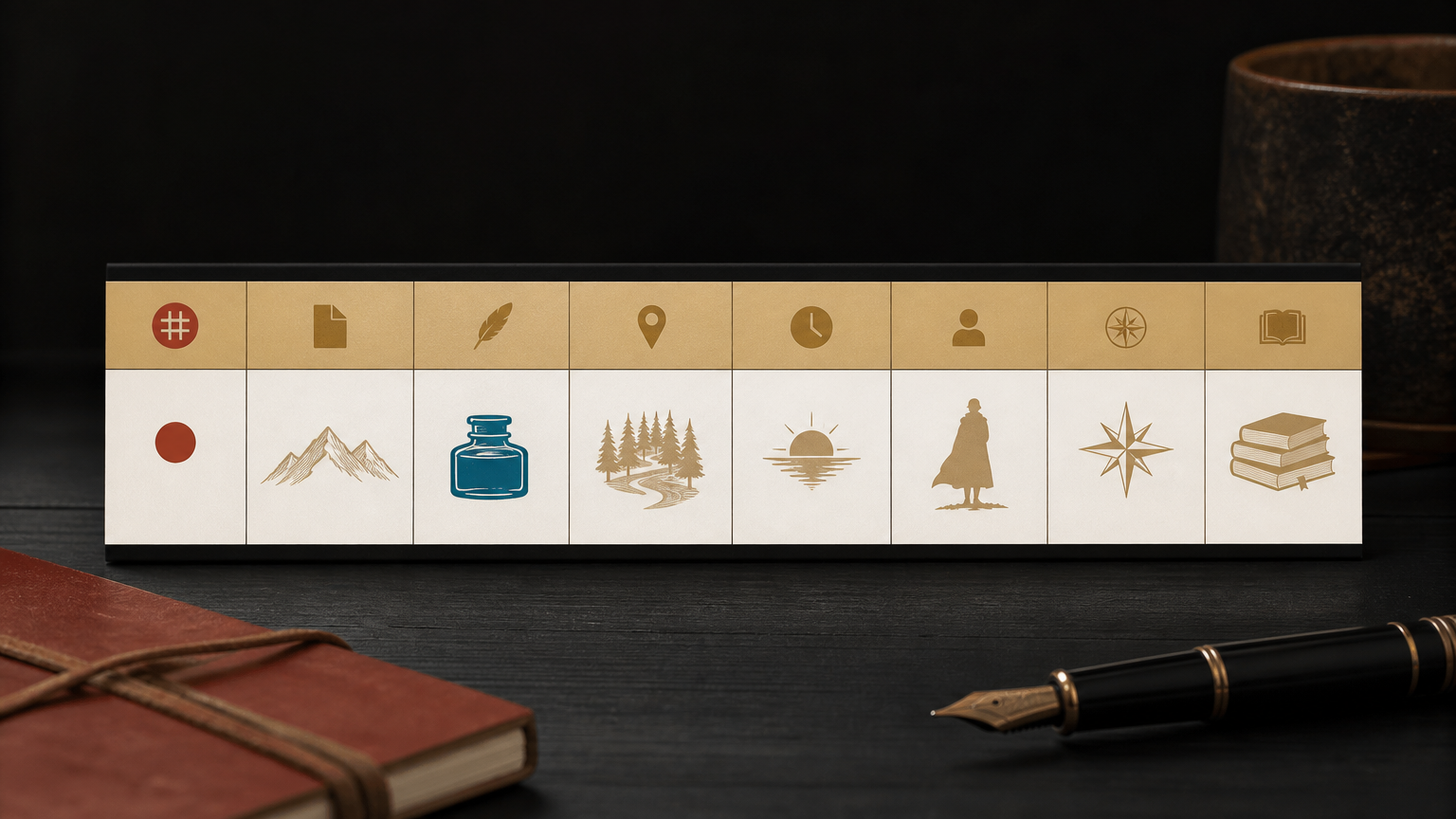 Two shapes work. Pick one; do not build both.
A minimal template (for plotters who prefer brevity)
The minimal version fits on a single index card or one row in a spreadsheet: chapter number, POV, one-sentence goal, one-sentence outcome, and word count target. That is it. This shape suits single-POV narratives with a clear linear arc, and writers who trust themselves to improvise the scene-level detail while drafting. If your protagonist is doing most of the heavy lifting alone, how to open a book with a character worth following pairs well with a minimal template.
An expanded template (for writers who need more scaffolding)
The expanded version adds: primary conflict or obstacle, emotional shift across the chapter, foreshadowing planted, callbacks resolved, and the open-questions field. This format suits multi-POV or multi-timeline novels where the reader is being asked to hold a lot at once. Reviewing why other characters are the real engine of change helps if your secondary POVs are still fighting for room.
Both shapes must be readable at a glance. If you cannot scan the whole outline in five minutes, it is too granular to be useful during a drafting session. Cut fields until the scan works. External resources like the Story Planner chapter plans library collect worked examples of both shapes if you want reference material.
Takeaway: minimal for linear single-POV, expanded for complex structures, and legibility beats completeness.
Troubleshooting Common Chapter Planning Problems
Four failure modes show up in almost every first-novel template. Diagnose and fix.
Symptom: every chapter feels like it has the same shape. Cause: no scene-level variation in conflict type. Fix: add a conflict category field (internal / interpersonal / external) and vary it deliberately across consecutive chapters. See hero and villain tension for how external conflict alternates with internal doubt.
Symptom: the midpoint chapter exists in the plan but feels hollow. Cause: the midpoint lacks a real reversal or revelation. Fix: ask what the protagonist now believes that they did not believe before, and write that sentence as the chapter purpose. The piece on writing twists and unexpected turns is useful for shaping the reversal.
Symptom: the outline keeps growing but writing never starts. Cause: perfectionism dressed as planning. Fix: set a date to lock the template and begin drafting with whatever exists at that point. Writers who tend to over-plan often benefit from a read of writing by the seat of your pants as a corrective.
Symptom: later chapters in the template are vague stubs. Cause: you have not solved the ending yet. Fix: work backwards from the last clear image and outline in reverse until the gap closes. The tiny final action that makes your novel memorable is a good prompt for finding that closing image.
Takeaway: vary conflict, sharpen the midpoint, lock the plan, and outline backwards from the ending.
How to Choose the Right Chapter Planning Format for Your Novel
Format is a personality question, not a craft one.
| Format | Best for | Strength | Weakness |
|---|---|---|---|
| Spreadsheet | Data-minded writers | Sort by POV or location instantly | Feels clinical |
| Index cards | Visual thinkers | Move scenes spatially | Fragile, hard to search |
| Dedicated writing app | Writers who switch contexts often | Outline and manuscript in one place | Learning curve |
Spreadsheets suit writers who think in rows and columns; sorting by POV reveals imbalances at a glance. Index cards on a physical board suit those who need to see the whole arc spatially. A dedicated writing tool that combines outline and manuscript reduces the friction of switching between planning and drafting, which is where most sessions leak time. If subplots keep sprawling in whatever format you pick, is your subplot trying to tell you something is worth a look.
Whatever format you choose, the template should live within arm’s reach of your draft. If consulting it feels like leaving the room, the format is wrong. Change it now, not on chapter twenty.
Takeaway: match the format to how you think, and keep it physically close to the draft.
Frequently Asked Questions
What fields should every chapter planning template include?
At minimum: chapter number, POV character, location, time stamp, one-sentence purpose, target word count, and status. Add scene-level goals and an open-questions field if you want a working outline rather than just a summary.
How detailed should a chapter outline be before I start writing?
Detailed enough to know the chapter’s purpose and outcome, loose enough to leave room for discovery. If every line of dialogue is planned, drafting becomes transcription. If nothing is planned, drafting becomes wandering.
Can I build a chapter planning template for a novel I’ve already started?
Yes, and it often surfaces structural problems the draft has been hiding. Reverse-outline what you have written, fill the template retroactively, and you will see repeated scene shapes and missing signposts almost immediately.
What is the difference between a chapter outline and a scene outline?
A chapter outline summarises the chapter’s purpose and outcome. A scene outline breaks that chapter into individual scenes with goals, conflicts, and outcomes. Most working templates nest scene outlines beneath each chapter entry.
How many chapters should a first novel have?
Divide your target word count by your genre-typical chapter length. An 80,000-word literary novel at 3,000 words per chapter runs roughly 25 to 30 chapters. Thrillers may double that; epic fantasy may halve it.
Should I complete the entire chapter template before writing chapter one?
No. Fill in the first three chapters in detail, sketch the structural signposts, and leave later chapters as stubs. Drafting teaches you what the later chapters actually need, and rigid plans rarely survive contact with real prose.
What is the best format for a chapter planning template: spreadsheet, index cards, or an app?
The one you will open tomorrow. Spreadsheets sort and filter; index cards move spatially; apps unify outline and draft. Try the format that matches how you already think, then change it if it stops helping.
How do I use a chapter template to track my writing progress?
Add a status column (Not started / In progress / Drafted / Revised) and a target word count. Update status at the end of each session. Momentum comes from watching entries move rightward across the tracker.
Conclusion
A chapter planning template is not a straitjacket; it is a milestone map. It shows you where the next turn sits, warns you when a chapter is drifting, and gives you the small satisfaction of marking work as drafted at the end of a session. Build the minimum viable version, test it on three chapters, and adjust. The template that finishes your first novel is almost never the one you started with. If you want a quiet, focused place to hold that outline alongside your draft, the ClearARC app is built for exactly that kind of work.