The three-act structure is one of the oldest frameworks in storytelling, tracing its roots back to Aristotle’s Poetics and still shaping novels, films, and plays written today. For a new novelist staring at a blank page, it offers something invaluable: a reliable map from opening scene to final chapter. ClearARC is built for writers who want that scaffolding without the noise. This guide explains what the three acts are, how they work, and how to put them to use in your own fiction.
Definition: What the Three-Act Structure Actually Is
The One-Sentence Definition
The three-act structure divides a story into three connected parts: the Setup (Act One), the Confrontation (Act Two), and the Resolution (Act Three). Each act carries specific dramatic work, and the transitions between them are marked by turning points rather than arbitrary chapter breaks. If you are new to structural thinking, a short primer like this walkthrough of the three-act model can help the labels stick.
In Plain English
Think of it as beginning, middle, and end, with rules about how one gives way to the next. Aristotle argued in his Poetics that stories must be a chain of cause-and-effect beats, never a string of isolated episodes. Screenwriter Syd Field formalized the modern labels in his 1979 book Screenplay: The Foundations of Screenwriting, and novelists have borrowed the vocabulary ever since. The structure is scaffolding, not a cage; it gives shape to material that would otherwise feel random. For a plain-language introduction aimed at first-time novelists, this explainer covers the same ground with a fiction lens.
How the Three Acts Work

Act One: The Setup
Act One establishes your main characters, the world they inhabit, and the shape of their ordinary life. Somewhere in the first quarter, an inciting incident disrupts that ordinary life and pushes the protagonist toward a decision. That decision leads to the first plot point, which closes Act One and raises the central dramatic question the rest of the book will answer. A strong opening asks the reader to invest in a person, not a premise, so opening with a character worth following matters as much as the incident itself.
Act Two: The Confrontation
Act Two is typically the longest stretch of the novel, often around half the total length. The protagonist tries to solve their problem and keeps making it worse, because they lack the skills, self-knowledge, or allies to succeed yet. Roughly at the halfway point, a midpoint shift raises the stakes; later, a “dark night of the soul” drives the protagonist to their lowest point before they find the resolve to press on. This is also where the character arc does its heaviest lifting, because internal change is what earns the eventual climax.
Act Three: The Resolution
Act Three answers the dramatic question. The climax brings the main tensions to their most intense point, and the falling action shows the protagonist and the people around them with a new sense of who they are. Endings often turn on a single decisive gesture, which is why writers pay so much attention to the small final action that makes a novel memorable. The point is not spectacle; it is meaning.
Takeaway: the three acts are joined by turning points, not chapter numbers. If you cannot name the incident that ends Act One, you probably have not written it yet.
A Concrete Worked Example

Mapping a Familiar Story to the Three Acts
Consider a story you already know: a young protagonist living an ordinary life discovers she has inherited a burden she did not ask for. Act One introduces her home, her routines, and the arrival of the burden itself. The first plot point is her decision to leave home, which makes returning to the old life impossible. Sketching this on paper before drafting is often easier with a simple story-structure template to keep the beats in view.
Act Two follows her escalating attempts to carry the burden. She gains allies, loses them, and reaches a midpoint where the true antagonist reveals himself. A crushing setback sends her into the dark night, and only then does she find the internal shift that lets her act. Along the way, the secondary cast pushes her forward, because other characters are the real engine of change in most novels; the protagonist rarely transforms alone.
Act Three answers the question the reader has been holding since the end of Act One: will she carry the burden through? The climax provides the answer, and the falling action shows how her world, and she herself, have changed. Every scene between the first plot point and the climax should either advance the plot or reveal character; anything else is filler, however lovely the prose. Writers who habitually plan their novels deeply find this filter easier to apply.
Takeaway: cause and effect is the connective tissue. Each scene must earn the next.
Why the Three-Act Structure Matters for Novelists
Credibility Across Genres
The three acts are not a screenwriter’s private tool. Literary fiction, thrillers, romance, and epic fantasy all lean on the same scaffolding, though they weight the beats differently. Romance often front-loads the meet-cute as the inciting incident; thrillers stretch Act Two into a corridor of escalating threats; fantasy uses Act One to build a world before disrupting it. Genres also share a common weakness, which is why comparing frameworks like the seven-point story structure alongside three-act thinking can sharpen your sense of pacing.
Common Misconceptions
Misconception: structure kills creativity. Reality: structure frees creative energy for character and prose. Writers who know what beat they are writing spend less time guessing and more time making sentences worth keeping.
Misconception: the three acts must be equal in length. Reality: Act Two is conventionally the longest, often around half the book. Equal thirds usually produce a rushed middle.
Misconception: three-act structure replaces every other framework. Reality: it happily layers with the hero’s journey, Save the Cat, Freytag’s pyramid, and Christopher Booker’s seven basic plots. Many working novelists use two or three models at once.
A saggy middle almost always signals a weak Act Two: insufficient escalation, a missing midpoint, or a subplot that never connects. Diagnostic thinking of that kind is one reason a wandering subplot is worth listening to rather than deleting outright.
Takeaway: the structure is a diagnostic tool as much as a drafting one. Use it on drafts that are not working.
How to Apply the Three-Act Structure to Your Novel
Start With Your Dramatic Question
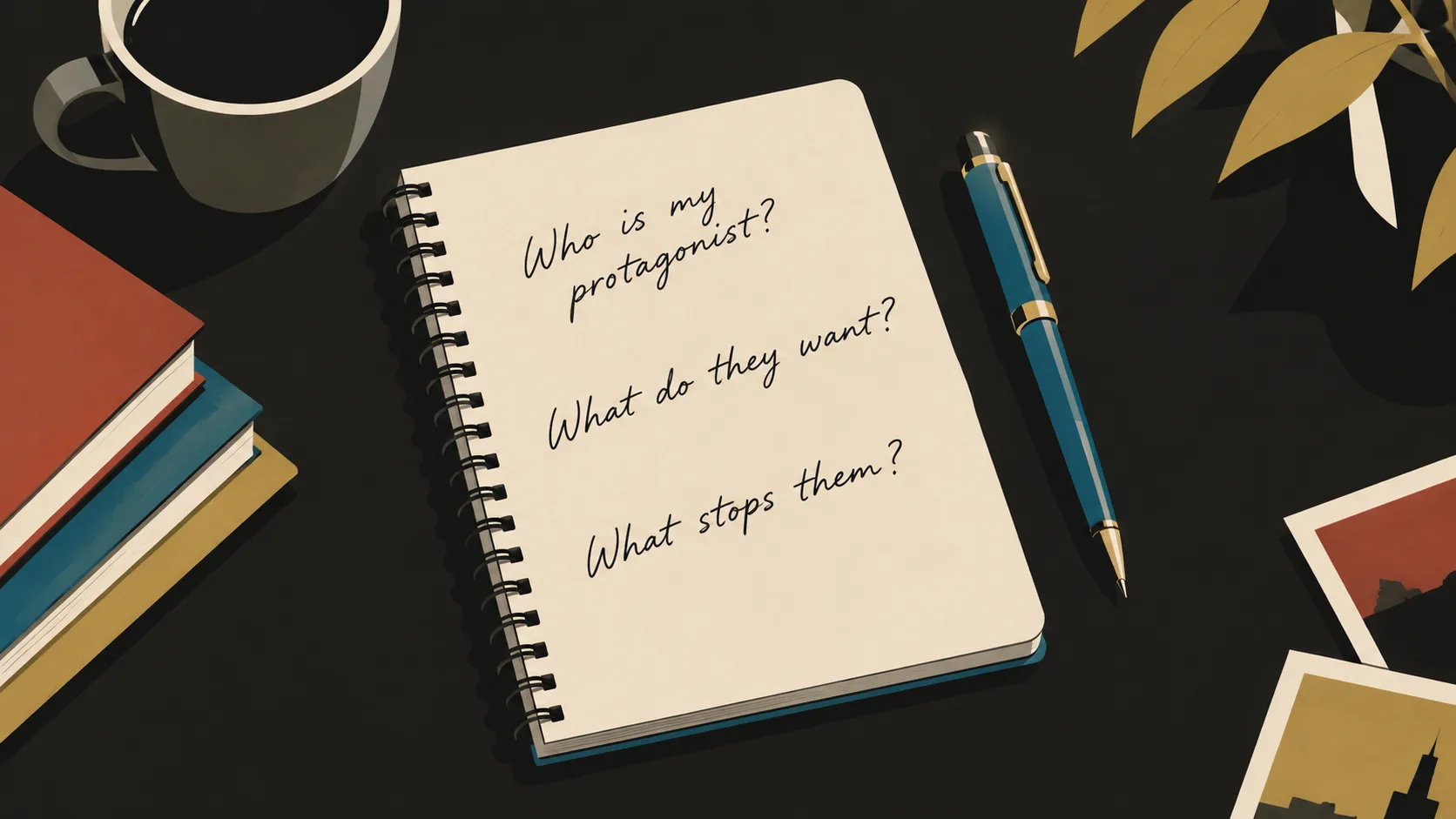
Before you draft, answer three questions on paper: who is the protagonist, what do they want, and what prevents them from getting it? Those three answers form the spine of your three acts. If your protagonist feels vague on the page, the fix is usually here, at the level of desire and obstacle, which is often why a protagonist reads as boring in early drafts.
Build Your Key Plot Points First
Sketch the four essential beats before you write a scene:
- The inciting incident that shakes the ordinary world.
- The first plot point that ends Act One and forces the protagonist forward.
- The midpoint that raises the stakes and reframes the story.
- The climax that answers the dramatic question.
Everything else hangs off these anchors. If you are working with a template, a three-act template built for novelists will give you rows to fill in for each beat rather than a blank page.
Using an Outline as a Working Document
An outline is a working document, not a contract. Most novelists change it substantially as they get to know their characters, and that is a good sign, not a failure. What the outline gives you is direction: each writing session begins with a clear destination, even if the route changes. Ask of every scene whether it moves the story forward or reveals character in a meaningful way; if it does neither, it is filler. Discovery writers can still use the model as a check after each chapter, which is one reason the pantser approach benefits from occasional structural review.
Takeaway: know how the book ends before you draft the middle. Direction is the single biggest gift structure gives you.
Related Concepts
Inciting Incident
The event in Act One that disrupts the protagonist’s ordinary world and sets the story in motion. It is not the same as the first plot point, which comes later and locks the protagonist into Act Two.
Midpoint
The scene near the center of Act Two that shifts the story’s terms, often by revealing new information or raising the stakes. Without a strong midpoint, Act Two sags.
Character Arc
The internal change a protagonist undergoes from Act One to Act Three. External plot and internal arc should turn on the same events, which is why writers spend so much effort on creating characters readers cannot stop thinking about.
Rising Action
The escalating sequence of obstacles across Act Two that pushes the protagonist toward the climax. Rising action is not just more events; it is events that cost more.
Conclusion
The three-act structure has shaped storytelling from Aristotle to contemporary bestsellers, and it endures because it matches how readers process cause and effect. Mastery does not come from memorizing labels; it comes from understanding why one act must give way to the next. Writers who internalize the framework find the blank page less daunting because they always know, at minimum, what kind of story moment they are writing toward. If you want a quiet drafting space that keeps your beats visible without adding noise, ClearARC was built with exactly that discipline in mind. Pick up a pen, pour the coffee, and put the first act on paper.
Frequently Asked Questions
What are the three acts in the three-act structure?
The three acts are the Setup, the Confrontation, and the Resolution. Act One establishes character and world, Act Two escalates conflict as the protagonist struggles, and Act Three delivers the climax and its aftermath.
How long should each act be in a novel?
Roughly one quarter, one half, and one quarter. Act Two is conventionally the longest, often around fifty percent of the total length, with Act One and Act Three sharing the remaining half between them.
Where did the three-act structure come from?
Aristotle described the principle of beginning, middle, and end in his Poetics in the 4th century BC. Screenwriter Syd Field formalized the modern Setup, Confrontation, and Resolution labels in his 1979 book Screenplay.
Is the three-act structure only for screenwriting or does it work for novels too?
It works for both. Novelists across literary fiction, thrillers, romance, and fantasy use the same three-act scaffolding, though they weight the beats differently. The structure describes narrative cause-and-effect, not medium.
What is the inciting incident and where does it appear in the three-act structure?
The inciting incident is the disruptive event that pulls the protagonist out of ordinary life. It usually appears early in Act One and triggers the chain of decisions leading to the first plot point that ends Act One.
What happens at the midpoint of a three-act structure?
The midpoint sits near the center of Act Two and shifts the story’s terms. New information, a reversal, or a raised stake reframes what the protagonist is fighting for and prevents the middle of the novel from sagging.
Can I use the three-act structure if I am a pantser (discovery writer)?
Yes. Many discovery writers use the model retrospectively, checking after each draft chapter that the beats are landing. The pantser’s tricky planning problem is often solved by structural review rather than heavy pre-outlining.
What is the difference between the three-act structure and the hero’s journey?
The three-act structure is a general scaffold of beginning, middle, and end joined by turning points. The hero’s journey is a more specific pattern of stages, such as the call to adventure and the return, that fits inside three-act thinking rather than replacing it.