
Plotting a novel for the first time can feel like staring at a blank map with no compass. The good news: every published author started in the same spot, notebook open, coffee cooling, wondering where the story really begins. The ClearARC app is built for writers who want a digital version to plan their stories without losing the spark that started them. Meanwhile, this guide walks you through plotting your novel step by step with pen and paper, from raw idea to a scene list you can actually write from.
Outcome: a working outline and scene list for your novel. Time: two to six focused sessions. Skill level: beginner.
What You’ll Need Before You Start

Plotting doesn’t require software or a shelf of craft books. It requires a place to think and a willingness to commit ideas to the page before they drift away. Before you dive into the numbered steps, gather your materials and decide, roughly, what kind of writer you want to be for this project. That decision shapes everything downstream, and it’s a decision most first-timers put off far too long, as this deep planning guide for novelists lays out.
Tools and materials
You need less than you think. A notebook you like writing in. A pen that doesn’t skip. A single document, folder, or app where scene notes live so they stop scattering across sticky pads and phone memos. If you prefer digital, pick something quiet and distraction-free rather than something crowded with widgets. A good story structure template can double as your scene tracker.
Beyond the physical kit, you need a rough sense of your story’s central tension: a protagonist, something they want, and something in the way. Even a single sentence works. Author Caroline Hardaker points out that most writers benefit from some form of outline, even if they later stray from it, and that observation is where most experienced novelists start.
The mindset shift: plotter vs. pantser
Writers generally fall into two camps. Plotters plan scene by scene before drafting. Pantsers discover the story as they write, following characters into rooms without knowing what’s inside. Most working writers land somewhere in the middle, and there’s no moral high ground on either side. If you’re not sure which you are, this breakdown of writing by the seat of your pants is a fair, warm read.
For this guide, assume the hybrid path. You’ll plan enough to have a spine, then leave enough air for surprises during drafting. Pure pantsing works for some, but it has real costs, laid out honestly in the obstacle most pantsers hit.
Before You Start: Back Up Your Ideas
Nothing to back up for this one in a technical sense. But the ideas themselves are fragile. Writers who skip capturing the early sparks often find, weeks later, that they can’t reconstruct the original energy of the concept. Put everything into one place from day one. A dedicated notebook. A single document. A folder in your writing app. The format matters less than the discipline of one home, which is the argument behind treating your novel like one field that holds the whole plot together.
Before formal plotting begins, run a short “story dump” session. Sit down for thirty minutes and write anything and everything about the idea: fragments of dialogue, half-formed scenes, character names, questions you can’t yet answer. This is a low-risk way to surface raw material. If openings feel intimidating, a dump session is often where the real first line quietly appears.
Step 1: Define Your Story’s Core
Write your one-sentence premise
The Snowflake Method, created by Randy Ingermanson, begins with exactly this: a single sentence summarizing the entire novel. From there you expand outward into paragraphs, character sheets, and a scene list. The one-sentence stage is deceptively hard, and worth the sweat. If you can write the back-cover blurb in a single line, you know what the book is about. This character arc primer is a useful sanity check on the premise.
Try this form: “A [character] who wants [goal] must [action] before [obstacle or stakes].” That’s it. Refine it until you can read it aloud without cringing. Force clarity now and you save yourself dozens of pages of drafting later, especially the kind of drafting where your protagonist starts to feel boring.
Identify themes and character arcs
Themes are the “about” beneath the surface: love, betrayal, survival, forgiveness. Even plot-driven genre fiction needs a thematic spine to give the ending emotional weight. Ask what point the story is quietly making. Then look at your protagonist and identify the lie they tell themselves at the opening; the arc is the slow demolition or reinforcement of that lie.
Every protagonist needs a clear goal and an obstacle that prevents easy achievement. Author Mary Adkins argues the gap between want and obstacle is where plot actually lives. Kurt Vonnegut’s “Shape of Stories” maps the emotional journey as a line graph of ups and downs. Try sketching your protagonist’s arc as a curve, marking where they rise and where they crash. It’s a fast diagnostic for whether your character actually changes, or just moves through events. For a deeper look, see why major characters need strong beliefs.
Step 2: Choose a Plot Structure

Pick one structure and commit for this draft. You can always break the frame later.
The Three-Act Structure
The Three-Act Structure divides the story into Setup (introduction, inciting incident, first plot point), Confrontation (rising action, midpoint, second plot point), and Resolution (climax, falling action, conclusion). It’s the workhorse. Most published novels sit on this skeleton, whether the author admits it or not. For a full walkthrough, this three-act structure explainer covers the beats in order.
The Hero’s Journey
The Hero’s Journey, popularized by Joseph Campbell, maps departure, initiation, and return. It shows up across myths, novels, and films because it mirrors how humans actually process change. If your story involves a protagonist leaving a familiar world and coming back altered, this is a natural fit. It pairs well with Christopher Booker’s seven basic plots, which offers another lens on the same instinct.
The Snowflake Method
The Snowflake Method scales especially well for stories with multiple POV characters, B-plots, or dense world-building, because it grows from one sentence into a full scene list incrementally. You never face a blank page; you only face the next expansion. If your book has subplots trying to tell you something, Snowflake gives them room to breathe.
The five classical plot elements, exposition, rising action, climax, falling action, and resolution, appear inside every structure listed above. They’re the common language beneath the labels. No structure is objectively correct. The right one is whichever keeps you moving forward instead of paralyzed by theory. Takeaway: pick one, name it out loud, and move on.
Step 3: Map Your Scenes and Build Momentum
List your major plot points
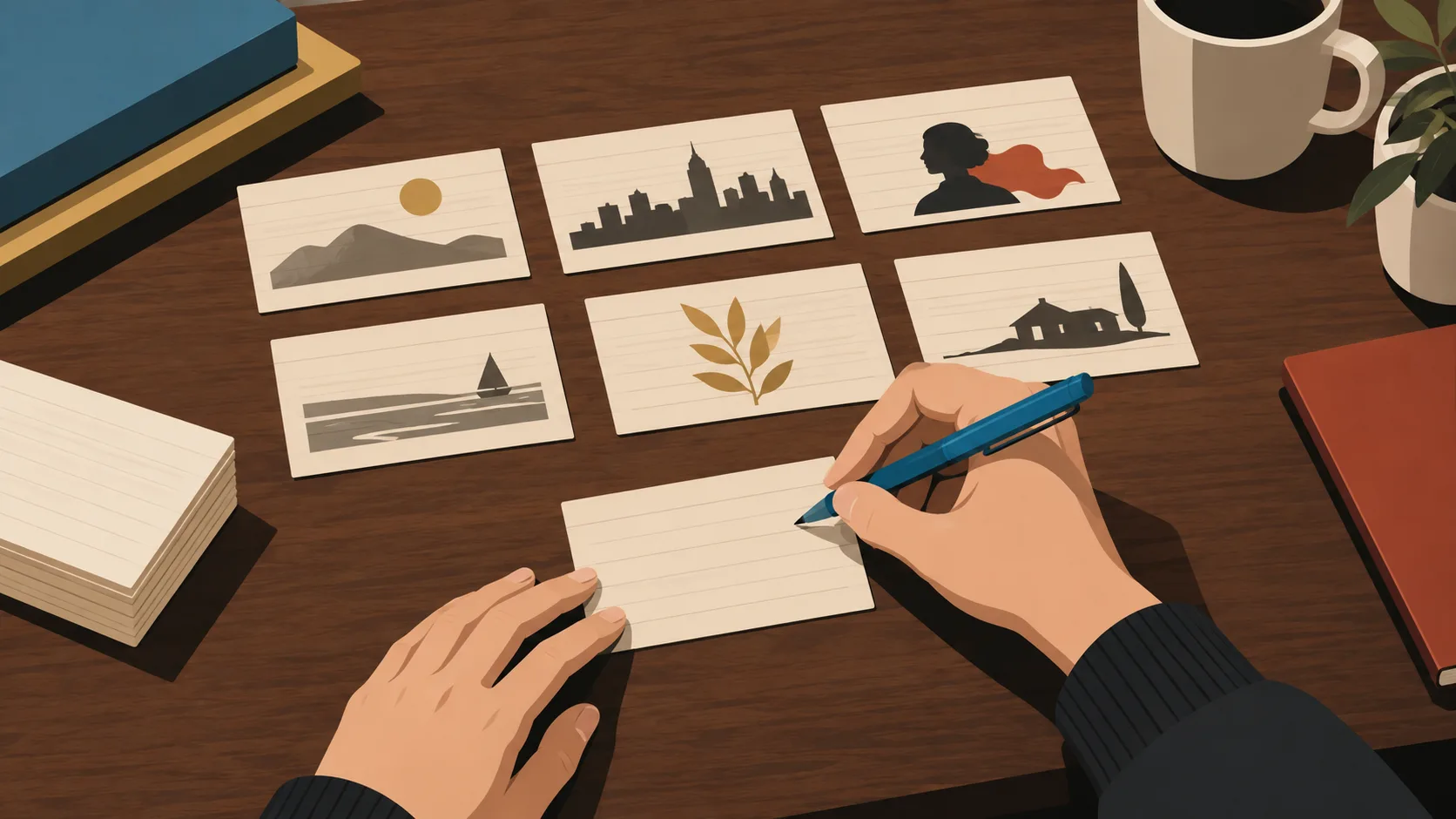
Open a fresh page and list the events you already know, in chronological order. Each one should be a turning point, a character shift, or a significant reveal. Don’t worry about gaps. The list will feel thin at first, then thicken as you work through it. This spine is what you return to when drafting loses direction, and it pairs naturally with a three-act structure template.
Planting tension and the unsatisfied want
Mary Adkins argues that a strong opening page establishes an unsatisfied want for the protagonist immediately, giving the novel an engine from page one. Make sure your first scene puts that want on the page, even if the want is as small as a glass of water they can’t reach. Then list every existing tension in your outline and mark the stretches where the story goes calm too long. Those calm patches are pacing problems in disguise. Fix them now, before the draft, using techniques from this hero-and-villain tension guide.
Ordering your scene list
Your scene list can be as simple as a numbered list of events, or as detailed as a spreadsheet with columns for POV character, location, goal, conflict, and outcome. Pick the level of detail that matches your patience. Structure should climb toward tension and a climax at every level: the whole novel, each chapter, each scene. That fractal logic is what keeps readers turning pages. For a practical trick on scene-to-scene pull, see looping techniques for pantsers. Takeaway: a scene list is a promise you make to yourself; the draft is the delivery.
Troubleshooting Common Plotting Problems
Every first novel wobbles somewhere. These are the four most common breakdowns and how to fix them at the outline stage, before they cost you weeks of drafting.
Plot feels flat or meandering
Symptom: the middle sags. Readers (and you) lose interest around chapter twelve. Cause: the protagonist’s want is too easily satisfied or temporarily forgotten. Fix: reintroduce a concrete obstacle that directly blocks the stated goal. Digression weakens plot; every scene should either move the story forward or deepen the reader’s understanding of a character. This is where twists and unexpected turns earn their keep.
Character doesn’t seem to drive the story
Symptom: the protagonist feels passive; things happen to them. Cause: external events shape the plot rather than the character’s decisions. Fix: trace each plot point back to a choice the protagonist makes, even a flawed one. If the answer is “they just react,” rewrite the beat. Support characters can help by pushing back, which is the argument in why other characters are the real engine of change.
Ending falls apart
Symptom: the climax feels unearned. Cause: it resolves a problem that wasn’t clearly set up in Act One. Fix: return to the inciting incident and verify the ending directly answers the question it raised. The final beat should echo the opening. For the smaller closing note that lingers, see the tiny final action that makes your novel memorable.
Themes feel preachy or invisible
Symptom: readers either notice the message too much, or not at all. Cause: theme was added after plotting rather than woven into character motivation. Fix: identify one value the protagonist holds at the start and show how the climax tests or changes it. Theme carried by character never feels preachy, which is what makes characters unforgettable.
FAQ: Frequently Asked Questions
What is the difference between plotting and outlining a novel?
Plotting is the creative work of deciding what happens and why. Outlining is the organizational act of writing those decisions down in order. You plot first, then outline. Most writers do both simultaneously without noticing.
How detailed should a novel plot outline be before you start writing?
Detailed enough that you know where the story is headed, loose enough that discovery is still possible. For most first-timers, that means a one-page synopsis plus a numbered scene list with a sentence per scene. Anything more risks over-planning.
Can I plot a novel if I’m a pantser?
Yes, and lightly plotting often helps pantsers finish. Try a “signpost” approach: identify the inciting incident, midpoint, and climax, then pants the connective tissue between them. You keep discovery without losing the ending.
What are the five elements of plot structure?
Exposition, rising action, climax, falling action, and resolution. These five beats show up in almost every story structure, from Three-Act to Hero’s Journey to Snowflake. They’re the shared vocabulary beneath the labels, useful for diagnosing any draft.
How long does it take to plot a novel?
Anywhere from a weekend to several months, depending on your process and the complexity of the book. Two to six focused sessions is realistic for a first-timer using this guide. Don’t confuse plotting time with procrastination time.
What is the best plot structure for a first-time novelist?
The Three-Act Structure, without hesitation. It’s simple, widely understood, and forgiving. Once you’ve drafted one novel on that skeleton, you’ll have the instincts to try Hero’s Journey or Snowflake on the next book without getting lost.
How do I plot a novel with multiple POV characters?
Use the Snowflake Method. Its incremental expansion handles multiple characters and B-plots cleanly. Build a separate scene list per POV, then interleave them chronologically. Watch for chapters where a POV drops out for too long, which usually signals a structural problem.
What should I do if my plot falls apart mid-draft?
Stop drafting. Return to your outline and find the last scene that felt right. Ask what changed after that: did the protagonist stop wanting something, or did an obstacle vanish? Fix the outline first, then resume writing. Don’t push through blind.
Wrapping Up
Plotting a novel is craft, not magic. You define the core, choose a structure, map the scenes, and troubleshoot the wobbles before they become rewrites. Do that with patience and a decent notebook and you’ll have a draft worth revising. When you’re ready to move from planning to writing, ClearARC gives you a quiet, no-AI space to keep the whole plan in one place. Now close the tabs, open the notebook, and start.