
Bring fiction to life by choosing specific verbs and nouns, selecting a few sensory details, showing emotion through action, and matching how much you describe to how much it matters to the story. At ClearARC we care about getting your own words onto the page, and the steps below take one drafted scene from flat to vivid. Skill level: beginner to intermediate. If you are still finding your feet, our guide to help writing a book for first-time novelists sits well alongside this one.
What you’ll need
 1. A scene you have already drafted. One page is plenty. Description is easier to fix than to invent from nothing.
- Pen and paper, or a document. Either works. Print the scene if you edit better on paper.
- A highlighter, or a highlight colour in your document.
- Optional: the free First-Novel Finisher’s Kit, which includes a one-page plan, a chapter-planning grid, a seven-plots cheat sheet and a series of emails, and needs only pen and paper.
Next step: pick the scene now. Choose one that feels dull to you; it will show the biggest change.
Before you start
Decide whose point of view the scene sits in and the one emotion it must carry. Description changes with viewpoint: a nervous character and a bored one notice different things in the same room, so fix this first or you will rewrite twice. Then save a copy of the original draft so you can compare versions at the end.
Next step: write the viewpoint character and the emotion at the top of the page.
Step-by-step: rewrite a flat scene
 Work through these in order. Each step ends with a check so you know it worked.
1. Highlight every vague word
Read the scene and highlight words that could describe almost anything: nice, really, very, good, beautiful, things, went, looked. The BBC Bitesize guide to descriptive writing points out that the first words that occur, such as “nice” and “really”, are not always the most interesting.
Check: you have at least a handful of highlights. If you have none, you are reading too kindly. Try again tomorrow.
2. Swap in specific verbs and nouns
Replace each highlight with a word that only fits this moment. Favour verbs over adjectives. Here is the worked example we will carry through the next steps.
Example: imagine a scene where Ellen, a widow, eats dinner alone for the first time since her husband died.
- Draft: “Ellen had a really nice dinner but she was sad.”
- Pass one, word choice: “Ellen ate her roast chicken, but she was sad.”
This follows the BBC Bitesize pattern of turning “We had a really nice dinner” into “We enjoyed a tasty meal”. Specific nouns (roast chicken) and a plain verb beat the vague pair.
Check: no highlighted word survives unless you chose to keep it deliberately.
3. Pick two or three senses, not all five
Sight is the default. Add one or two other senses that suit the emotion. Advice shared on Reddit’s r/writing recommends using the five senses selectively, where they genuinely add to a scene. For Ellen, sound and smell carry loneliness: the scrape of one knife, the smell of chicken cooked for two.
Check: count the senses in the paragraph. Two or three is right; five usually reads like a list.
4. Show the feeling through action
“She was sad” is a label. Famous Writing Routines contrasts “She was sad” with a tear trickling down a cheek and slumped shoulders. Let the body and behaviour do the work.
- Pass two, show don’t tell: “Ellen carved the roast chicken into two portions out of habit, then slid the second slice back into the tin. Her knife scraped the plate, the only sound in the kitchen.”
The word sad has gone. The reader feels it anyway.
Check: cover the emotion word. Can a reader still name the feeling? If yes, delete the word.
5. Match the amount of detail to importance
Readers treat whatever you describe at length as important. Mary Kole of Good Story Company gives the example of a cookie described over three paragraphs that never returns to the story, leaving readers puzzled. So ask what in Ellen’s scene matters. The second portion does. The tablecloth does not.
- Pass three, proportion: “Ellen carved the chicken into two portions out of habit. She looked at the second slice for a long time: the crisp edge he always took, the pale meat underneath. Then she slid it back into the tin. Her knife scraped the plate.”
The second slice now gets the most words because it carries the story.
Check: the longest description in the scene belongs to the detail that matters most.
6. Zoom in and out
Writing.ie’s descriptive tips mention adding layers and zooming in and out. Open wide (the kitchen, the evening), then close in on one object, then pull back. In our example, a final line could pull back: “Outside, the street lamps came on one by one.”
Opening lines work the same way. BBC Bitesize notes that a strong first paragraph gives enough detail for a sense of place without telling everything at once. If you are starting a fresh scene, begin close on one concrete detail, then widen.
Check: your paragraph moves between at least two distances.
7. Read it aloud and cut
Read the rewrite out loud. Anything you stumble over or skip, cut. Tighter almost always reads better. Stephen King has strong views on trimming too; see our Stephen King writing tips for novelists.
Check: the final version is no longer than it needs to be, and you can read it without tripping.
Next step: put the original and final versions side by side. That gap is your proof the method works on your own pages.
Link description to your character’s arc
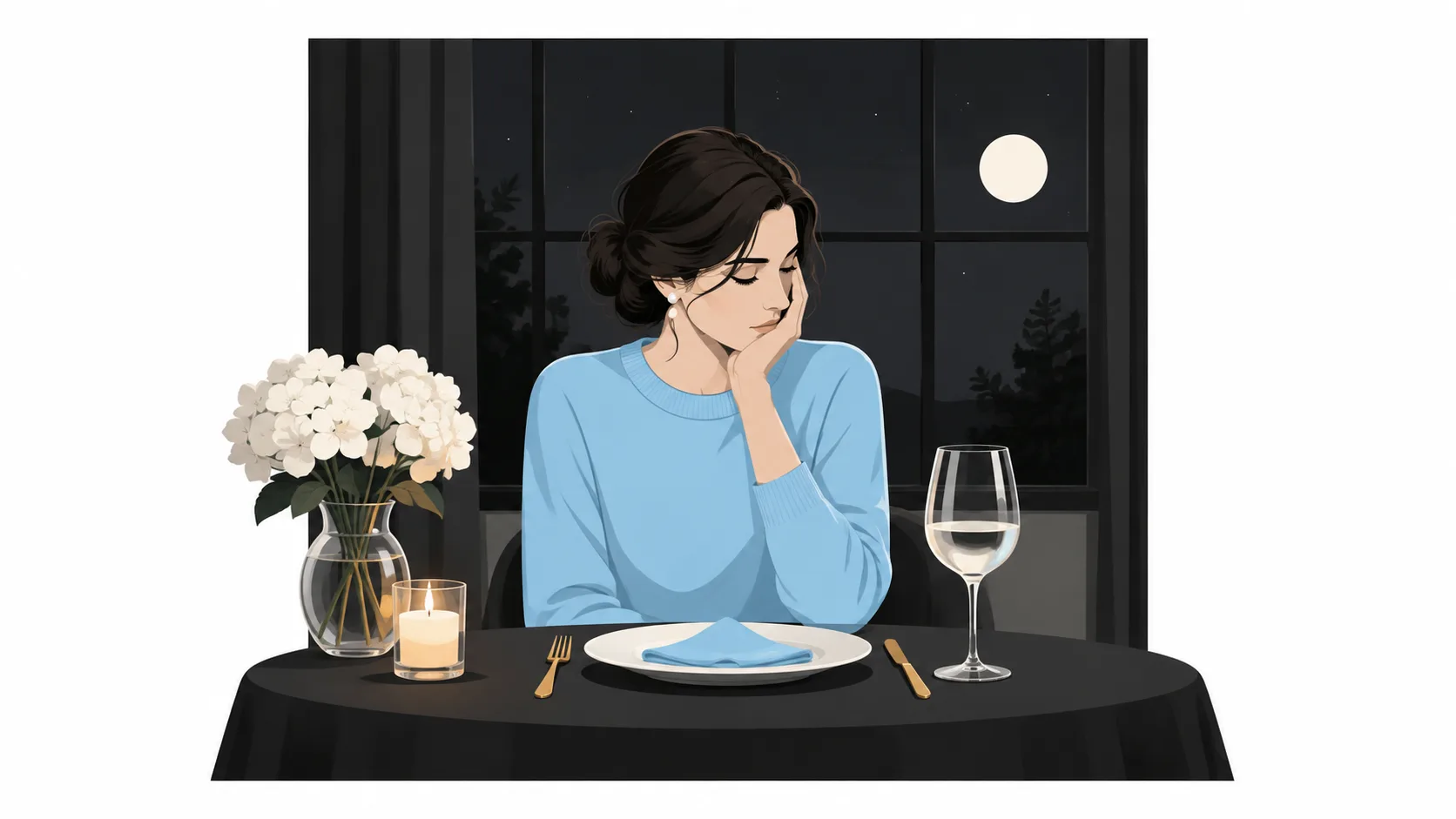 Here is what most descriptive advice skips. What a character notices should come from who they are at the start and what they want. Ellen notices the second slice because her internal starting position is grief, and her arc, perhaps, is learning to live alone. A character arc, step by step, is what links that starting position to the final chapter. By the final chapter she might notice something else in the same kitchen: a new plant, the radio. The setting stays; her attention shifts.
Try this:
- Write your character’s internal starting position in one line.
- Write their external goal in another.
- In each key scene, choose one detail they notice that reflects where they are on that journey.
For more on building that inner life, read about developing compelling characters in fiction. If you want to see how those internal shifts line up with turning points, three-act story structure is a useful frame, and writing twists and unexpected turns shows how planted details can pay off later.
If you plan digitally, a character planning view that keeps each character’s internal starting position and external goal side by side helps, as does an arc tracker that plots the internal shift against plot points. It is a tool, not a teacher; the craft is still yours.
Next step: choose one recurring object in your novel and decide how your lead sees it in chapter one and in the last chapter.
Troubleshooting

Symptom: the scene reads like a list of adjectives
- Cause: adjectives are doing work verbs should do.
- Fix: replace two adjectives with one precise verb. “The old, creaky door opened slowly” becomes “The door groaned open.”
Symptom: readers skim your description
- Cause: every detail gets the same weight, so none stands out.
- Fix: apply the cookie rule. Cut description of anything that never matters again and spend the words on the one detail that does.
Symptom: a detail never pays off
- Cause: you described something at length and forgot it.
- Fix: either bring it back later or shrink it to a phrase. A beat sheet for fiction writers helps you note where a planted detail should return.
Symptom: the opening feels generic
- Cause: it starts wide and vague, such as weather or a general setting.
- Fix: open on one concrete, slightly strange detail that gives a sense of place and raises a question. Hold back the rest. If the blank page itself is the problem, our guide to overcoming writer’s block on a first novel may help.
Next step: pick the symptom that sounds most like your draft and fix one scene today.
FAQ: Frequently Asked Questions
How can I start descriptive writing?
Start with one concrete detail your viewpoint character notices, then widen out. Give enough to set the place and raise a question, but hold back the rest so readers want to keep going.
What are the five writing strategies?
Lists vary, but for description the useful five are: specific word choice, selective sensory detail, showing rather than telling, matching detail to importance, and zooming in and out between wide and close views.
What are 10 descriptive words?
There is no fixed list. Strong descriptive words are specific to the moment: scraped, groaned, damp, crisp, flickered, sour, tin, lamplit, slumped, hissed. Choose words that only fit your scene, not words that fit anything.
How do I write a story in English?
Plan a simple shape with a beginning, rising tension, a turning point and a resolution. Draft quickly, then revise description using precise verbs, a few senses and action that shows feeling.
How much description is too much?
Too much is when description outweighs the detail’s importance. Readers assume whatever you linger on matters. If an object never returns or changes anything, trim it to a phrase or cut it.
Should I use figurative language?
Yes, sparingly. Imagery, sensory detail and figurative language such as simile and metaphor are all standard descriptive techniques. Use a comparison when it sharpens the picture or reveals character, not as decoration.
Conclusion
Description is not about more words. It is about the right ones in the right places. Swap vague words for specific verbs and nouns, use two or three senses, show feelings through action, and give the most words to what matters most. Then tie what your characters notice to how they change. Shape the scenes around a clear spine with our story writing structure guide for beginners. Pick a scene and start the first pass today.