Tag: story structure

  • What Is A Character Arc? A Guide For First-Time Novelists

    What Is A Character Arc? A Guide For First-Time Novelists

    A character arc is the change a character goes through over the course of a story. Usually it is the protagonist moving from one outlook or personality trait to another in response to what happens in the plot. That sounds simple. Getting it believable on the page is the hard bit, and it is where many first drafts wobble. This guide from ClearARC gives you the definition, the mechanics, and one worked example you can copy tonight.

    Definition: what a character arc is
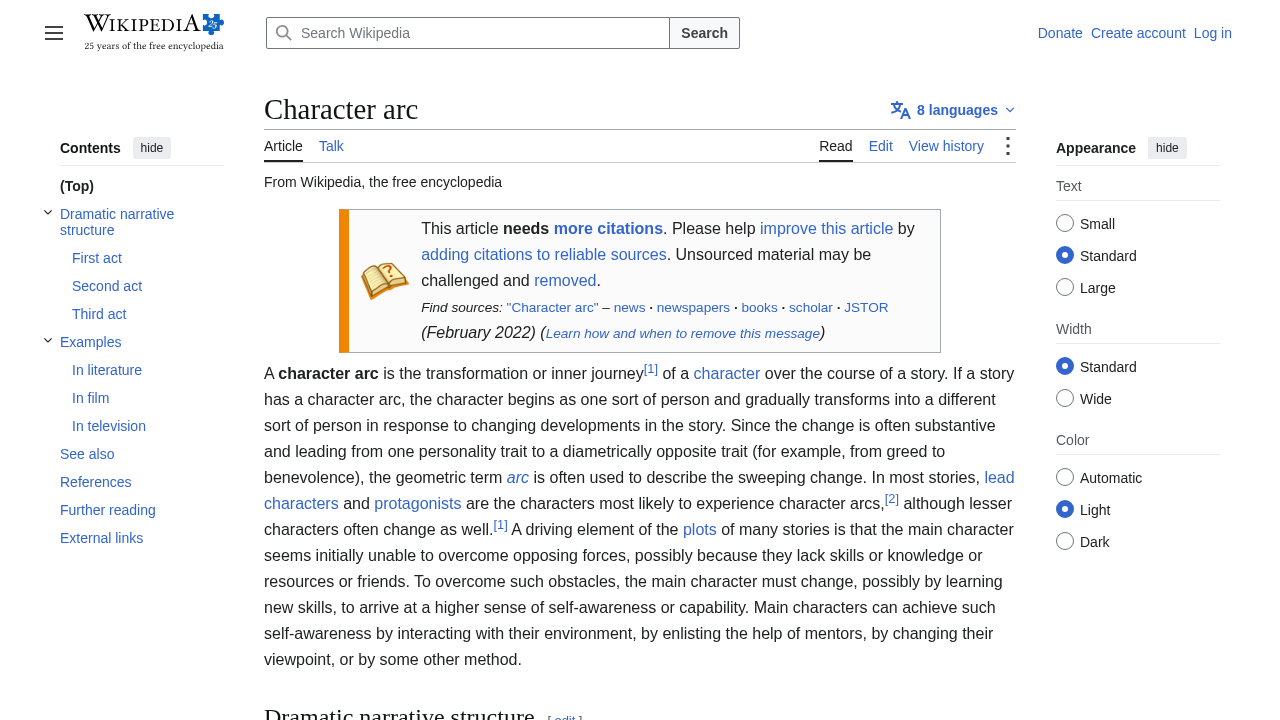
    en.wikipedia.org page screenshot

    A character arc is the transformation, or inner journey, of a character across a story. According to Wikipedia’s entry on character arcs, the character begins as one sort of person and gradually becomes a different sort of person as events unfold, often moving from one trait to its opposite, such as greed to benevolence. Editor Nathan Bransford describes it as change over a story’s course, whether positive growth or negative descent.

    In plain language: an arc is who your character is on page one, compared with who they are on the last page, and why.

    Other words you will see for it: transformation, inner journey, character growth. Keep it apart from the plot arc. The plot arc is what happens. The character arc is what those events do to the person living through them. Protagonists are the characters most likely to carry an arc, though side characters often change too.

    Takeaway: write one sentence describing your protagonist at the start and one at the end. If the two sentences match, you have a steadfast character or a problem. Decide which.

    How a character arc works

    Pencil and sketchbook representing how a character's arc develops through story pressure

    Arcs do not appear because you announce them. Editor September C. Fawkes makes the point that an arc comes out of the story rather than being stuck on top of it. The mechanism runs roughly like this:

    1. Starting belief. The character holds a view of themselves or the world. Often it is a flaw or a limitation.
    2. External goal. They want something concrete: a job, a rescue, a win.
    3. Pressure from the plot. Opposition gets in the way, and each setback costs more than the last.
    4. Crisis. The old belief stops working. The character has to choose.
    5. Changed or steadfast end. They either change, or they hold firm and the world around them changes instead.

    Internal start and external goal

    The trick for a first novel is keeping two lines apart: the inner one (what they believe) and the outer one (what they chase). Mash them together and your draft drifts. If you would rather work out the gap on paper first, read up on the gap between want and need.

    A worked example: planning one character

    Here is an invented character. Assume a contemporary novel, set in a seaside town, roughly 80,000 words, told in three acts.

    LineStart of storyPressureEnd of story
    Internal starting positionMaggie believes asking for help makes her weakHer bakery floods; she refuses her sister’s offerShe asks for help in public and keeps her dignity
    External goalKeep the bakery open through winterDebts pile up; a chain café opens across the roadThe bakery survives, run as a shared venture

    Look at the two rows. The outer goal could succeed while the inner belief stays stuck, which would make a flatter book. The arc lives in the top row. The plot in the bottom row exists to squeeze it. For more on what a character tells themselves at the start, see the lie your character tells themselves.

    Takeaway: fill in the two-row table for your protagonist before you draft chapter three.

    Why character arcs matter

    Reader absorbed in a novel, showing why character change keeps readers engaged

    Three reasons, and none of them is about ticking a craft box.

    • Readers invest in change they can track. Writing coach Rebecca Pickens compares it to hearing stories from someone you love: you remember who they were, you see how they have changed, and you care who they will become. A clear arc gives readers that view of your character.
    • The climax has to be believable. The Odyssey Writing Workshops note that most writers know the main character should change, but making that change believable is far harder than it looks, and it is where many stories fail. A planned arc gives the climax somewhere to land.
    • Arc carries theme. Script Reader Pro ties character arc to theme and three-act structure. Fawkes adds that how a character responds to struggle puts a value on a belief system. Your arc is your argument.

    If you want strong characters before you worry about arcs, start with developing compelling characters in fiction.

    Takeaway: write down the belief your ending rewards. That is your theme, and your arc should prove it.

    Common misconceptions

    Misconception: every character must change

    Reality: Script Reader Pro points out that James Bond does not have much of an arc, and neither does Mavis in Diablo Cody’s Young Adult. Fawkes lists steadfast arcs among her four basic types: a character who holds firm while pressure tests them.

    Misconception: arc and development are the same thing

    Reality: a widely shared distinction on Reddit’s r/writing puts it well: the arc is the overall transformation, while development is the building of depth and detail. You can develop a character richly who never transforms.

    Misconception: an arc is always positive

    Reality: arcs can go downhill. Bransford’s definition covers negative descent, and Fawkes counts changing negatively as one of the four types. Tragedy runs on it.

    Misconception: a character chart is an arc

    Reality: the Odyssey Writing Workshops warn that character sketches and charts usually describe a static character, not a conflicted, changing one. Eye colour and favourite food tell you nothing about the turn at the climax.

    Takeaway: if your character plan is mostly a chart, add one line: what does this person believe on page one that the story will test?

    Related concepts

    Character development

    The depth you give a character: history, habits, voice. It supports the arc but is not the arc. See how to create unforgettable characters.

    Positive and negative arcs

    A positive arc moves a character towards a better belief; a negative one moves them into decline. Our piece on the negative character arc explained covers the corruption version.

    Steadfast arc

    The character’s core belief holds under pressure. Change still happens, usually in the people or world around them.

    Plot arc and structure

    The shape of events, often in three acts. Wikipedia notes that character arcs often unfold beside the narrative arc across those acts. Our guide to three-act structure explains the beats.

    Want versus need

    What the character chases versus what they lack. Script Reader Pro treats outer goal and inner goal, want and need, as labels for the same idea.

    Takeaway: pick one related term above and write a single sentence about how it shows up in your book.

    How to get started

    Do just enough planning to keep moving. Four actions:

    1. Write two lines for your protagonist. One for the starting belief, one for the external goal. Keep them separate.
    2. Pick one of the four arc types. Change positively, change negatively, stay steadfast positively, or stay steadfast negatively, as Fawkes sets them out. If you are unsure, build a character arc template and test each option.
    3. Map it to three acts. Where is the belief set up, where does it crack, where is it resolved? Our walkthrough of how to plot a novel step by step helps here.
    4. Grab the free kit. The free First-Novel Finisher’s Kit contains a one-page plan, a chapter-planning grid, a seven-plots cheat sheet and a series of emails. It needs only pen and paper.

    Takeaway: do step one now. Two lines. Five minutes.

    FAQ: Frequently Asked Questions

    What is an arc in a plot?

    A plot arc is the shape of events from setup to resolution, often across three acts. A character arc runs beside it, tracking how those events change the person living through them, rather than the events themselves.

    What is another word for character arc?

    Common alternatives are transformation, inner journey and character growth. Wikipedia describes the arc as the transformation or inner journey of a character over a story, so those terms are used fairly interchangeably by writers.

    What are the best character arcs?

    The best arc is the one your plot pressure can believably produce. Classic examples include Scrooge’s turn from miser to generous employer, while Bond shows that a steadfast lead can also work well.

    What does development arc mean?

    It usually means the arc of a character’s growth. Strictly, development is the depth and detail you build into a character, while the arc is the overall transformation across the story. Keep the two ideas apart.

    Does every protagonist need a character arc?

    No. Script Reader Pro cites James Bond as a protagonist with little arc. Steadfast leads hold their belief under pressure. Most novels still benefit from a changing protagonist, especially first novels built around inner conflict.

    How many types of character arc are there?

    September C. Fawkes sets out four basic types: change positively, change negatively, remain steadfast positively, and remain steadfast negatively. Others group them as three: positive, negative and flat. Both models describe the same territory.

    Conclusion

    A character arc is change you can track: a belief at the start, pressure in the middle, a choice at the end. Keep the inner line and the outer goal apart, and the climax has something real to resolve. That is the craft, and it is yours. ClearARC is a no-AI tool built by Quentin Pain to plan, plot, write and publish a book. It holds your plan; the sentences stay yours. Next step: fill in those two lines for your protagonist, then write the next scene.

  • Negative Character Arc Explained: The Corruption Arc

    Negative Character Arc Explained: The Corruption Arc

    A negative character arc is a change for the worse: the protagonist starts with a belief or denial, never confronts it, and is damaged or destroyed by it, as with Anakin Skywalker or Dorian Gray. The corruption arc is the version where the character is gradually pulled into that fall. Most guides stop at the definition. This one walks a fall through five beats you can plan before chapter one, the same way ClearARC keeps belief and goal side by side.

    Definition: what a negative character arc is

    Notebook with a line of writing beside tea, representing defining a character's lie

    A character arc is the shape of the inner journey a character takes across the story. In a negative arc, the character ends the novel worse than they began. They reject the truth in favour of a lie, never overcome the lie they started with, or discover something even worse, and that choice leads to their downfall.

    In plain language: your character believes something false, keeps believing it, and it ruins them.

    Set it beside the other two shapes. In a positive arc the character lets go of the lie and grows. In a steadfast arc the character already holds a truth and changes the world around them instead. The negative arc is the one where the lie wins. If you want the groundwork first, read our character arc basics.

    Next step: write one sentence naming the lie your character starts with.

    How a corruption arc works, step by step

    Schoolteacher's hands on a worn register, showing a character drawn into compromise

    A corruption arc runs on two tracks. The internal track is what the character believes. The external track is what they want to get done. The fall happens when chasing the goal keeps feeding the belief. Kingdom Pen’s guide to character arcs frames the negative arc as a character grappling with a Lie, and names Anakin Skywalker as a classic case.

    Anakin shows the pattern clearly. He wants to stop the people he loves from dying. He believes he can control that outcome if he gains enough power. Each step towards the goal costs him a little more of himself, until the cost is everything.

    A worked example: five beats of a fall

    Example: imagine a novel about Ruth, a village schoolteacher in 1950s Yorkshire. Assume she is the protagonist, the story is told mostly from her point of view, and the book ends with her alone.

    1. Internal starting position. Ruth believes that respect must be earned by being needed. If nobody depends on her, she is nothing.
    2. External goal. She wants to keep the village school open when the county threatens to close it.
    3. First compromise. She inflates the attendance register by two names. Small. Defensible. It works, and the belief gets stronger.
    4. Point of no return. An inspector spots the gap. Ruth blames a young colleague, who is dismissed. She could confess here. She does not.
    5. Final cost. The school survives, but the village learns the truth. Ruth keeps the building and loses every person who once needed her.

    Notice how each beat ties back to beat one. The goal never changes; the belief simply grows teeth. Keeping the internal start and the external goal on separate lines makes this easier to see, which is why a planning view that holds them apart helps.

    Takeaway: write the final cost first, then work backwards to the first compromise.

    Why negative arcs matter for your novel

    A negative arc earns its place when the story is about consequence. Three uses come up again and again.

    • Tragedy. Dorian Gray trades his soul for youth, and the novel is the bill arriving. Clovis Editorial describes negative arcs as all about self-destruction.
    • The villain-protagonist. Magneto is a strong example: a reader can follow his reasoning while dreading where it goes.
    • The cautionary tale. Anakin’s fall warns against fear dressed as love. Readers recognise the temptation, which is what makes it sting.

    There is also a neighbouring route. In a disillusionment arc, the character learns a painful truth that shatters their beliefs. They see clearly, but seeing hurts. It can sit close to a fall without being one.

    For more cases worth studying, see our character arc examples for novelists.

    Next step: decide which of the three uses your book is closest to.

    Common misconceptions about negative arcs

    Misconception: a negative arc means a villain / Reality: protagonists can fall

    Anakin and Dorian Gray are both protagonists. The fall belongs to the person we follow. Takeaway: keep your fallen lead at the centre of the story.

    Misconception: the character must be unlikeable / Reality: readers follow the temptation

    Readers stay because the first compromise looks reasonable. Ruth’s two fake names feel almost kind. Takeaway: make beat three something a decent person might do.

    Misconception: every character needs an arc / Reality: often only the protagonist changes

    Clovis Editorial notes that often only the protagonist goes through a dramatic change. Supporting characters can push, though; see why other characters are the real engine of change. Takeaway: give one character the fall, and let others apply pressure.

    Misconception: it is just a positive arc backwards / Reality: the Lie wins

    A negative arc is not growth run in reverse. It is the same lie meeting the same chances to let go, and refusing each time. Takeaway: build moments where the truth is offered and turned down.

    Related concepts

    Positive arc

    The character starts with a lie, confronts it through internal and external conflict, and ends changed for the better. Clovis Editorial calls it the most common arc in novels.

    Steadfast arc

    The character holds a truth from the start and keeps it, changing the world rather than themselves. It is sometimes called a flat arc.

    Disillusionment arc

    A character realises a painful truth that breaks what they believed. Helping Writers Become Authors explores this in its piece on the disillusionment arc.

    The Lie

    The false belief at the heart of an arc. In a fall, it is never surrendered. See our piece on the lie your character tells themselves.

    Want versus need

    The want is the external goal; the need is the inner change they should make. A corruption arc widens the gap between want and need until it swallows them.

    Next step: label your character’s want and need on one line each.

    How to get started

    Blank paper with three pencil lines, representing starting a character arc plan

    You do not need a big plan. You need three lines on paper.

    1. Write the starting belief. One sentence, in the character’s own voice. “If nobody needs me, I am nothing.” Strong beliefs drive strong falls; read why your major characters need strong beliefs.
    2. Pick one external goal. Concrete and visible. Keep the school open. Win the seat. Save the farm.
    3. Plan the fall in a grid. Put the five beats against your chapters so you know roughly where the first compromise and the point of no return land. Our guide on how to build a character arc template for your novel shows the method.

    If you prefer paper, the free First-Novel Finisher’s Kit needs only pen and paper and includes a one-page plan, a chapter-planning grid, a seven-plots cheat sheet and a series of emails.

    Next step: fill in beat one and beat five tonight, then stop.

    FAQ: Frequently Asked Questions

    What is a negative character arc?

    It is a change for the worse. The character starts with a lie or denial, never overcomes it, and is damaged or destroyed by it. Anakin Skywalker and Dorian Gray are the classic examples.

    What are some good character arcs?

    Bilbo Baggins grows into courage in a positive arc. Katniss Everdeen holds her truth in a steadfast arc. Anakin Skywalker, Magneto and Dorian Gray show how a negative arc can be just as memorable.

    What are the three types of character arc?

    Positive, steadfast and negative. A positive arc changes the character for the better, a steadfast arc keeps them true while the world changes, and a negative arc changes them for the worse.

    What is the difference between a corruption arc and a disillusionment arc?

    In a corruption arc the character clings to a lie and falls because of it. In a disillusionment arc the character learns a painful truth that shatters their beliefs. One refuses the truth; the other is broken by it.

    Does a negative arc need a villain?

    No. The fall comes from the character’s own lie. An antagonist can add pressure, but the protagonist does the damage. Often the fallen protagonist becomes the story’s real threat by the end.

    Can a negative arc still have a satisfying ending?

    Yes. Satisfaction comes from inevitability, not happiness. If every beat traces back to the starting belief, readers feel the ending was earned, even when the character loses everything they wanted to keep.

    How do I plan a fall arc in a first novel?

    Write the starting belief, pick one external goal, then map five beats: belief, goal, first compromise, point of no return, final cost. Write the final cost first and work backwards to the start.

    Conclusion

    A negative arc is simple at its core: the lie wins. Give your character a belief worth defending, a goal worth chasing, and a chance to turn back that they refuse. Plan the five beats, then go and write the chapters. ClearARC is a no AI app to plan, plot, write and publish a book, made by Quentin Pain. It holds your plan; the sentences stay yours.

  • How To Build A Character Arc Template For Your Novel

    How To Build A Character Arc Template For Your Novel

    Build a character arc template by giving your protagonist an internal starting position, an external goal, a turning point at each act and an ending state, then checking each box against a plot event. That’s it. It’s written for first-time novelists, the writers ClearARC is built for, and you need nothing more than a pen.

    What you’ll need

    1. Pen and paper, or the free First-Novel Finisher’s Kit. The kit has a one-page plan, a chapter-planning grid, a seven-plots cheat sheet and a series of emails, and it needs only pen and paper.
    2. A one-line premise. “A lighthouse keeper’s daughter must save the town she wants to leave.” Rough is fine.
    3. A protagonist name. Just one character for now.
    4. Beginner level. No craft theory required, though character arc basics is a handy primer.

    Takeaway: you need no software to start. Find a pen and clear the table.

    Before you start

    Decide two things before you write a word in the template. First, pick the arc type: a positive change arc (the character grows), a flat arc (the character holds a truth and changes others) or a fall (the character gets worse). Second, commit to your protagonist. Swapping the protagonist later means redoing the template from scratch, so choose the person who has the most to lose.

    Next step: write the arc type and the protagonist’s name at the top of the page.

    Step-by-step: build your character arc template

    Hands sketching two columns on paper under a desk lamp while planning a novel's character

    Draw two columns. Label the left one Internal starting position and the right one External goal. Keeping them apart stops you blurring what your character believes with what they chase.

    Our example protagonist, with stated assumptions: Mara, 24, the lighthouse keeper’s daughter from the premise. Assume a positive change arc in three acts.

    1. Write the internal starting position

    Write one sentence in the left column describing what your character wrongly believes at page one. K.M. Weiland’s breakdown of how to write character arcs calls this the Lie, and pairs it with the Ghost, the past wound behind it. If you want to dig further, read about the lie your character tells themselves.

    Example: Mara believes nobody in this town will ever see her as more than her father’s helper.

    Check: you can read the sentence aloud and it describes a belief, not an event.

    2. Set the external goal

    Write one concrete, visible goal in the right column. Jericho Writers notes that the goal forms the spine of the plot arc, so make it something a reader could photograph.

    Example: Win the art college place in London before the autumn term.

    Check: someone else could tell you whether the goal was achieved.

    3. Name the want versus the need

    Under the columns, add two lines: Want (the goal) and Need (the truth that fixes the starting belief). The gap between want and need is where your tension lives.

    Example: Want: escape to London. Need: believe her own worth where she stands.

    Check: the need directly contradicts the internal starting position.

    4. Mark the act-by-act turning points

    Draw three rows: Act 1, Act 2, Act 3. In each row, write one moment where the belief is pushed. Weiland’s truth chart approach links each act’s plot points to the character’s arc, and the three-act structure explained for first-time novelists covers the act shape itself.

    Act Turning point Belief under pressure
    1 Storm wrecks the lighthouse lamp She’s needed, but only as a helper
    2 Townsfolk ask her, not her father, to lead repairs Doubt cracks
    3 Interview date clashes with the storm season relaunch Must choose

    Check: every row names an event, not a feeling.

    5. Add the climax test

    Write one line: the choice at the climax. Robert McKee’s line, quoted in a Substack guide to mapping arcs, is that the climax is where the protagonist’s values are most fully tested. Make it a choice between want and need.

    Example: Mara skips the interview to relight the lamp herself.

    Check: the choice costs something the character wants.

    6. Write the ending state

    At the bottom, write one sentence that mirrors the starting position, turned around.

    Example: Mara knows she is seen, and applies to college next year on her own terms.

    Check: read the first and last sentences together. They should feel like a before and after.

    7. Check each box against a plot event

    Go through every box and pencil in the chapter or scene where it happens. Any box without a scene is a wish, not a plan. Browse these character arc examples if you need a model, then transfer the scenes into your chapter planning template.

    Check: no empty pencil marks. Next step: tick each box once it has a scene.

    Where to keep the template as the draft grows

    Corkboard with pinned index cards at a writer's desk as a novel template grows

    A paper grid is fine for one character. Once you have four characters and forty chapters, the paper starts to curl. You have two sensible options.

    Option Good for Watch out for
    Paper grid Fast start, no screen Hard to edit, easy to lose
    Planning app Holding many characters and chapters Fiddling instead of drafting

    It comes as a single version with everything included, and it supports exporting for publishing. It’s a tool, not a writing teacher: it holds your plan but does not write the sentences. That part is yours, which is the point. For a wider view of planning approaches, see novel outline formats for first-time fiction writers.

    Next step: pick one home for the template today and stop moving it.

    Troubleshooting

    Writer pausing with pen lifted over paper, weighing a choice at a story's climax

    Symptom: the character never changes

    Cause: the climax has no real choice; events decide for them. Fix: rewrite the climax so the character picks between want and need, and the pick costs them.

    Symptom: the goal and the change feel unrelated

    Cause: the external goal doesn’t touch the internal flaw. Jericho Writers frames the arc as driven by a clear narrative goal, so the goal has to press on the belief. Fix: change the goal so pursuing it forces the character to face their starting belief.

    Symptom: side characters vanish

    Cause: they have no job in the protagonist’s change. Fix: give each one a moment that pushes the belief. Read why other characters drive change and how to fix the disappearing side character problem.

    Symptom: the middle sags

    Cause: Act 2 has no turning point that shifts the belief. Fix: add a midpoint event where the character gets a glimpse of the need and wobbles. Then check it against a scene.

    FAQ: Frequently Asked Questions

    What is a character arc template?

    It’s a one-page grid that tracks how your protagonist changes. It holds an internal starting position, an external goal, turning points for each act, a climax choice and an ending state, each tied to a scene.

    How long should a character arc be in a novel?

    The arc runs the length of the book, from the first chapter to the last. The template itself should fit on one page, so you can see the start and end side by side at a glance.

    What is the difference between want and need?

    The want is the visible goal the character chases, such as a job or a person. The need is the inner truth that fixes their mistaken belief. Good arcs put the two in conflict at the climax.

    Do flat arcs need a template?

    Yes, though it looks different. The protagonist already holds the truth, so track how their belief tests and changes the people around them. Keep the turning points and plot checks exactly the same.

    Can I use a template for several characters?

    Yes. Fill in one page per major character, each with its own starting position and goal. Then check that their turning points land in scenes that also push your protagonist’s change forward.

    Is the free kit enough to start?

    Yes. The First-Novel Finisher’s Kit includes a one-page plan, a chapter-planning grid and a seven-plots cheat sheet, and it needs only pen and paper. Add your two-column arc grid alongside it.

    Conclusion

    Two columns, seven steps, one page. Write the starting belief, set the goal, split want from need, mark the turning points, test the climax, write the ending and tie every box to a scene. Then start drafting. If your plan outgrows paper, the ClearARC planning app was built for first-time novelists who want to plan, plot and write without AI doing the work for them. Pick up the pen and fill in the left column now.

  • The Snowflake Writing Method Explained for First-Time Novelists

    The Snowflake Writing Method Explained for First-Time Novelists

    The Snowflake Method is a way of designing a novel by starting with a one-sentence idea and expanding it in stages, through character and plot, until you have the scenes needed to begin a first draft. This matters if you have a story in your head and no idea how to get it onto paper. ClearARC exists to help first-time novelists, and this guide will help you finish by showing a worked example and your next steps.

    What the Snowflake Method is

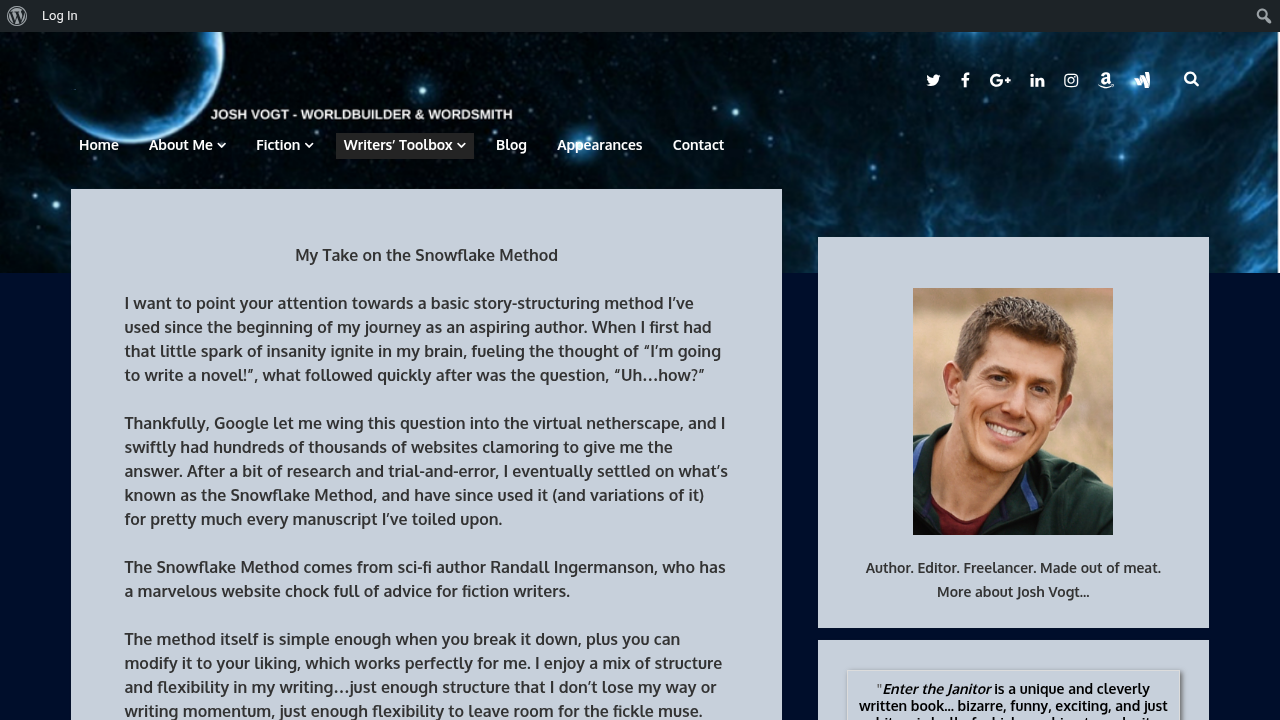
    jrvogt.com page screenshotThe Snowflake Method comes from Randy Ingermanson, the physicist and novelist known as “the Snowflake guy”, according to The Creative Penn’s interview with him. Ingermanson sets out ten steps, and their main purpose is to help you write your first draft. The method takes you from a single sentence to the scenes you need to start drafting, growing something small into something complex.

    It is a design method. It is not a writing teacher. It shapes the plan; it does not show you how to write a good sentence. A planning tool works the same way: it holds your plan, but you still write every line.

    For a longer primer, see our guide on what the Snowflake Method is.

    In plain language

    Write your story in one line, then keep making that line bigger until you know every scene.

    Next step: grab a pen. You will need it in the next section.

    How the Snowflake Method works, with an example

    Hands folding a paper snowflake next to manuscript pages, representing growing a story in roundsThe name comes from the method for drawing a snowflake fractal: start with a simple shape and add detail to each edge, round after round.


    The core steps

    Ingermanson’s ten steps can be grouped into four moves:

    1. One sentence. Sum up the story in a single line. If you cannot, the idea may not be ready.
    2. One paragraph. Expand that sentence into a paragraph. Ingermanson suggests it mirror three-act structure, with sentences for the major disasters and a final sentence for the resolution.
    3. Characters. Write a short summary of each major character: who they are, what drives them, their role.
    4. Expand to scenes. Grow the paragraph into a page, then a longer synopsis, then a list of scenes.

    If you want a fill-in format for these stages, our post on using a Snowflake Method template to plot your novel walks through it.

    A worked example

    For example, assume an invented idea, one sentence long, and a target of a ten-scene list for the opening stretch.

    Sentence: A retired Cornish lifeboat volunteer must find her missing grandson before a winter storm closes the harbour.

    Paragraph: Edith Penrose has given up the sea after a rescue went wrong. When her grandson Tom fails to come home from a night fishing trip, the coastguard calls off its search too soon. She takes her old boat out alone, but the engine fails off the headland. Stranded, she finds Tom’s dinghy wrecked and empty, and suspects he never went fishing at all. She brings him home, and herself back to the water.

    Character start and goal: Split each main character into where they begin inside and what they chase outside.

    Character Internal start External goal
    Edith Blames herself for a past rescue; afraid of the sea Find Tom before the storm
    Tom Ashamed of debts he hides from family Pay off a dangerous creditor

    Scene list (first few of ten):

    1. Edith hears Tom’s boat has not returned.
    2. The coastguard ends the search at dusk.
    3. Edith uncovers her old boat in the shed.
    4. Tom’s friend admits Tom owed money.
    5. Edith sets out alone as the wind rises.

    Notice how each layer answers questions the last one raised. The paragraph forces disasters. The character table forces motive. The scene list forces order.

    Next step: write your own sentence before reading on. Ten minutes. No editing.

    Why it matters for first-time novelists

    First novels often stall in the same places. The Snowflake Method helps with three of them.

    • Fewer aimless early pages. Written Word Media notes the method can help you avoid fifty pages of wandering prose that goes nowhere. You know where the story is heading before you start.
    • Steady momentum. Fantasy author Josh Vogt describes wanting just enough structure that he does not lose his way or his writing momentum.
    • Room to change things. Vogt also points out you can modify the method to your liking, and he uses variations of it himself.

    The plan has to live somewhere. Some writers use paper; others use one app to plan, plot and write, with no AI drafting anything for them.

    Next step: decide where your plan will live today, a notebook or an app, and stick with it.

    Common misconceptions

    A loosely planned notebook page beside a cup of tea, suggesting flexible planning

    Misconception: It is only for plotters / Reality: you can modify it

    It looks rigid on paper. In practice, Vogt skips some steps and adds an optional scene spreadsheet. Treat the ten steps as a menu, not a contract. Our piece on plotter vs pantser writing styles can help you work out how much planning suits you.

    Misconception: It writes the draft for you / Reality: it designs, you write

    The method ends where drafting begins. You get a scene list, not chapters. The sentences are still yours, and that is the good part.

    Misconception: It is the same as the maths snowflake / Reality: it is a fiction term

    The name borrows the image of the snowflake fractal, where a simple shape gains detail with each pass. In fiction it means only a planning approach. Search for it with “novel” attached if you keep landing on geometry pages.

    Next step: pick one step you might skip and one you will definitely keep.

    Related concepts

    Plotter

    A writer who plans the story before drafting. Snowflakers sit firmly on this side, with flexibility.

    Pantser

    A writer who drafts “by the seat of their pants” and finds the story as they go. Read more on writing by the seat of your pants.

    Three-act structure

    A beginning, middle and end shape, with turning points between them. The Snowflake paragraph leans on it; see our guide to three-act structure for first-time novelists.

    Outline

    Any written plan of the story’s events. A finished Snowflake is one kind of outline; compare others in our roundup of novel outline formats.

    Beat sheet

    A list of the key story moments a genre tends to hit, in order. Our guide to Save the Cat story structure shows one well-known version.

    Next step: choose one adjacent idea to read about this week, not five.

    How to get started today

    A pen resting on a notebook by a window, ready to start drafting a first novelPlanning can become its own hiding place. Do just enough, then write.

    1. Write your one sentence. Character, problem, stakes. Keep it under twenty-five words if you can.
    2. Expand to a paragraph. Three disasters and an ending. Rough is fine.
    3. Sketch two characters. For each, note where they start inside and what they want outside.
    4. List your first ten scenes. Stop there and start drafting scene one.

    You do not need software for any of this. The free First-Novel Finisher’s Kit needs only pen and paper, and it includes a one-page plan, a chapter-planning grid, a seven-plots cheat sheet and a series of emails.

    Next step: set a timer for twenty minutes and write your sentence and paragraph now.

    FAQ: Frequently Asked Questions

    What is the Snowflake Method?

    It is a novel-planning method that starts with a one-sentence summary and expands it in stages, through a paragraph, characters and synopsis, until you have a list of scenes ready for writing a first draft.

    Who created the Snowflake Method?

    Randy Ingermanson, a physicist and suspense novelist often called the Snowflake guy, created it. He set it out as ten steps whose main purpose is helping you produce your first draft of a novel.

    How do I start writing fiction?

    Start small. Write one sentence that sums up your story, then expand it into a paragraph with a beginning, middle and end. Then write your first scene, even if it feels clumsy on the page.

    What is the Snowflake Method in maths?

    In maths, a snowflake usually refers to a fractal drawn by repeatedly adding detail to a simple shape. The writing method borrows that image: begin with something simple and enlarge it, layer after layer.

    Is the Snowflake Method good for beginners?

    Yes, for many. It breaks a daunting project into small, clear tasks and gives you direction before drafting. If heavy planning drains your energy, use only the first few steps and start writing sooner.

    Can I change the steps?

    Yes. Writers commonly skip steps, merge them or add their own, such as a scene spreadsheet. Keep whatever moves you towards a finished draft and drop anything that becomes busywork.

    Conclusion

    The Snowflake Method works because it asks one small question at a time. A sentence becomes a paragraph, a paragraph becomes characters and scenes, and scenes become chapters you can actually write. Use what helps, skip what does not. If you want a place to hold the plan while you write, ClearARC is built for exactly that. Your next step: write the sentence.

  • What Is the Snowflake Method? A Novelist’s Guide Explained

    What Is the Snowflake Method? A Novelist’s Guide Explained

    The Snowflake Method is a way of designing a novel by starting with a one-sentence summary and expanding it in stages into character charts, a synopsis and a scene list. It was created by Randy Ingermanson. At ClearARC we help first-time novelists plan their books.

    What the Snowflake Method is

    The Snowflake Method is a novel-planning process taught by Randy Ingermanson, an award-winning author and theoretical physicist. You start small, with a single sentence about your story, then add detail about characters and plot in rounds until you have a full outline with a list of every scene. Ingermanson borrowed the idea from a snowflake fractal: a simple triangle that grows more detailed with each step until it looks like a snowflake.

    In plain language

    Write the heart of your book in one line, then keep enlarging it until you know every scene.

    Next step: before reading further, grab paper and a pen. You will need them in a moment.

    How the Snowflake Method works

    Paper snowflake unfolding over a manuscript, illustrating layered novel planningThe core idea is simple. You pen the heart of the novel first, then flesh it out layer by layer. Each layer uses the one before it as its seed.

    The ten steps at a glance

    According to Writing Mastery’s step-by-step guide, the method runs roughly like this:

    1. Write a one-sentence summary of the book.
    2. Expand it into a one-paragraph summary: setup, three disasters, ending.
    3. Write a short summary for each main character, including goals.
    4. Expand each sentence of the paragraph into its own paragraph.
    5. Write a fuller description of each main character.
    6. Grow the plot into a longer synopsis.
    7. Build full character charts.
    8. List every scene.
    9. Add notes to each scene.
    10. Write the first draft.

    The five-sentence paragraph in step two maps neatly onto the three-act story structure: setup, first disaster, midpoint, a dark moment near the end of act two, then climax and resolution.

    A worked example: one sentence to a full plan

    Here is an invented story to show the first three steps in action.

    Step 1, the sentence. For example: A disgraced lighthouse keeper must expose the smugglers who framed her before the island’s last ferry leaves for winter. Notice it names her role, not her name, and ties her inner wound (disgrace) to an outer task.

    Step 2, the paragraph. For example:

    • Setup: Mara tends a lighthouse on a Hebridean island, shunned since a wreck she was blamed for.
    • Disaster one: she finds cargo from that wreck in a neighbour’s barn.
    • Disaster two: her only ally is revealed as one of the smugglers.
    • Disaster three: the smugglers lock her in the lamp room as the ferry is due.
    • Ending: she signals the ferry with the light itself, and the island finally sees the truth.

    Step 3, the characters. Give each person a starting position on the inside and a goal on the outside. For example:

    Character Internal starting position External goal
    Mara Believes she deserves the blame Prove who caused the wreck
    The ally Sees smuggling as harmless survival Keep the island’s secret
    The ferry captain Distrusts the keeper Get passengers off before the storms

    That split between internal start and external goal is the pairing ClearARC’s character planning view uses.

    First-novel pitfalls at this stage:

    • Cramming the plot into step one. One sentence, one problem.
    • Disasters that happen to the hero but never force a choice.
    • Characters with goals but no inner starting point, so they cannot change.

    Next step: write your own sentence now, then check it against those three pitfalls.

    Why the Snowflake Method matters

    Novelist with a stack of planning pages before drafting, showing why planning saves draftsPlanning is not glamorous, but it saves drafts. Three cases stand out.

    • First novels needing structure. The literary agency Liza Dawson Associates writes that a friend who used the method on her first novel produced a book that was admirably tight, with characters of rare depth for a debut.
    • Avoiding the saggy middle. The same agent calls the vast middle of a story “the Sahara Desert called plot”, where writers face endless drafts and restarts.
    • A second book after a contract. The agency points out that debut authors often face a second-novel deadline from scratch, and that treating plotting as a learnable skill eases the panic.

    It is also popular. Ingermanson says his page draws over a thousand views a day and has been viewed more than six million times.

    If the middle is where you tend to give up, read our guide on how to finish your novel when you feel like quitting.

    Common misconceptions about the Snowflake Method

    Misconception: it is only for plotters who hate creativity

    Reality: it grows from a seed. Every layer is a creative decision. Ingermanson says the design work is partly creative and partly organising.

    Misconception: you must follow all ten steps exactly

    Reality: use what works for you. Ingermanson himself tells readers to decide what might work and ignore the rest.

    Misconception: it is the snowflake theory or the maths snowflake

    Reality: it is a novel-planning method. The mathematical snowflake fractal only inspired the name, as a picture of something growing from simple to detailed. If you searched for maths or another “snowflake theory”, this is a different topic.

    Misconception: it writes the book for you

    Reality: it only plans. Step ten still says write the draft. A tool can hold your plan, but the sentences remain yours.

    Next step: pick which steps you will actually use, and cross the rest off.

    Related concepts

    Three-act structure

    A beginning, middle and end, split by turning points. See what the three-act structure is.

    Save the Cat

    A beat sheet originally built for screenplays, now widely used by novelists. Our guide to Save the Cat story structure covers it.

    Hero’s Journey

    A pattern of departure, trial and return, often used for quest and coming-of-age stories.

    Plotter vs pantser

    Plotters plan first; pantsers discover the story while drafting. Read plotter vs pantser to place yourself.

    Story structure template

    A reusable frame of beats to fill in. Try using a story structure template for your plan.

    How to get started with the Snowflake Method today

    Keep it small. Do these three things before bed:

    1. Write your one-sentence summary on paper. Role, problem, stakes.
    2. Expand it to five sentences. Setup, three disasters, ending.
    3. Give each main character a start and a goal. One inner position, one outer aim.

    When you want a structured place to keep it, our walk-through on using the Snowflake Method template to plot your novel takes you further. ClearARC is a no AI app built for first-time novelists to plan, plot, write and publish a book, with a character view for those start-and-goal pairs. Prefer paper? The free kit needs only pen and paper and includes a one-page plan, a chapter-planning grid, a seven-plots cheat sheet and a series of emails. For turning scenes into chapters, see how to create a novel outline from scratch.

    FAQ: Frequently Asked Questions

    What is the Snowflake Method?

    It is a novel-planning process that starts with a one-sentence summary and expands it in stages into a paragraph, character summaries, a synopsis, character charts and a scene list, before you write the first draft.

    Who created the Snowflake Method?

    Randy Ingermanson, an award-winning novelist and theoretical physicist, created and teaches it. He named it after a snowflake fractal, which starts as a simple triangle and grows more detailed with each repeated step.

    What is the snowflake theory?

    In novel writing, people usually mean the Snowflake Method: growing a story from one sentence into a full outline. The phrase is used in other fields too, so check the context of what you are reading.

    Is the Snowflake Method the same as the snowflake method in maths?

    No. The maths snowflake is a fractal shape. Ingermanson only borrowed it as a metaphor for building a story from simple to detailed. The writing method involves no mathematics at all, just planning.

    Is it good for first novels?

    Yes, for many writers. A literary agent at Liza Dawson Associates reports a friend’s first novel planned this way was admirably tight. Start with the first three steps and see whether the structure helps you.

    How long does it take?

    It depends on your book’s length, how many steps you use, and how much you already know about your characters. The first three steps are short; scene lists and character charts take considerably longer.

    Can software help with it?

    Yes, software can hold your sentence, characters and scene list in one place. It will not plan for you, though. A good tool stores your decisions; you still make them and write every sentence.

    Conclusion

    The Snowflake Method is one sentence, grown carefully until it becomes a book you can draft. You do not need all ten steps; you need enough plan to reach the end of the middle. Write your sentence today, then your paragraph tomorrow. ClearARC, made by Quentin Pain, is there when you want somewhere to keep it, and the free First-Novel Finisher’s Kit is the pen-and-paper way to start.

  • What Is a Beat Sheet? The Fiction Writer’s Complete Guide

    What Is a Beat Sheet? The Fiction Writer’s Complete Guide

    A beat sheet is a form of outline in which each major plot point or dramatic moment gets its own short entry, so you can see a story’s structure before you write it in full. Most advice on the subject comes from screenwriting, which leaves novelists guessing how scene beats differ from plot beats.

    What Is a Beat Sheet?

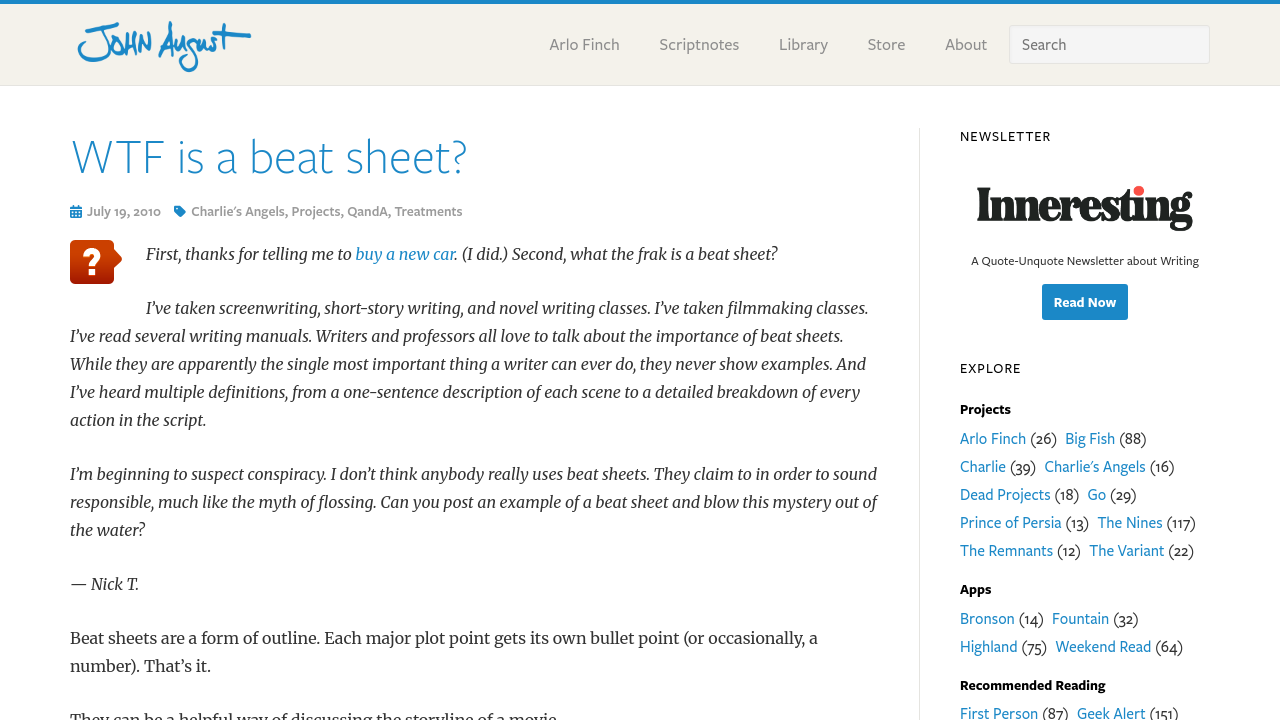
    johnaugust.com page screenshotScreenwriter John August puts it bluntly: beat sheets are a form of outline, and each major plot point gets its own bullet point, or occasionally a number. What changes is the size of the thing you are outlining: a whole story, a structural template, or a single scene.

    In plain language

    A beat sheet is a list of the moments that matter, one line each, written before the prose.

    Three kinds of beat sheet compared

    Type of beat sheet What a beat is Best used for Source
    Plot-level outline One major plot point per bullet Seeing and rearranging the whole storyline John August; johnaugust.com
    Blake Snyder’s Save the Cat structure A named section of the three-act structure, each with a specific goal Plotting a full story against a template; writers use its 15 beats for genre novels such as fantasy Tim Stout; YouTube tutorials
    Scene-level beat sheet An individual dramatic moment inside one scene Planning or rescuing a single scene BBC Writers (Danny Stack)

    All three come from screenwriting, and all three transfer to the novel without fuss. A chapter has turning points just as a film does. If you want template-specific detail, our guide to Save the Cat beat sheet examples for fiction writers goes deeper.

    Takeaway: pick one level first. Plot your whole book or fix one scene, but do not try both on the same page.

    How a Beat Sheet Works

    A spilled coffee cup in a busy café, the turning point that drives the scene beat exampleThe mechanism is simple: break a story or scene into its turning points, then test whether each one causes the next.


    A worked scene example

    BBC Writers offers a café scene that shows the difference beats make. The flat version has one beat: John bumps into Jane, she spills coffee on him, it is love at first sight. The beat sheet version splits it into three:

    1. In a busy café, John spills his takeaway coffee over a frail old woman, not a beautiful stranger.
    2. She is furious, hits him with her umbrella and lectures him. John stays calm.
    3. He helps her on her way, catches Jane smiling at his patience, heads for the exit smitten, and slips on the spilled coffee.

    For a novel, expand it. For example, you might add a fourth beat: that evening, John finds Jane’s number written on his coffee-stained receipt, and has to decide whether he is brave enough to ring. Now the scene does not just end; it hands the next chapter a question. In prose fiction you can also add an interior beat, such as John’s embarrassment curdling into hope, because a novel can sit inside his head in a way a camera cannot.

    Steps to build your own

    1. List the turning points. Write every moment where something changes.
    2. Keep each to one line. If it needs a paragraph, it is two beats.
    3. Put them in order. Shuffle them freely; paper is cheap.
    4. Check cause and effect. Each beat should happen because of the one before, not merely after it.

    August also notes that beat sheets are commonly written after a draft exists, as a roadmap for rewriting. That is a sound habit for novelists revising a sagging middle. For more on choosing a planning method, see our roundup of novel outline formats for first-time fiction writers.

    Takeaway: if two beats sit side by side with no causal link, you have found a weak spot.

    Why Beat Sheets Matter for Novelists

    Writer reviewing a manuscript page with a red pen to find weak scenes

    Spotting a flat scene

    The BBC Writers piece describes a scene that technically works but reads like “functional furniture”. A scene beat sheet is the diagnostic: count the beats. One beat usually means one note, and readers feel it. Pair this with our piece on writing a scene that makes readers cry when the missing ingredient is emotion.

    Seeing the shape of the whole story

    Blake Snyder’s beat sheet, from the Save the Cat books, breaks the three-act structure into manageable sections such as Catalyst, Midpoint and All Is Lost, each with a job to do. August shows the same idea in a looser form, and even uses a producer’s quip about Inception to illustrate how beats get debated and moved.

    Keeping character change visible

    Plot beats track what happens; your protagonist also changes inside. Write a second column beside each beat noting where the character stands emotionally. ClearARC‘s arc tracker plots that internal shift alongside external plot points, and its character view separates the internal starting position from the external goal. Our guide to developing compelling characters in fiction covers the craft behind it.

    Takeaway: use scene beats to fix pages, plot beats to fix books, and an arc column to keep both honest. In ClearARC we call beats ‘events’, because that is what they are. It makes it easier to understand when you think in terms of events. If any event does not serve the story’s purpose, cut it (or your readers will get bored or confused).

    Common Misconceptions About Beat Sheets

    Misconception: Beat sheets are only for screenplays

    Reality: novelists borrow them constantly. Snyder’s template is applied to graphic novels and prose, and genre writers use its beats to plot fantasy.

    Misconception: A beat sheet is a full script breakdown

    Reality: August’s definition is one bullet per major plot point. A detailed action-by-action breakdown is something else.

    Misconception: Everyone uses Save the Cat

    Reality: it is one template among several. Plain bullet lists, scene beats and other structures all count. Part of the confusion is that, as screenwriters on Reddit point out, real examples are hard to find.

    Misconception: Beat sheets kill creativity

    Reality: they are editable plans. August describes beats being cut and reordered in discussion. Nothing is carved in stone. If a blank page is the bigger fear, see our help on overcoming writer’s block on a first novel.

    Takeaway: treat a beat sheet as a pencil sketch, not a contract.

    Related Concepts

    Outline

    Any written plan of a story before drafting. A beat sheet is one lean kind of outline; others add synopsis, setting and character notes.

    Treatment

    A prose summary of a story, told in paragraphs. A beat sheet lists moments; a treatment narrates them.

    Three-act structure

    Setup, confrontation, resolution. Snyder’s beats subdivide it. Read our explainer on Syd Field’s three-act structure.

    Seven-point structure

    A framework built around seven key turning points from hook to resolution. See seven-point story structure explained.

    Seven basic plots

    Christopher Booker’s argument that stories fall into a handful of recurring shapes. For more detail, see Christopher Booker’s seven basic plots.

    Takeaway: a structure tells you what beats to expect; the beat sheet is where you write yours.

    How to Get Started With Your First Beat Sheet

    Blank notebook page in morning light, ready for a first rough beat sheet1. Take a pen and a sheet of paper. List ten to fifteen moments your story cannot do without. Do not polish. Coffee helps.

    1. Try a template. Lay your list against Save the Cat’s sections and see what is missing. Writing a love story? Our guide on how to use a romance beat sheet adapts the idea.
    2. Grab the free First-Novel Finisher’s Kit. It needs only pen and paper and includes a one-page plan, a chapter-planning grid, a seven-plots cheat sheet and a series of emails.
    3. Track the arc. Next to each beat, note your protagonist’s inner state. Watch it move.

    Takeaway: a rough list today beats a perfect plan next month.

    FAQ: Frequently Asked Questions

    What should you include in a beat sheet?

    Include each major plot point or dramatic moment, one line apiece, in story order. Some writers add which characters appear or how the protagonist feels, but the core is simply the turning points.

    Is a beat sheet the same as a treatment?

    No. A beat sheet is a list of moments, usually bullets. A treatment tells the story in prose paragraphs. Many writers draft beats first, then expand them into a treatment or synopsis later.

    What is the difference between a beat sheet and an outline?

    A beat sheet is a type of outline. Outlines can include anything from setting notes to chapter summaries; a beat sheet strips that back to one entry per major plot point or dramatic moment.

    How long should a beat sheet be?

    It depends on the story and the method. A scene might need three or four beats, while Save the Cat uses fifteen for a whole story. Keep each entry short enough to scan at a glance.

    Can novelists use a beat sheet?

    Yes. Although the format grew out of screenwriting, beats map neatly onto chapters and scenes. Novelists can also add interior beats, capturing a character’s thoughts in ways a screenplay cannot easily show.

    What is a beat in a scene?

    A scene beat is an individual dramatic moment that, together with others, makes up the scene. Each beat shifts something: a reaction, a decision, a reveal. More beats usually give a scene more life.

    Conclusion

    A beat sheet is the simplest plan a novelist can make: one line per moment that matters. Choose your level, whole book or single scene, test each beat for cause and effect, and keep the character’s inner journey in view. When you are ready to move from paper to manuscript, ClearARC is a no AI writing tool built for first-time and independent novelists, covering plan, plot, write and publish in one app, with a single version that includes everything. Pick up your pen and start listing.

  • Save the Cat Beat Sheet Examples for Fiction Writers

    Save the Cat Beat Sheet Examples for Fiction Writers

    Save the Cat examples show Blake Snyder’s 15-beat structure, which splits a story’s beginning, middle and end into plot points, filled in with a specific story so you can see what each beat does. Originally written for screenwriters, the tips largely carry over to novels.

    What a Save the Cat beat sheet is

    savannahgilbo.com page screenshot

    A Save the Cat beat sheet is a story structure template from Blake Snyder that subdivides the beginning, middle and end of a story into 15 beats, or plot points. According to Savannah Gilbo’s breakdown of the beats, each beat has a specific purpose within the overall story, and the method helps you decide both the order of events and when they should happen. Snyder wrote his book for screenwriters, which is why many explanations still talk about pages and scenes in film terms.

    In plain language: it is a checklist of fifteen story moments, in order, with a rough idea of where each one belongs.

    If you want the full theory before the example, start with our guide to Save the Cat story structure explained for novel writers. The takeaway here is simple: a beat is defined by its job, not by its content.

    Save the Cat beat sheet example, beat by beat

    Cosy Yorkshire village tearoom setting for a mystery novel example

    The invented premise

    For example, assume a first-time novelist is writing a cosy mystery set in a Yorkshire village. The heroine, Ruth, runs the village tearoom. Her internal starting position: she hides from risk and lets other people decide things. Her external goal: clear her brother, who is accused of poisoning a rival at the summer show. The table assumes a standard novel with three acts and the usual 15 beat names.

    # Beat External plot event Internal shift
    1 Opening Image Ruth bakes for the show, avoiding the committee meeting Avoidant, comfortable
    2 Theme Stated The vicar says, “Nobody fights your battles for you” Ruth shrugs it off
    3 Set-Up Village, tearoom, brother Tom, rival baker introduced Her habit of deferring shown
    4 Catalyst The rival collapses after eating Tom’s pie Fear
    5 Debate Police arrest Tom; Ruth waits for a solicitor to fix it Hoping someone else acts
    6 Break into Two Ruth decides to ask questions herself First chosen risk
    7 B Story A retired detective joins the WI and befriends her A mirror for courage
    8 Fun and Games Gossip, secret recipes, a locked village hall Growing confidence
    9 Midpoint She finds the poison came from the rival’s own garden False victory, overconfident
    10 Bad Guys Close In A second suspect is cleared; locals turn on her Old doubts return
    11 All Is Lost Her tearoom is vandalised; Tom is charged Ready to give up
    12 Dark Night of the Soul Ruth closes the tearoom for a day Faces her pattern of hiding
    13 Break into Three She remembers the vicar’s line and spots a clue Decides to lead
    14 Finale She stages a show-day reveal and names the killer Acts without permission
    15 Final Image Ruth chairs the committee meeting she once dodged Changed, open

    Act one beats

    Beats 1 to 6 set the world and force a choice. Notice that the external event (the arrest) only matters because it collides with Ruth’s internal habit of waiting.

    Act two beats

    Beats 7 to 12 test the choice. The Midpoint raises the stakes; All Is Lost should hurt both her case and her self-belief at once.

    Act three beats

    Beats 13 to 15 resolve both lines. Gilbo describes the Finale as the beat where the story’s problems are resolved and the protagonist proves they have changed. Ruth’s reveal does exactly that.

    Takeaway: write one sentence per beat before you write anything longer.

    Why writers use it: planning, revising and character change

    jamigold.com page screenshot

    Plotting before drafting

    Many writers use the beat sheet to plot before drafting. It also sits comfortably beside other approaches; see how it compares in our guide to narrative story structure for fiction writers.

    Using it on a finished draft

    The beat sheet is just as useful afterwards. Author Jami Gold describes using it on a completed, pantsed novel, saying it forced her to see the story from a different perspective. She filled in a beat sheet spreadsheet for novels during revisions to check that turning points land in the right place. If your draft stalls in the middle, a beat check often shows why; our piece on writing subplots that complement the main plot helps with saggy B stories.

    Pairing beats with a character arc

    Gilbo pairs structure with a character who needs to change and does change. That is the column most examples skip. ClearARC‘s character arc tracker plots the internal shift alongside external plot points, and its character view keeps a separate internal starting position and external goal. Even on paper, two columns are enough. For deeper work on the person behind the beats, read about developing compelling characters in fiction.

    Takeaway: every beat should move the plot and nudge the character.

    Common misconceptions about Save the Cat

    Misconception: it only works for screenplays

    Reality: Snyder wrote for screenwriters, but Jami Gold estimates that 95% of his tips work for novellas and novels too.

    Misconception: it is a rigid formula

    Reality: Gilbo describes it as a template for the order and timing of events. Some beats take one scene, others several. Your village, your killer and your twists are still yours; see how to write twists and unexpected turns.

    Misconception: it is only for planners

    Reality: Gold used it on a pantsed draft during revision. Discovery writers can draft freely, then check the beats.

    Misconception: beats replace character work

    Reality: structure without change is hollow. Gilbo’s point is that the beats work when combined with a protagonist who changes.

    Related concepts

    Three-act structure

    The older division of a story into set-up, confrontation and resolution, which Save the Cat subdivides. See Syd Field’s three-act structure.

    Seven-point structure

    A leaner plotting model built around a hook, turning points and resolution, explained in our seven-point story structure guide.

    Seven basic plots

    Christopher Booker’s idea that most stories follow a handful of master shapes. Start with what are the seven basic plots.

    Beat

    A single story moment with a job to do, such as the Catalyst or the Midpoint.

    Character arc

    The journey from a character’s internal starting position to who they become by the end.

    How to get started with your own beat sheet

    Starting a personal beat sheet on paper with a kettle nearby

    Put the kettle on and take a sheet of paper.

    1. List the 15 beats down the left margin, on paper or a spreadsheet.
    2. Write one line per beat describing the external event. No more yet.
    3. Add the internal shift beside each line, starting from your character’s internal position and ending at the change.
    4. Check the timing: does the Catalyst arrive early, and does the Finale feel earned?
    5. Turn beats into chapters using a 12-chapter Save the Cat book outline.

    If you prefer to begin away from screens, the free First-Novel Finisher’s Kit needs only pen and paper. It includes a one-page plan, a chapter-planning grid, a seven-plots cheat sheet and a series of emails.

    FAQ: Frequently Asked Questions

    What are the 15 Save the Cat beats?

    Opening Image, Theme Stated, Set-Up, Catalyst, Debate, Break into Two, B Story, Fun and Games, Midpoint, Bad Guys Close In, All Is Lost, Dark Night of the Soul, Break into Three, Finale and Final Image.

    Can I use a beat sheet after drafting?

    Absolutely. Filling in beats on a finished draft shows where turning points actually fall and gives you a fresh view of structure. It is especially helpful on drafts written without an outline first.

    Is a beat sheet the same as an outline?

    Not quite. A beat sheet marks fifteen key moments and their timing. An outline goes further, usually scene by scene or chapter by chapter. Many writers build the beat sheet first, then outline from it.

    How detailed should each beat be?

    Start with one sentence per beat. That is enough to test order and timing. Expand into scenes only once the fifteen sentences tell a complete story with a character who clearly changes.

    What if my story does not fit the beats?

    Treat the beats as a diagnostic, not a law. If a beat is missing, ask whether the story feels weaker for it. Some beats span several scenes, and placement can flex to suit your book.

    Conclusion

    A beat sheet earns its place when you can see it working on a real story, and when every plot event is matched by a change in your character. Write your fifteen lines, mark the inner shift, then pick a format from our guide to novel outline formats for first-time writers. Now finish that book.

  • Best Novel Outline Formats For First-Time Fiction Writers

    Best Novel Outline Formats For First-Time Fiction Writers

    For a first novel, pick an outline format that fits how you think: a stage-based structure such as the Hero’s Journey gives a clear sequence, while Kurt Vonnegut’s Shape of Stories gives a looser emotional graph, and a planning tool can hold either. Pour the coffee. Choose one. Then write.

    How we ranked these novel outline formats

    Writer weighing index cards while judging outline formats

    Most pages on this topic are template dumps or one writer’s personal method. This one judges each option against four tests you can argue with:

    1. Beginner clarity. Can someone who has never finished a book follow it without a glossary?
    2. Flexibility. Does it bend to your genre and voice, or force every story down the same road?
    3. Character focus. Does it keep your protagonist’s change at the centre, not just events?
    4. Fit with a plan-then-write workflow. Can you move from the outline straight into chapters?

    Only two named formats are ranked here, alongside one planning tool. For any other format you meet, run it through the same four questions. If it fails two, put it down and pick up a pen.

    Takeaway: a format earns its place by how easily it gets you to chapter one, not by how clever it looks.

    Quick summary

    1. ClearARC: a no AI app to plan, plot, write and publish.
    2. Hero’s Journey: a twelve-stage route through a familiar storyline.
    3. Kurt Vonnegut’s Shape of Stories: a graph of emotional highs and lows.

    At a glance

    Tool Pricing Best for Standout
    1 ClearARC Single version with everything included First-time novelists who want structure and character in one place Arc tracker plotting internal shift against plot points
    2 Hero’s Journey Not a product, a storytelling structure Writers who want a step-by-step route – use it inside ClearARC, or just use pen and paper. Stage-by-stage structure
    3 Vonnegut’s Shape of Stories Not a product, a storytelling approach Writers who think in mood and momentum – use it inside ClearARC or pen and paper Line graph of the protagonist’s emotional swoops

    Takeaway: the question is which shape your brain prefers.

    1. ClearARC: outline around character change

    the brand homepage screenshot

    ClearARC is not a format. It is the desk the format sits on. It is a no AI writing tool that lets you build a book from scratch in one app: plan, plot, write, publish.

    Here is why it ranks first for a novice. Its character planning view asks for two separate things: your protagonist’s internal starting position and their external goal presented through their character arc. Plenty of first drafts fail because the hero wants a thing but never changes as a person.

    The character arc tracker (shown in both the timeline and the character editor) then plots that internal shift alongside your external plot points. Lay the twelve stages of the Hero’s Journey down as plot points, or sketch Vonnegut’s rises and falls, and the tracker shows where your character’s inner change lands against them. Any format, same anchor: change.

    Practical details:

    • Pricing: one version that includes everything for everyone, with no tiers to puzzle over.
    • Cancelling: done directly with PayPal – you’re in control.
    • Who made it: Quentin Pain.
    • Who it suits: first-time and independent fiction novelists, with the United Kingdom as its home market.

    Not ready for an app? The free First-Novel Finisher’s Kit includes a one-page plan, a chapter-planning grid, a seven-plots cheat sheet and a series of emails, and it needs only pen and paper.

    Caveat: a tool cannot choose your structure for you. You still need to pick a format, which is what the next two picks are for.

    Takeaway: whatever format you choose, outline the character’s inner shift beside the plot, or the plot will feel hollow.

    2. Hero’s Journey: twelve stages for a clear route

    The Hero’s Journey, sometimes called the universal storyline, breaks a story into stages, from the ordinary world through the call, the trials and the return. The Novel Factory lists it among its plot outline templates, under the name the Universal Storyline.

    Why it scores well:

    • Clarity: each stage tells you what should happen next, which is gold when the middle starts to sag.
    • Workflow fit: twelve stages divide neatly into chapter clusters.
    • Character focus: the return home implies change, though you must write that change in yourself.

    If you want a deeper look at stage-led plotting, the seven-point story structure is a leaner cousin, and Save the Cat story structure offers another beat-by-beat route.

    Caveat: for quieter literary stories, twelve fixed stages can feel formulaic. Use them as milestones, not a cage.

    Takeaway: choose the Hero’s Journey if a blank middle frightens you more than a familiar shape does.

    3. Kurt Vonnegut’s Shape of Stories: the emotional graph

    Vonnegut’s Shape of Stories treats a novel as a line graph of the protagonist’s fortunes, rising and falling across the book. Novelist Caroline Hardaker’s first draft checklist describes it as a timeline of your protagonist’s emotional swoops, and argues that without an outline a narrative can fizzle into nothing.

    Why it works for some first-timers:

    • Flexibility: it fits literary fiction, thrillers and romance alike.
    • Character focus: it is built on how the protagonist feels, so inner change is the whole point.
    • Clarity: one sheet of paper, one pencil line.

    Caveat: a graph tells you the mood of a stretch, not what happens in chapter seven. Pair it with a grid; this guide on how to build a chapter planning template shows the idea, and the chapter-planning grid in the free kit does the same job on paper.

    Takeaway: draw the curve first, then fill the chapters beneath it.

    How to choose

    Hand hovering over paper sketches while choosing a story structure

    Start with the criterion that scares you most. If sequence is the problem, the Hero’s Journey gives the clearest route; if your story is about feeling, Vonnegut’s graph keeps you honest. Whichever you pick, track the character’s inner shift beside the plot. For a low-commitment start, print the free First-Novel Finisher’s Kit and plan on paper this weekend. Other formats exist, such as the three-act structure and the Snowflake Method; judge them by the same four tests. Unsure whether you plan at all? Read plotter vs pantser before committing.

    FAQ: Frequently Asked Questions

    Reading lamp over a manuscript answering novel outline questions

    What is the correct way to format a novel?

    There is no single correct outline format. Choose one that fits how you think: stages for a clear sequence, a graph for emotional flow. Manuscript layout for submission is a separate question decided by publishers or agents.

    What are the five parts of a novel?

    A common five-part model is exposition, rising action, climax, falling action and resolution. It is one way to describe a story’s shape, and it maps loosely onto three-act and stage-based outlines alike.

    How do you create an outline for a novel?

    Summarise the story in one line, define the protagonist’s goal and inner change, choose a format, then break it into chapters. This guide to create a novel outline from scratch walks through it.

    How to start writing a novel step by step?

    Pin down your premise, sketch your main character’s starting point and goal, outline the major turns, then draft chapter by chapter. Set small milestones and keep moving forward rather than polishing early pages endlessly.

    Do I need software to outline a novel?

    No. Pen and paper work perfectly well, and the free First-Novel Finisher’s Kit needs nothing more. ClearARC is optional, useful if you want planning, character arcs and drafting together in one place.

    Can I mix outline formats?

    Yes. Many writers use stages for plot and a Vonnegut-style graph for emotion. Keep one format as the backbone so you are not juggling competing maps when you sit down to write.

    Conclusion

    Fountain pen resting on a blank page ready to begin chapter one

    Ranked by clarity, flexibility, character focus and workflow fit, the order holds: a planning tool that ties structure to character, then the Hero’s Journey for a clear route, then Vonnegut’s graph for feel. Start on paper with the free kit if you like. When you want everything in one place, the ClearARC writing app was built for first-time novelists like you. Choose a shape, sharpen the pencil, and finish the book.

  • How To Create A Novel Outline From Scratch

    How To Create A Novel Outline From Scratch

    Create a novel outline by distilling your idea into one sentence or blurb, choosing a structure, defining your characters, then breaking the story into a chapter-by-chapter grid you can check and revise. The aim is simple: help you finish the book, and a sound outline is where you start.

    What You’ll Need

    Keep the kit small. Outlining is thinking work, not shopping.

    1. Pen and paper, or a spreadsheet. Either works. If you like spreadsheets, our guide will help: using a spreadsheet to outline a novel, with chapters and characters set out in columns so you can see the whole story from above.
    2. A premise. Even a rough one: a person, a problem, a hunch about the ending.
    3. Quiet time. A couple of uninterrupted sittings beats ten snatched minutes.
    4. A rough sense of your genre. You will refine it in step 4.
    5. Optional printed tools. The free First-Novel Finisher’s Kit includes a one-page plan, a chapter-planning grid, a seven-plots cheat sheet and a series of emails. It needs only pen and paper.

    Takeaway: if you have a pen, a page and a premise, you can start today.

    Before You Start

    Writer considering plotter or pantser approach before outlining a novelMake three decisions now, because they are tedious to undo later. First, know your leaning: are you a plotter or pantser? Bransford notes that writers broadly split into planners and pantsers, and that an outline is still useful even when built retrospectively after a pantsed draft. Second, settle your genre. Third, choose your point of view, since first person and close third shape which scenes you can show.

    Also decide how loose your outline will be. NY Book Editors suggests a simple one-page outline covering the beginning hook, middle and end, plus genre, controlling idea and POV. Jerry Jenkins points out that you have options, from a detailed plan to a rough synopsized roadmap. Start with one page. You can always add detail; cutting a forty-page plan is harder on the nerves.

    Takeaway: write your leaning, genre and POV at the top of page one before step 1.

    Step-by-Step: How To Outline Your Novel

    Work through these in order. Each ends with a check, so you know when to move on. If you want to see the destination first, look at what a finished outline looks like.

    Step 1: Write your idea as one sentence or blurb

    Write one sentence that names your protagonist, what they want and what stands in the way. Then expand it into a short blurb, the kind printed on a back cover. LitReactor’s Jena Brown starts her outlines with the blurb, asking who the main character is, what they want, what blocks them and what choice they make.

    Check: read the sentence aloud to someone. If they can repeat the premise back without your help, it works.

    Step 2: Choose a story structure

    Pick a frame to hang events on. For most first novels, the three-act shape is the plainest: setup, confrontation, resolution.

    Check: you can write your opening, your midpoint and your ending as one line each.

    Step 3: Build your characters with an internal start and an external goal

    Give each major character two lines. The first is their internal starting position: what they believe, fear or lack at page one. The second is their external goal: the concrete thing they chase. A grieving widower (internal: closed off) wants to win back the family bakery (external). The story lives in the friction between those lines. For more depth, read about creating unforgettable characters.

    Check: every major character has both lines filled, and the two pull against each other.

    Step 4: Match your plot to your genre and a basic plot type

    Note what your genre promises readers: a body in a crime novel, a pairing in romance. Then pick the closest of the seven basic plots, such as Rags to Riches or the Quest. The kit’s seven-plots cheat sheet is a handy reference for these.

    Check: you can name your genre’s key promise and your plot type in a single line.

    Step 5: Plot the emotional beats alongside the events

    Events are what happens; emotional beats are how your protagonist changes because of them. Brown lists plotting your characters’ emotional beats as its own step. Under each major event, write how the internal starting position shifts. ClearARC’s arc tracker does exactly this, plotting the internal shift alongside external plot points.

    Check: by the final event, your protagonist’s internal line reads differently from where it began.

    Step 6: Lay out a chapter-by-chapter grid

    Now draw the grid. One row per chapter, with columns like these:

    Chapter Main plot event Protagonist’s internal shift Subplot / other characters
    1 Bakery closes Numb, avoids help Daughter phones, unanswered
    2 Sees sale notice Spark of anger Rival buyer appears

    This mirrors Bransford’s column approach and the kit’s chapter-planning grid. Our article on building a chapter planning template covers layout options.

    Check: no row is empty, and every chapter moves either the plot or the character.

    Step 7: Read the outline start to finish and fix gaps

    Pour a coffee and read the whole grid in one sitting, as a reader would. Mark any chapter where nothing changes, any character who vanishes, and any jump in logic.

    Check: you can tell the full story aloud from the grid in five minutes without stalling. Then start drafting.

    Troubleshooting Your Outline

    Editing a novel outline to fix a weak turning point

    Symptom: The middle sags

    • Cause: the protagonist reaches the midpoint without a reversal, so chapters repeat the same problem.
    • Fix: add a turning point that raises the stakes or flips what the protagonist thought they knew. Our guide to novel story structure for your first book shows where it usually sits.

    Symptom: Characters feel flat

    • Cause: they have an external goal but no internal starting position, so nothing inside them moves.
    • Fix: go back to step 3 and set both lines for each major character, then confirm in step 5 that the internal line shifts.

    Symptom: Outlining kills your enthusiasm

    • Cause: you are over-planning. NY Book Editors argues that heavy pre-writing can turn the writer into a translator of a story already known, rather than a discoverer.
    • Fix: shrink back to one page. Leave scenes deliberately open, and see how deep to plan your novel.

    Symptom: The outline keeps changing

    • Cause: drafting is teaching you things the outline could not know.
    • Fix: good. Treat the outline as a working document, not a contract. Update the grid at each milestone and keep writing.

    Takeaway: most outline problems are fixed by one turning point, two character lines or one page less.

    FAQ: Frequently Asked Questions

    How to structure a novel outline?

    Start with a one-sentence premise, set it inside a structure such as three acts, define characters by internal start and external goal, then lay the events into a chapter grid with columns for plot and character.

    How do you create an outline for a book?

    Distil your idea into a blurb, choose a structure, build your main characters, match the plot to your genre, track emotional beats, and finish with a chapter-by-chapter grid you read through and revise for gaps.

    What tool can I use to outline my novel?

    Pen and paper work perfectly well, and a spreadsheet helps you see plotlines from above. ClearARC is a no-AI app for planning, plotting, writing and publishing, with a single version that includes everything.

    What are the three rules of outlining?

    There is no single official set, but three habits serve beginners well: know your ending before you begin, give every chapter a change, and keep the outline loose enough to revise as you draft.

    How long should a novel outline be?

    As long as it needs to be useful. A one-page plan covering beginning, middle and end is a good start, and you can expand it into a chapter grid once the shape holds.

    Do I have to outline before writing?

    No. Plenty of writers draft by discovery and many fall somewhere between planning and pantsing. Even pantsers usually start with a lead character, a problem and a rough idea of the ending.

    Can I outline after writing a first draft?

    Yes. Building an outline retrospectively from a finished draft is a practical way to spot sagging chapters, missing character arcs and forgotten subplots before you start revising the manuscript.

    Is outlining right for first-time novelists?

    Usually, yes. A road map is reassuring when the draft gets hard. Keep it light, one page first, so planning supports your enthusiasm rather than replacing the pleasure of writing.

    Conclusion

    One sentence, one structure, two lines per character, a genre promise, emotional beats, a chapter grid and a read-through: that is how a novel outline gets built from scratch. None of it needs gadgets. Print the free kit, sharpen a pencil, and fill page one tonight. When you want plan, plot, write and publish in a single no-AI app made by Quentin Pain, the ClearARC writing app is there for the next chapter.

  • Sample Novel Outline: What One Actually Looks Like

    Sample Novel Outline: What One Actually Looks Like

    A sample novel outline is a short, structured plan listing the premise, the main character’s starting position and goal, and the major plot beats in order, usually in three acts. As detail grows, it expands into chapter notes. Most guides hand you a blank template; this one fills one in, with the character’s inner journey running beside the plot.

    What a novel outline is

    Folded paper map beside a pencil representing a story's structure

    A novel outline is a structured breakdown of a story’s plot, characters and key turning points, written before or alongside the draft. It summarises the story rather than telling it, so it can be flat, brief and purely functional. Good outlines start as a barebones sketch and gain detail in layers as you learn more about the book.

    In plain language

    An outline is your map: where the story starts, where it turns, and where it ends up.

    A sample novel outline, filled in

    Here is a complete worked example. The novel is invented, and the numbers are example assumptions: 24 chapters, roughly 80,000 words, three acts. That gives about 3,300 words per chapter, a comfortable length for a debut.

    The premise and the character’s two tracks

    Premise: Nell Barker, a 34-year-old bookkeeper in a Yorkshire market town, discovers her late father’s hardware shop is secretly in debt to a local developer, and she has one summer to save it.

    Every strong outline tracks the character on two lines:

    • External goal: keep the shop open and out of the developer’s hands.
    • Internal starting position: Nell believes asking for help is a weakness, so she carries everything alone.

    The plot tests the goal. The plot also forces the belief to crack. Keep both lines on the page from day one.

    Act by act: external beats and internal shift

    Act Chapters External plot beat Internal shift
    One 1-3 Status quo: Nell balances other people’s books, avoids the shop Self-reliance feels like strength
    One 4-6 Inciting incident: the debt letter arrives; she takes over the shop Refuses her brother’s offer to help
    Two 7-11 She cuts costs, runs a sale, the developer makes an offer Exhaustion; first cracks in her certainty
    Two 12 Midpoint: she learns her father hid the debt to protect her Sees her father made her exact mistake
    Two 13-18 Townspeople rally, then the developer buys the freehold Accepts help, then retreats when it goes wrong
    Three 19-21 Lowest point: eviction notice; Nell confesses the full debt to the town Asking for help becomes a choice, not a defeat
    Three 22-24 A community share offer saves the shop New normal: she leads, but not alone

    Notice the midpoint. It is both a plot reveal and the moment Nell’s belief starts to turn.

    Zooming in to chapter notes

    Once the acts hold, expand each chapter to one line covering what happens and what Nell feels:

    1. Ch 1: Month-end at the accountancy firm; Nell turns down a funeral-tea invitation. Alone and proud of it.
    2. Ch 4: The letter. She reads it twice, tells no one. Secrecy as instinct.
    3. Ch 12: Father’s ledger in the stockroom. Grief turns into recognition.

    If you want a structure for this layer, see our guide to building a chapter planning template.

    Takeaway: aim for one line per chapter, with both the plot event and the inner shift in it.

    Why outlining pays off

    Writer pausing midway through a draft in front of index cards

    An outline earns its keep in three practical ways.

    • Getting through the middle. Writers often stall midway through a draft. A map of beats tells you what Chapter 14 must do, which is gentler than staring at a blank page. Our piece on beating writer’s block on a first novel covers the rest.
    • Tracking subplots and minor characters. Editor Nathan Bransford outlines in a spreadsheet, with columns for the main plot and each major character, an approach he says was inspired by J.K. Rowling’s hand-written spreadsheet for Order of the Phoenix. Seeing the book from above stops characters disappearing.
    • Revising with a roadmap. An outline makes revision easier because you can check each chapter against its job. Bransford also notes you can build one retrospectively, after writing a draft by the seat of your pants.

    Takeaway: an outline is cheapest to fix and most useful before the messy middle.

    Common misconceptions about outlines

    Pencil and eraser on a sketched page showing outlines stay flexible

    Misconception: An outline locks you in

    Reality: it evolves. Good outlines stay flexible, and many writers update them as the story surprises them. Treat yours as pencil, not ink.

    Misconception: Pantsers cannot outline

    Reality: retrospective outlines work. Draft first, then map what you wrote to find the sagging chapters. Our guide to plotter vs pantser helps you place yourself.

    Misconception: An outline is only plot

    Reality: character arc belongs in it. Writing teacher Mary Kole’s novel outline template puts heavy weight on interiority and character arc, not just plot arc. That is the logic of the second column in the sample above.

    Misconception: One format fits everyone

    Reality: many formats exist: bullet lists, three-act sheets, beat sheets, spreadsheets, index cards. Pick the one you will actually open each morning with your coffee.

    Related concepts

    Three-act structure

    A division of the story into beginning, middle and end, each anchored by turning points. See three-act structure explained for first-time novelists.

    Plot beats

    The key events that move the story: status quo, inciting incident, midpoint, crisis, resolution. Together these are often treated as the main parts of a novel.

    Character arc

    The internal change a character undergoes, from a starting belief to a new one, driven by the plot’s pressure.

    Synopsis

    A prose summary written for agents or readers. An outline is a private working tool; a synopsis is a finished pitch.

    Plotter vs pantser

    Plotters plan ahead; pantsers discover the story while drafting. Most writers sit somewhere between, which is why pantsers face their own planning obstacle.

    How to get started today

    Hand with fountain pen beginning an outline in a blank notebook

    You need an hour and a pen.

    1. Write a one-sentence premise. Who, where, and what is at stake.
    2. Sketch beginning, middle and end. Three lines. Flat is fine.
    3. Add a midpoint. Find the reveal that turns both plot and character.
    4. Grid your chapters. Two columns per row: external beat, internal shift.

    If paper suits you, the free First-Novel Finisher’s Kit includes a one-page plan, a chapter-planning grid, a seven-plots cheat sheet and a series of emails, and needs only pen and paper. Prefer it on screen? ClearARC has a character planning view where you can record internal starting positions and external goals, and track character changes across the timeline and plot points. For the next layer, read how to plot a novel step by step.

    FAQ: Frequently Asked Questions

    How do you structure an outline for a novel?

    Start with a premise, then the main character’s starting position and goal, then the major beats in order, usually across three acts. Expand those beats into chapter notes once the overall shape feels solid.

    What are the four types of outlines?

    There is no fixed set of four. Common novel formats include a bullet-point summary, a three-act outline, a beat sheet and a spreadsheet or grid. Choose whichever you will actually keep using while drafting.

    What are the five steps to writing an outline?

    A simple sequence: write the central idea, build your main character, sketch beginning, middle and end, add a midpoint, then expand into chapter notes. Revisit the outline as the draft teaches you things.

    What are the five main parts of a novel?

    Loosely: the status quo, the inciting incident, a rising middle with a midpoint, the crisis or climax, and the resolution. Labels vary between teachers, but the underlying shape stays remarkably consistent across genres.

    Should I outline before or after writing a draft?

    Either works. Planners outline first to avoid dead ends. Pantsers can draft freely, then build a retrospective outline to spot structural problems before revising. The outline matters more than its timing.

    How detailed should a novel outline be?

    Detailed enough to know what each chapter must do. Some outlines fit on a single page; others run to ten or twenty. Start barebones and add layers only when the story asks for them.

    Can I use a spreadsheet to outline a novel?

    Yes. A spreadsheet with chapters down one side and the main plot and major characters across the top shows the whole book at once, making forgotten subplots and flat character arcs easy to spot.

    Conclusion

    A useful outline is small: a premise, two tracks for your main character, and one line per chapter carrying both the plot event and the inner shift. Fill in Nell’s table with your own story and you will have a map to write towards. Or start with the free kit and a good pen.